


Share this blog:
.png)
Part 1 found the floor: $80,000 in aggregate cost basis beneath $127 billion in institutional capital. Part 2 identified who breaks first: 21Shares already underwater, BlackRock just 7% above break-even, 90-day buyers down 22.5%.
The question that remains: what happens when the price actually tests these levels?
The Stress Test Matrix
The cost basis framework lets us model drawdown scenarios precisely. We know where every entity's break-even sits. We know the volume profile at each price level. We can calculate exactly how much of the complex goes underwater at any given price.
- Current ($89,237): 38.2% underwater, 1 of 11 entities in the red
- -10% ($80,313): 41.9% underwater, 3 of 11 entities in the red
- -20% ($71,389): 51.8% underwater, 8 of 11 entities in the red
- -30% ($62,466): 78.2% underwater, 11 of 11 entities in the red
Break-Even Waterfall
The critical thresholds matter because they represent psychological and mechanical tipping points. At 25% underwater, stress exists but remains manageable. At 50% underwater, the majority of holdings are in loss positions. Risk models flag. Investment committees convene. The conversation shifts from "when do we add" to "when do we cut."
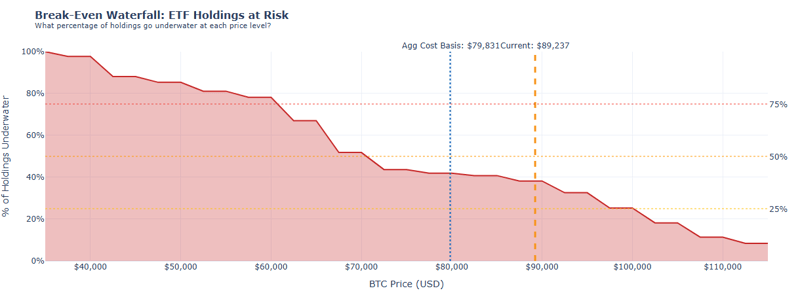
The -20% Cliff. The stress test reveals a critical non-linearity. From current prices to -10%, the underwater percentage increases by just 3.7 percentage points. The system absorbs the move. Between -15% and -25%, that same ten percentage point price decline produces six times the stress increase. The underwater percentage jumps 23.4 points.
This non-linearity matters. The first 15% of downside is survivable. The next 15% is where damage compounds. The air pocket between $75,000 and $85,000 becomes a trapdoor.
Cascade Mechanics
Stress doesn't propagate evenly. The weaker hand capitulates first. Their selling pushes price lower. Lower prices put the next weakest hand underwater. They sell. The loop continues until price reaches a level where remaining holders have enough cushion to absorb pressure.
The Stages:
- Stage 0 (Current): 21Shares underwater, isolated, absorbed by Fidelity accumulation
- Stage 2 (-7%): BlackRock goes underwater, 53% of holdings flip to loss
- Stage 3 (-10%): Aggregate floor breached, $11.85B in profit turns negative
- Stage 6 (-25%): Fortress zone approached, maximum institutional defense
The BlackRock step dwarfs every other step in the cascade. That single entity going underwater is more significant than all others combined. It isn't one domino among many. It's the domino that takes out half the board.
Transmission Mechanisms. How does stress at one entity transmit to the broader market? Three channels matter.
Direct selling: underwater entities facing redemptions must sell BTC to meet outflows. Narrative contagion: headlines about institutional losses change sentiment across the complex. Mechanical triggers: many institutional allocators have risk limits and drawdown thresholds that fire automatically when breached.
The cascade propagates through risk management systems as much as through discretionary decisions. Understanding these channels helps anticipate the speed and severity of moves through different price zones.
Flow Quality
Net flows tell you direction. They don't tell you meaning. The ETF complex has seen net outflows of 29,978 BTC over 30 days. Sounds bearish. But the interpretation depends entirely on who is selling and why.
The 30-Day Breakdown:
- Profitable Sellers: -33,185 BTC across 9 entities (profit-taking)
- Underwater Sellers: -3,505 BTC across 1 entity (capitulation)
- Accumulators: +6,712 BTC across 1 entity (Fidelity)
90% of outflows came from entities sitting in profit. They're not panicking. They're booking gains. Only 10% represents genuine distress from the single underwater entity, 21Shares.
The same 30,000 BTC outflow means something entirely different depending on which bucket it falls into. Profit-taking is a sign of market health. Capitulation signals that conviction has cracked. The current 90/10 split is healthy. An 80/20 split would be concerning. A 60/40 split would signal deterioration. Anything approaching 50/50 means the cascade is underway.
The Redemption Pressure Index
Individual metrics tell pieces of the story. Distance from cost basis. Flow momentum. Entity stickiness. Price volatility. We built a composite indicator combining them into a single stress reading.
- Current RPI: 65.2 out of 100
- Zone: Elevated
- Primary Driver: Buffer compression (distance score: 85.8)
The distance component is doing most of the work. The thin buffer between current price and aggregate cost basis elevates the index even though flows remain orderly and volatility stays contained. RPI is signaling caution based on positioning rather than panic based on behavior.
Historically, readings above 70 preceded negative monthly returns 78% of the time. Readings below 30 preceded positive returns 71% of the time. The current 65.2 sits in the upper half of the caution zone. Not a sell signal. But not the time for maximum long exposure either.
The index suggests defensive positioning and patience rather than aggressive action in either direction.
The Complete Analysis
The full report includes:
- Full Stress Test Matrix: Nine scenarios from -5% to -50% with entity-by-entity breakdown
- Cascade Propagation Model: Stage-by-stage analysis of how selling begets selling
- Flow Quality Framework: Methodology for distinguishing profit-taking from capitulation
- Entity Stickiness Scores: Which capital is structural versus hot money
- RPI Deep Dive: Component breakdown, historical accuracy, and regime thresholds
- Key Levels Framework: Specific prices where dynamics shift for longs and shorts
[Download the complete report: "The Stress Test: ETF Cost Basis Part 3/3 - Full Report"]
Three Frameworks to Apply
The Three-Tier Support Model:
- Tier 1 ($97,600): Marginal buyer cost basis. Fragile.
- Tier 2 ($80,000): Aggregate floor. The line in the sand.
- Tier 3 ($65,000-$70,000): Fortress zone. Maximum structural support.
Flow Quality Ratio: Currently 90/10 profit-taking versus capitulation. Watch for deterioration toward 60/40.
RPI Regime: Currently 65.2 (elevated). Above 70 shifts to defensive. Below 50 shifts to constructive.
The framework doesn't predict price direction. It maps structural features of institutional positioning and identifies levels where behavioral dynamics shift. The distribution of capital, the sequence of vulnerability, and the composite stress readings provide context for evaluating conditions as they evolve.
Full-Market Research. Institutional Depth. Derivatives, ETFs, on-chain, DEXs, microstructure, risk signals—and more. Subscribe at the bottom of our page for research that covers every corner of crypto and visit the Amberdata Research Blog.
Access Amberdata Intelligence for institutional-grade digital asset intelligence powering actionable insights across blockchain and market data, or contact our team to discuss custom solutions for your risk management strategy.

Links & Resources
Amberdata Research Library
https://www.amberdata.io/research-library
Amberdata Intelligence Platform
Amberdata Docs
Contact Us
https://www.amberdata.io/contact-us
Recent from Amberdata (most recent at the top)
- [LINK TO PART 2]
- [LINK TO PART 1]
- Coincidence or Signal? Did WLFI Telegraph Crypto's $6.93B Meltdown
- How $3.21B Vanished in 60 Seconds: October 2025 Crypto Crash Explained Through 7 Charts
- Five Signals of FOMC Impact: How Interest Rate Decisions Reshape Crypto Market Microstructure
- Beyond the Spread - Understanding Market Impact and Execution
- The Rhythm of Liquidity - Temporal Patterns in Market Depth
- DeFi Activity, Stablecoins, and the Impact on Price Volatility: Part 1
- DeFi Activity, Stablecoins, and the Impact on Price Volatility: Part 2
- DeFi Activity, Stablecoins, and the Impact on Price Volatility: Part 3
- How Do On-Chain Metrics Explain Bitcoin Volatility? Part 1
- How Do On-Chain Metrics Explain Bitcoin Volatility? Part 2
- Amberdata 2024 Digital Asset Market Intelligence Report: Exchanges & Derivatives
- Crypto Pairs Trading: Part 1 — Foundations of Moving Beyond Correlation
- Crypto Pairs Trading: Part 2 — Verifying Mean Reversion with ADF and Hurst Tests
- Crypto Pairs Trading: Part 3 — Constructing Your Strategy with Logs, Hedge Ratios, and Z-Scores
- Crypto Pairs Trading: Part 4 — Empirical Results & Performance Analysis
Disclaimers
The information contained in this report is provided by Amberdata solely for educational and informational purposes. The contents of this report should not be construed as financial, investment, legal, tax, or any other form of professional advice. Amberdata does not provide personalized recommendations; any opinions or suggestions expressed in this report are for general informational purposes only.
Although Amberdata has made every effort to ensure the accuracy and completeness of the information provided, it cannot be held responsible for any errors, omissions, inaccuracies, or outdated information. Market conditions, regulations, and laws are subject to change, and readers should perform their own research and consult with a qualified professional before making any financial decisions or taking any actions based on the information provided in this report.
Past performance is not indicative of future results, and any investments discussed or mentioned in this report may not be suitable for all individuals or circumstances. Investing involves risks, and the value of investments can go up or down. Amberdata disclaims any liability for any loss or damage that may arise from the use of, or reliance on, the information contained in this report.
By accessing and using the information provided in this report, you agree to indemnify and hold harmless Amberdata, its affiliates, and their respective officers, directors, employees, and agents from and against any and all claims, losses, liabilities, damages, or expenses (including reasonable attorney’s fees) arising from your use of or reliance on the information contained herein.
Copyright © 2025 Amberdata. All rights reserved.