


Share this blog:
.png)
Bitcoin’s sharp ETF outflows and 35% price drawdown look like institutional capitulation — but the underlying data shows something very different. The selling was highly concentrated among a few issuers and tied to a mechanical basis trade unwind, not broad investor fear. This report breaks down the flows, the arbitrage dynamics, and what they signal about who’s actually leaving and who’s still accumulating.
The Headline Versus The Reality
Nearly $4 billion in Bitcoin ETF outflows since mid-October. Price collapsed from $125,000 to the low $80,000s - a 35% drawdown that erased six months of gains. The prevailing interpretation: institutions had arrived, seen enough, and were leaving.
The entity-level data tells a different story. BlackRock accounted for 97-99% of weekly outflows despite holding only 48-51% of assets under management. Fidelity posted modest inflows throughout. Smaller issuers - Bitwise, VanEck, Franklin Templeton - held steady or gained. Capitulation spreads broadly; this was concentrated.
That concentration points to a specific trade unwinding, not a sentiment shift. A significant portion of ETF inflows since launch represented basis arbitrage - hedge funds harvesting the spread between spot ETFs and futures contracts, a mechanical strategy indifferent to Bitcoin's direction. When that spread collapsed below profitability thresholds, positions closed.
This distinction matters for positioning. Capitulation implies damaged confidence requiring months to rebuild. Arbitrage unwinding is a clearing event after which the market continues - often healthier for shedding leveraged overhang. The following sections decompose the flows, examine the basis trade mechanics, and assess what the data signals about remaining holders.
Decomposing The Outflows
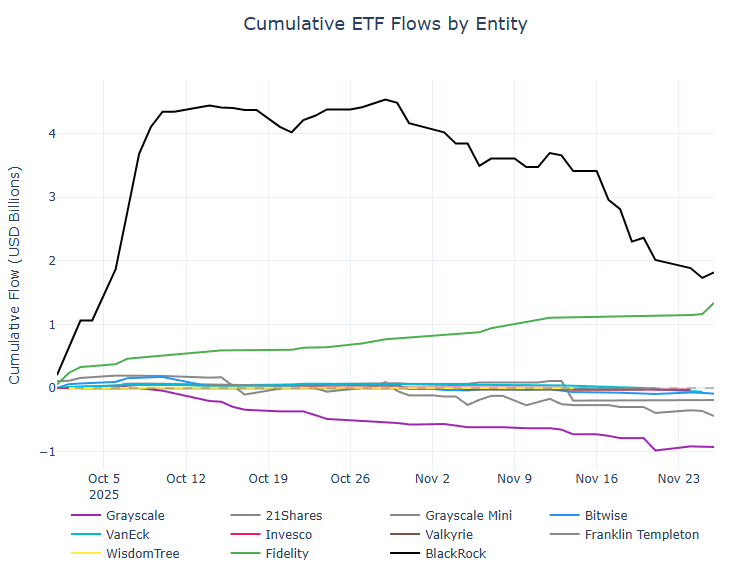
Outflow Concentration. Over the 53-day period from October 1 to November 26, gross outflows totaled $1.74B across nine entities. Grayscale alone accounted for $923M - 53.2% of all redemptions. Add 21Shares ($437M) and Grayscale Mini ($186M), and the top three entities represent 89.1% of outflows. The remaining six entities combined for just $189M.
Offsetting Inflows. BlackRock and Fidelity moved in the opposite direction. BlackRock added $1.82B across 49 separate flow days - the most active accumulator by both frequency and magnitude. Fidelity added $1.34B across 17 flow days, averaging $79M per transaction versus BlackRock's $37M. Gross inflows of $3.15B more than offset redemptions, resulting in net inflows of $1.42B for the period.

Total ETF holdings stand at 1.43M BTC ($128.8B). Gross outflows represent 1.4% of AUM; net flows represent 0.2%. This is rebalancing, not liquidation.
Proportional reductions by entity:
- 21Shares: -12% of holdings (largest reduction)
- Grayscale: -5.4% (largest dollar outflows, but larger base)
- Franklin Templeton: -$2M total (despite frequent headline mentions)
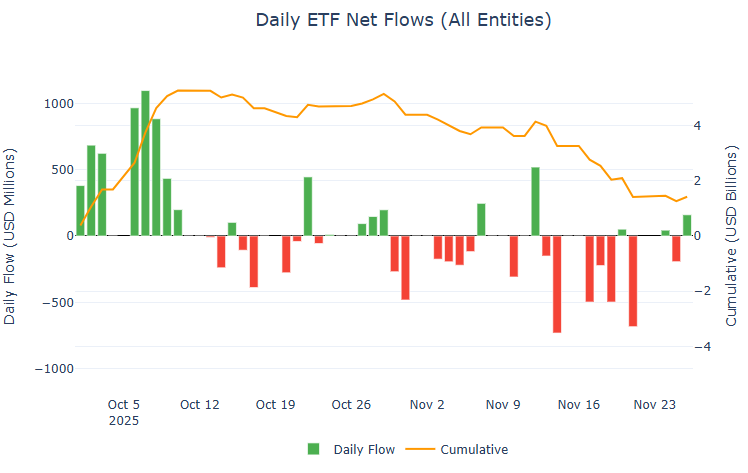
Timing. Of 53 trading days, 31 saw net inflows versus 21 with outflows. The five largest outflow days totaled $2.89B; the five largest inflow days totaled $4.25B. Daily flow volatility ran high - standard deviation of $372M against a mean of $27M - consistent with block redemptions from specific counterparties rather than steady distribution.
Capitulation is indiscriminate and persistent. This was episodic and concentrated, with the two largest industry players accumulating throughout.
The Basis Trade Mechanics
The basic trade is straightforward: buy spot Bitcoin (or ETF shares), sell futures against it, collect the spread. When futures trade at a premium to spot - contango - the annualized yield on this delta-neutral position can reach double digits. Hedge funds, prop desks, and arbitrage specialists deployed billions into this structure following ETF approval. They were not expressing a view on Bitcoin. They were harvesting yield.
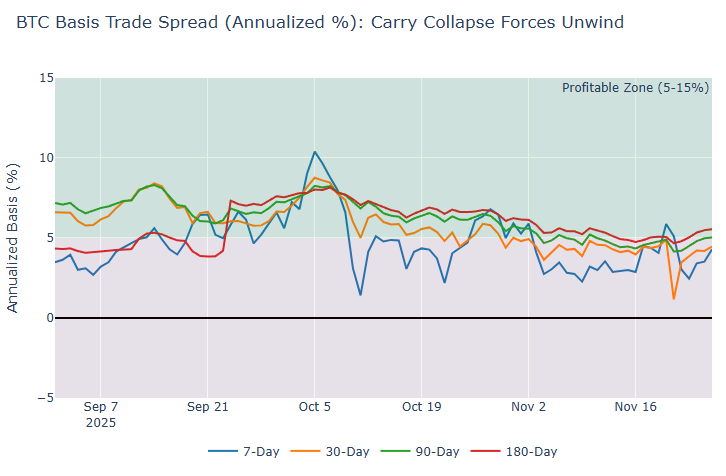
The trade works until it doesn't. Profitability requires the basis spread to exceed cost of capital plus execution costs - roughly 5% annualized as a floor. Below that threshold, the position destroys value. Funds don't hold unprofitable trades waiting for conditions to improve. They close.
Basis Compression. Over the 87-day analysis period, 30-day annualized basis fell from 6.63% to 4.46% - a 217 basis point compression. The damage was worse than the endpoint suggests:
- 30 of 87 days (34%) saw APR below the 5% profitability threshold
- In the most recent 30-day window, 28 of 30 days (93%) printed below breakeven
- Lowest reading: 1.17% on November 21
- Current 30D APR sits at the 20th percentile of the past 91 days
The term structure remains in contango (180D at 5.63% versus 7D at 4.16%), but the front end of the curve - where most basis trades are executed - has been unprofitable for weeks. Zero days in the past 30 exceeded the 10% threshold that would make the trade attractive.
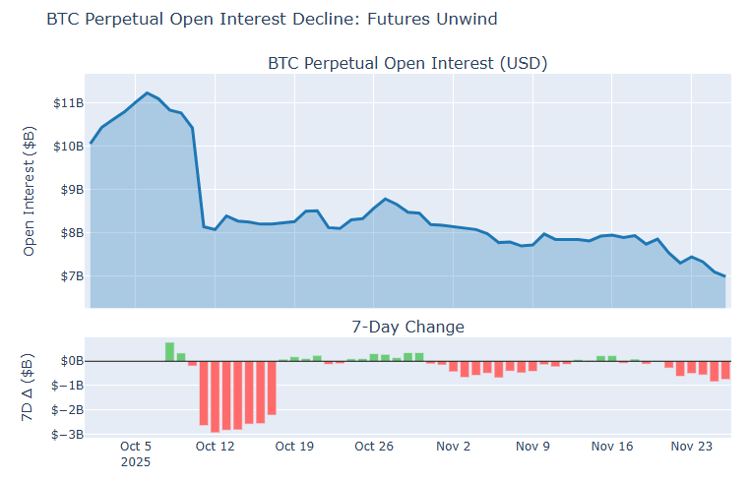
Open Interest Decline. BTC perpetual OI dropped from $10.05B to $6.99B over the period - a $3.06B reduction (30.5%). Peak-to-trough was steeper: $11.23B on October 6 to $6.99B by November 26, a 37.7% drawdown totaling $4.23B. Of the 57 days with OI data, 32 (56%) saw declining open interest versus 24 with growth. The longest consecutive decline streak ran 10 days.
Exchange Breakdown. Broad-based deleveraging across venues:
- Binance: -$1.25B (-26.3%)
- Bybit: -$1.24B (-38.2%)
- OKX: -$0.61B (-44.6%)
- Deribit: +$0.04B (+5.5%) - the outlier, consistent with its institutional options-focused client base
Market share shifted accordingly: Binance rose from 47.4% to 50.2% of total OI as smaller venues contracted faster.
Correlation. The correlation between basis compression and OI reduction is 0.878 - near-lockstep movement. This is the statistical signature of mechanical unwinding. As carry collapsed below profitability, positions closed. The relationship holds across lag structures: same-day correlation at 0.878, one-day lag at 0.888, three-day lag at 0.782. Basis and OI moved together in real time, not with one leading the other.
The ETF redemptions concentrated in Grayscale and 21Shares were the spot leg of this trade being closed. Selling ETF shares and buying back futures shorts are two sides of the same unwind. BlackRock and Fidelity, dominated by longer-duration allocators without corresponding futures hedges, accumulated throughout - their flows reflect genuine allocation decisions, not arbitrage mechanics.
The Correlation Evidence
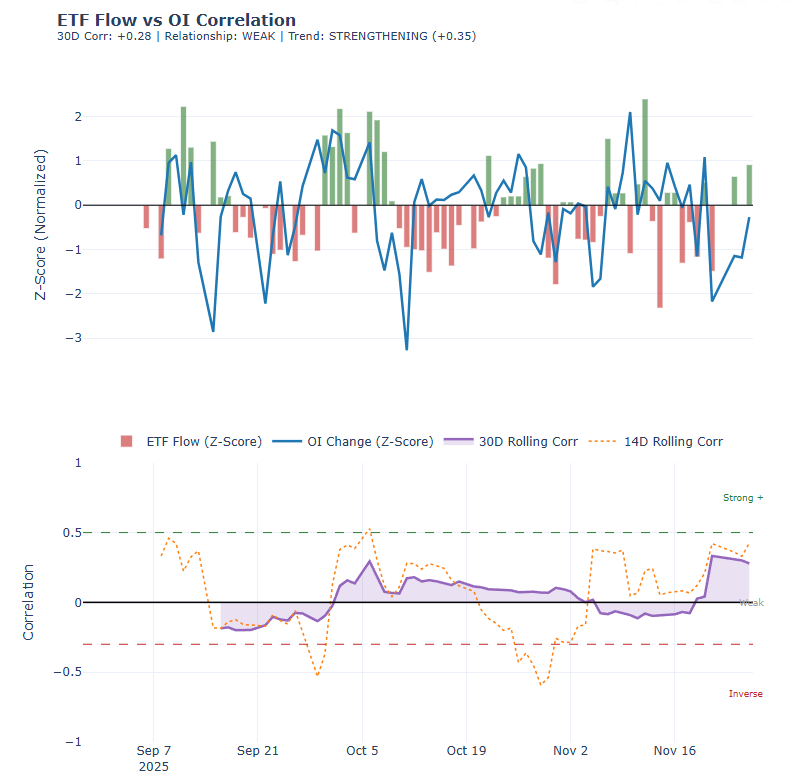
Directional Alignment. The mechanical linkage between ETF flows and futures positioning shows clearly in the timing. When ETF shares are redeemed, futures shorts are simultaneously covered. The relationship is contemporaneous, not lagged.
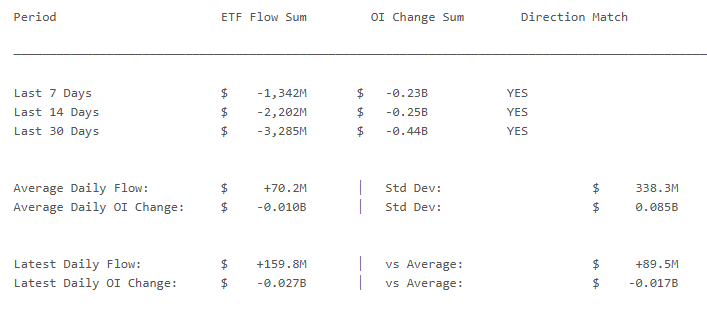
Daily Pattern. Across the full 66-day correlation window, ETF flows and OI changes moved in the same direction 60% of the time:
- 28 days (35%): both positive (inflows + OI expansion)
- 20 days (25%): both negative (outflows + OI contraction)
- Remaining 40%: mixed signals, consistent with other factors layered on top of basis trade
Strengthening Relationship. The 30-day rolling correlation currently reads +0.28, classified as weak. But the trend matters more: 7-day rolling correlation has strengthened to +0.57, up 35 basis points from a week ago. The relationship is tightening as the unwind progresses.
Sensitivity. For every $100M in ETF flow, OI moves approximately $10M in the same direction - reflecting the leveraged nature of futures positioning relative to spot ETF holdings.
What Capitulation Would Look Like. Broad institutional capitulation would show persistent outflows across all entities with weak or no correlation to derivatives positioning - investors selling because they want out, regardless of futures market dynamics. Instead, the data shows concentrated outflows from specific entities moving in sync with futures unwinds.
What Remains
The Unwind is Tentatively Complete. Total liquidations over the period reached $8.55B, with longs accounting for $6.08B (71.1%) versus shorts at $2.47B. Peak liquidation day was October 10 at $2.28B. Price moved from $117,125 to $88,575 - a 24.4% drawdown.
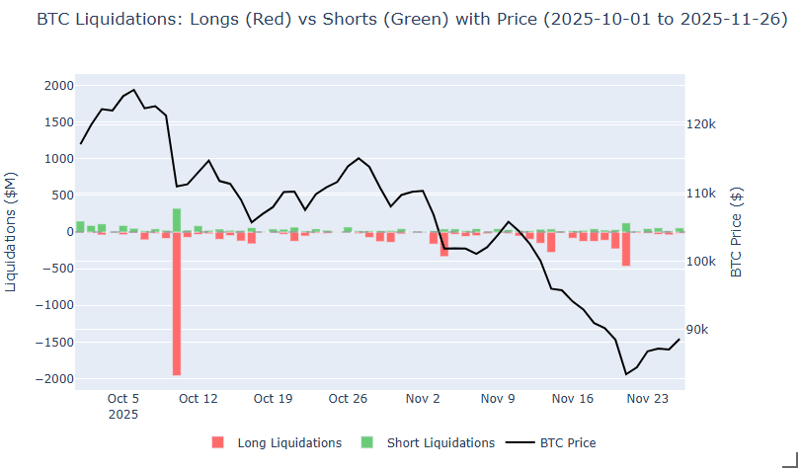
Market State Post-Clearing:
- OI reduced by $4.23B from peak (37.7% drawdown)
- Funding rates normalized near zero
- 30D basis APR at 4.46% - still below the 5% breakeven, but off the 1.17% lows
- Carry trade scorecard: 42/100 (Unattractive)
Who Remains. ETF holdings still total 1.43M BTC ($128.8B). The entities that accumulated through the volatility - BlackRock (+$1.82B) and Fidelity (+$1.34B) - represent longer-duration capital without leveraged futures overlays. These are allocation decisions, not spread trades. The holders who stayed are structurally different from those who left.
Structural Support. The $80,000-$85,000 zone aligns with estimated average ETF holder cost basis. Holders at or near their entry price are less likely to redeem at a loss. This creates natural demand at these levels - not a guarantee of support, but a concentration of interest.
What To Watch. Basis APR is the key signal - sustained moves above 5% would make the carry trade profitable again and likely draw arbitrage capital back in; drops below 2% would indicate further stress. On flows, net ETF inflows resuming would confirm the unwind is complete, while outflows broadening beyond Grayscale and 21Shares to BlackRock or Fidelity would suggest something more fundamental. OI stabilization followed by gradual rebuild is the healthy path; continued contraction signals ongoing deleveraging. Funding rates should normalize positive and stable - negative or highly volatile readings indicate persistent positioning stress.
Forward View. The basis trade unwind is mechanical, not directional. Participants exited because the spread stopped paying, not because they turned bearish on Bitcoin. With the arbitrage overhang cleared, remaining flows increasingly reflect genuine allocation rather than yield harvesting. The market that emerges is less leveraged, more conviction-driven, and structurally cleaner than the one that entered October.
For more crypto market microstructure analysis, visit the Amberdata Research Blog. Access Amberdata Intelligence for institutional-grade digital asset intelligence powering actionable insights across blockchain and market data, or contact our team to discuss custom solutions for your risk management strategy.
Links & Resources
Amberdata Research Library
https://www.amberdata.io/research-library
Amberdata Intelligence Platform
Amberdata Docs
Contact Us
https://www.amberdata.io/contact-us
Recent from Amberdata
- Coincidence or Signal? Did WLFI Telegraph Crypto's $6.93B Meltdown
- How $3.21B Vanished in 60 Seconds: October 2025 Crypto Crash Explained Through 7 Charts
- Five Signals of FOMC Impact: How Interest Rate Decisions Reshape Crypto Market Microstructure
- Beyond the Spread - Understanding Market Impact and Execution
- The Rhythm of Liquidity - Temporal Patterns in Market Depth
- DeFi Activity, Stablecoins, and the Impact on Price Volatility: Part 1
- DeFi Activity, Stablecoins, and the Impact on Price Volatility: Part 2
- DeFi Activity, Stablecoins, and the Impact on Price Volatility: Part 3
- How Do On-Chain Metrics Explain Bitcoin Volatility? Part 1
- How Do On-Chain Metrics Explain Bitcoin Volatility? Part 2
- Amberdata 2024 Digital Asset Market Intelligence Report: Exchanges & Derivatives
- Crypto Pairs Trading: Part 1 — Foundations of Moving Beyond Correlation
- Crypto Pairs Trading: Part 2 — Verifying Mean Reversion with ADF and Hurst Tests
- Crypto Pairs Trading: Part 3 — Constructing Your Strategy with Logs, Hedge Ratios, and Z-Scores
- Crypto Pairs Trading: Part 4 — Empirical Results & Performance Analysis
Disclaimers
The information contained in this report is provided by Amberdata solely for educational and informational purposes. The contents of this report should not be construed as financial, investment, legal, tax, or any other form of professional advice. Amberdata does not provide personalized recommendations; any opinions or suggestions expressed in this report are for general informational purposes only.
Although Amberdata has made every effort to ensure the accuracy and completeness of the information provided, it cannot be held responsible for any errors, omissions, inaccuracies, or outdated information. Market conditions, regulations, and laws are subject to change, and readers should perform their own research and consult with a qualified professional before making any financial decisions or taking any actions based on the information provided in this report.
Past performance is not indicative of future results, and any investments discussed or mentioned in this report may not be suitable for all individuals or circumstances. Investing involves risks, and the value of investments can go up or down. Amberdata disclaims any liability for any loss or damage that may arise from the use of, or reliance on, the information contained in this report.
By accessing and using the information provided in this report, you agree to indemnify and hold harmless Amberdata, its affiliates, and their respective officers, directors, employees, and agents from and against any and all claims, losses, liabilities, damages, or expenses (including reasonable attorney’s fees) arising from your use of or reliance on the information contained herein.
Copyright © 2025 Amberdata. All rights reserved.