


Share this blog:

This is Section 1, excerpted from our Amberdata Crypto Market Review 2025 and 2026 Outlook: Six Regimes, One Story. Our full report spans 14 sections - ETF flows, derivatives, on-chain, liquidity, and our complete 2026 outlook.
Six regimes, $29B in ETF capital, and the largest crash in history - here's your year-at-a-glance.
|
KEY TAKEAWAYS |
|
Here's 2025 in a single dashboard: six market regimes, $29.3 billion in institutional ETF capital, and the largest deleveraging event in crypto history.
Bitcoin ended the year at $88,000, down 7.3% YTD after a 32% maximum drawdown. The headline return masks extreme regime dispersion - from +21.5% in Infrastructure Build (R3) to -20.4% in Fragile Recovery (R6). Everything that follows in the Amberdata Crypto Market Review 2025 is the evidence behind these numbers.
Why This Dashboard Matters. The dashboard approach serves institutional readers who need the full picture before diving into details. Rather than burying conclusions in hundreds of pages of analysis, this executive summary presents the complete picture upfront. Each metric on the dashboard has a dedicated section in the full report. The subsequent 13 sections provide the forensic detail behind each metric. Read this section for the overview; read the full report for the evidence.
What Makes 2025 Different. This was not a typical crypto year. The market experienced its first full year with spot ETFs, absorbed $29B in institutional capital, survived a $19B all-crypto liquidation cascade, and established regulatory frameworks that fundamentally changed the market structure. The infrastructure stress test is complete. What remains is understanding what it revealed.
The Year at a Glance
The Hero Dashboard. The dashboard captures every dimension of 2025's market dynamics in a single view: price action across six regimes, carry trade economics that shifted from excellent to marginal, leverage that built to $56.6B before collapsing 43.5%, and institutional flows that totaled $29.3B despite October's volatility.
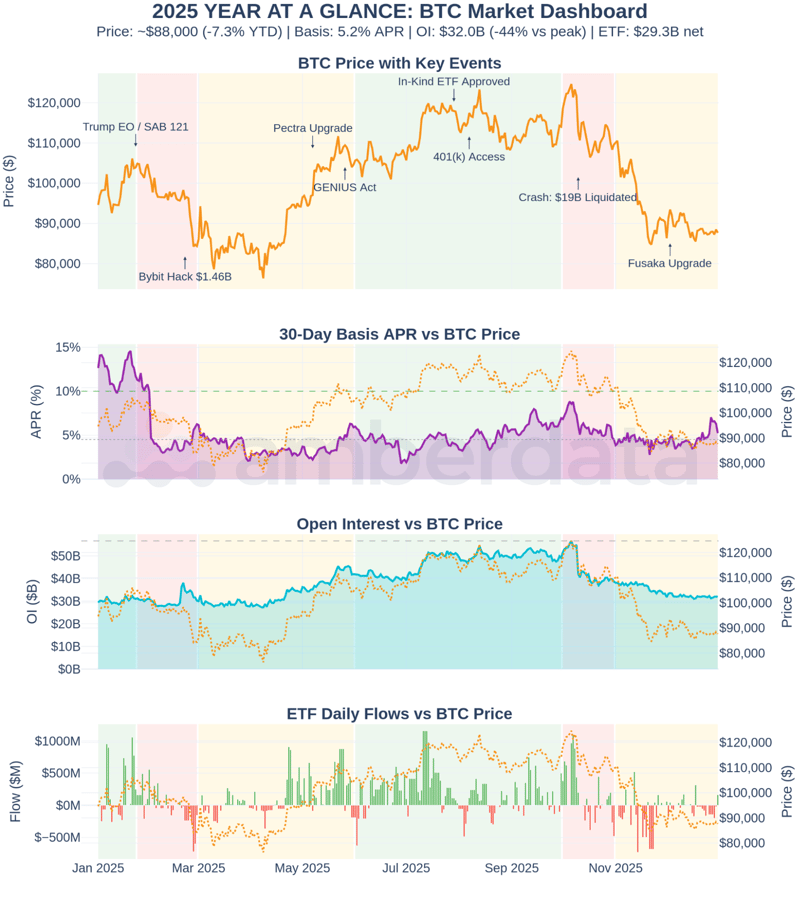
Figure 1.1: Year at a Glance Dashboard - The complete 2025 story in one view. Price with regime shading, basis APR evolution, OI trajectory, and cumulative ETF flows.
-7.3%
YTD return masks extreme regime dispersion. Best regime (R3): +21.5%. Worst regime (R6): -20.4%. A 42 percentage point swing within the same calendar year.
Price Summary. The following metrics capture the full price trajectory for 2025:
Start: $95,000
High: $125,000 (Oct 6)
Low: $76,000 (Apr 8)
Current: ~$88,000
Change: -7.3% YTD
Range: $49,000 (51%)
Notes: Max drawdown -32.0% on Nov 22; current drawdown -29.7%
The Price Trajectory. The price trajectory tells a story of phases rather than trends. January's policy euphoria drove prices higher on optimism around the new administration's crypto-friendly stance. February's Bybit hack triggered correction as security concerns resurfaced. March through May saw the year's strongest recovery (+21.5%) as the market absorbed legacy distributions and regulatory clarity emerged. Summer's institutional expansion set up September's peak as ETF inflows accelerated and new access channels opened. October's tariff announcement triggered the cascade that would define Q4. November and December have been about fragile recovery, with the market consolidating at lower levels while awaiting catalysts for the next move.
Regime Performance: The Dispersion Story
The Framework. The six-regime framework is the analytical foundation of the entire Amberdata Crypto Market Review 2025. Each regime represents distinct market conditions with different drivers, risks, and opportunities. Understanding these regimes transforms how you interpret every data point in this report.
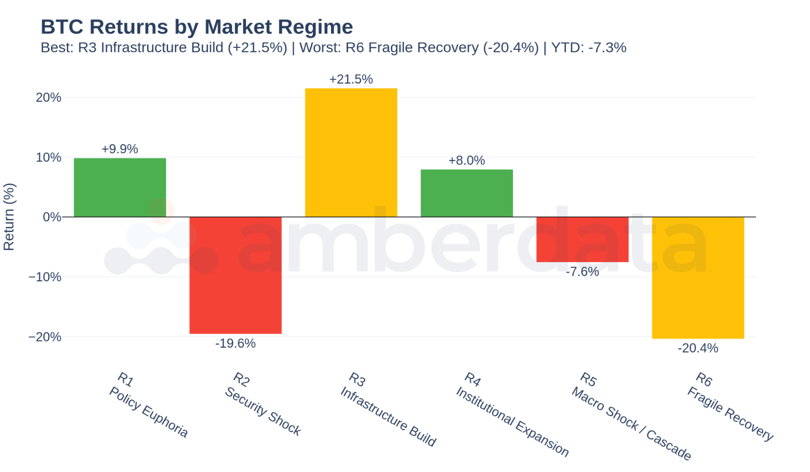
Figure 1.2: Regime Performance Table - Returns, basis, and ETF flows by regime. Note the extreme dispersion and how carry trade attractiveness varied dramatically across phases.
Regime 1 - Policy Euphoria (Jan 1-23). +9.9% return, 12.7% basis APR, +$4.16B ETF flows. Trump executive order and SAB 121 rescission created maximum optimism. Carry trade was excellent at 12.7% basis - the year's peak conditions. This was the window when institutional strategies generated their best returns.
Regime 2 - Security Shock (Feb). -19.6% return, 5.5% basis APR, -$0.51B ETF flows. Bybit's $1.46B hack triggered a flight to safety. The only regime with net ETF outflows. Basis compressed as risk appetite declined sharply. The hack served as a reminder that operational security remains the industry's Achilles heel.
Regime 3 - Infrastructure Build (Mar-May). +21.5% return, 3.7% basis APR, +$9.42B ETF flows. The year's best performer. Mt. Gox and FTX distributions absorbed smoothly - supply that the market had feared for years was finally digested. GENIUS Act passed. Ethereum Pectra upgrade completed. Steady accumulation without excessive leverage created healthy market structure.
Regime 4 - Institutional Expansion (Jun-Sep). +8.0% return, 4.8% basis APR, +$15.16B ETF flows. The largest ETF accumulation regime by far. In-kind redemptions approved, dramatically improving capital efficiency. 401(k) access enabled, opening the $40 trillion retirement market. Peak OI of $56.6B built during this phase - the leverage accumulation that set risk conditions for October.
Regime 5 - Macro Shock / Cascade (Oct). -7.6% return, 6.2% basis APR, +$4.39B ETF flows. Despite the crash, ETF flows remained positive (arbitrage rebalancing). Tariff announcement triggered cascade. $19B in all-crypto liquidations over 48 hours. OI collapsed 43.5%. This was the stress test that 2025 will be remembered for.
Regime 6 - Fragile Recovery (Nov-Dec). -20.4% return, 4.5% basis APR. The aftermath. OI subdued at $32.0B. Order book depth has not recovered - market makers remember. The market is awaiting catalysts for the next regime transition.
The same asset delivered +21.5% and -20.4% returns within the same calendar year. Regime identification matters more than general market outlook.
|
SO WHAT? Understanding which regime the market is in provides context for interpreting current data and anticipating how the market might respond to catalysts. The framework established here is the analytical spine of the entire Amberdata Crypto Market Review 2025. Every metric in subsequent sections is contextualized within these six phases. |
Carry Trade: From Excellent to Marginal
The Dominant Strategy. The carry trade - long spot via ETF, short futures - was the dominant institutional strategy of 2025. Its economics shifted dramatically across the year, and understanding this shift is essential for interpreting ETF flow data.
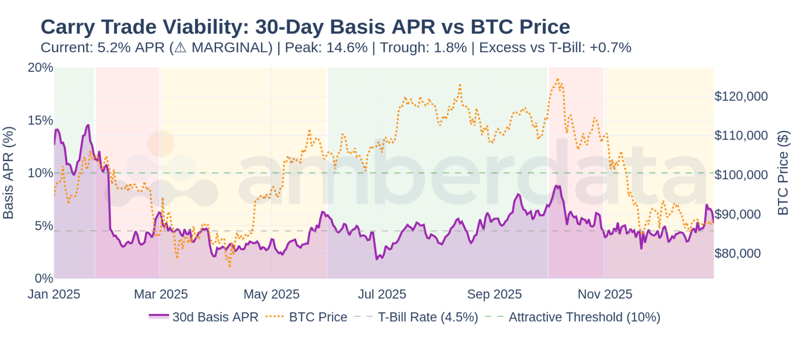
Figure 1.3: Carry Trade Summary - 30-day basis APR evolution with regime shading. Note the 14.6% peak in January versus the current 5.2% - a compression that reflects changed market dynamics.
Current Status: Marginal. 30-day basis APR at 5.2% versus 4.5% T-bill rate offers only 0.7% excess return. Insufficient compensation for operational complexity. Capital that was deployed in this trade has largely exited.
Year Summary. The carry trade economics across 2025:
Average: 5.1% APR
High: 14.6% (Jan 20)
Low: 1.8% (Jun 28)
Days above 10%: 29 (8% of year)
Days below 5%: 233 (64% of year)
The Narrow Window. The carry trade was attractive for only 29 days (8% of the year), all concentrated in Regime 1's policy euphoria. For the remaining 336 days, basis offered insufficient return to justify institutional deployment. The October cascade that drove basis from 6.2% to near the current 5.2% represented the unwind of carry positions accumulated during R1 and R4. This mechanical selling pressure amplified the crash - a dynamic that explains why ETF outflows during the cascade were concentrated in specific products rather than broad-based.
Return and Drawdown: The Risk Reality
Beyond the Headline. The -7.3% YTD return understates the volatility experienced during the year. For risk managers, the drawdown profile tells the real story.
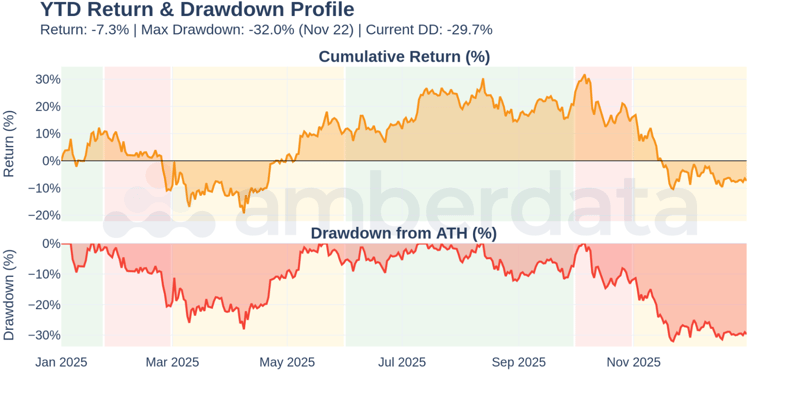
Figure 1.4: Return and Drawdown - Cumulative return and drawdown from ATH. The October cascade drove max drawdown to -32.0% before partial recovery.
-32.0%
Maximum drawdown on November 22. The path from peak ($125,000) to trough ($85,000) took 47 days. Recovery to current levels still leaves a -29.7% drawdown from ATH.
Recovery Arithmetic. The drawdown arithmetic creates challenging recovery dynamics. A 32% drawdown requires a 47% gain to recover - this asymmetry is why risk management matters more than return optimization. With the current price at $88,000 and prior ATH at $125,000, the market needs +42% to reclaim highs. At historical average monthly returns, this could take 6-12 months assuming no further drawdowns - a sobering timeline for investors who entered at the top.
ETF Flows: Institutional Participation
The Clearest Signal. ETF flows represent the clearest signal of institutional participation. Despite October's volatility, cumulative flows remained strongly positive - a fact that challenges the capitulation narrative.
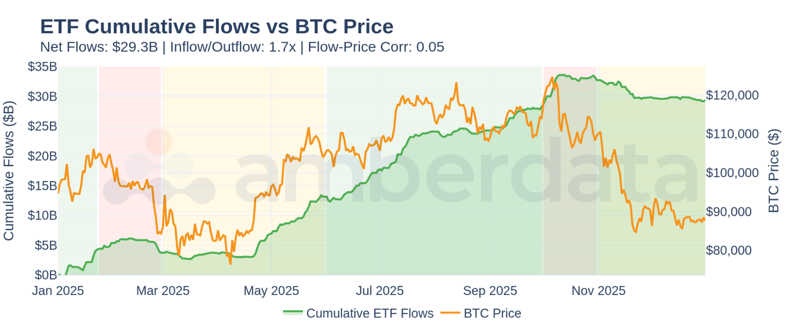
Figure 1.5: ETF Flows Summary - Cumulative ETF flows versus price. Note how flows remained positive even during October's crash - arbitrage rebalancing rather than capitulation.
Flow Summary. ETF flow metrics for 2025:
Net YTD: $29.34B
Inflow Days: 228
Outflow Days: 136
Ratio: 1.7x (inflows to outflows)
High: $1,157M (Jul 11)
Low: -$731M (Nov 14)
Persistent Accumulation. The 228 inflow days versus 136 outflow days (1.7x ratio) demonstrates persistent institutional accumulation throughout the year. Even during R5's cascade, net ETF flows were positive at $4.39B - counter to the narrative of an institutional exodus. The outflows were concentrated in specific arbitrage-focused products, not broad capitulation. This distinction matters for understanding market structure.
Flow-Price Decorrelation. Flow-price correlation was only 0.05 for the year, indicating that ETF flows are not reliable short-term price predictors. Institutions accumulate on different timeframes than retail, often buying weakness and selling strength. This decorrelation is actually healthy - it suggests flows represent fundamental allocations rather than momentum chasing. For traders expecting flows to predict price, this data is sobering. For long-term investors, it is reassuring.
Open Interest: The Leverage Story
Measuring System Leverage. Open interest measures the leverage in the system. Its trajectory through 2025 tells the story of accumulation and violent unwind - and provides the clearest warning signal for the October cascade.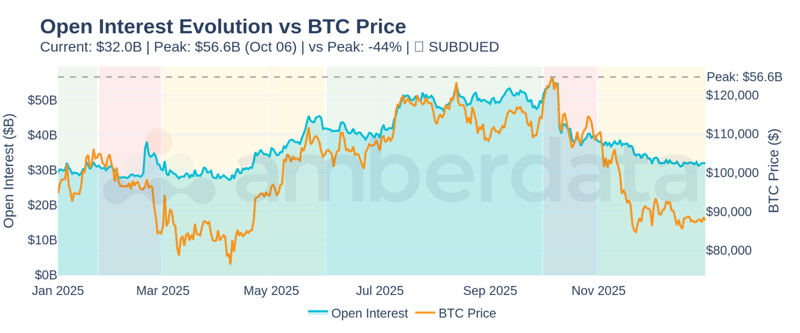
Figure 1.6: Open Interest Summary - OI evolution with regime shading. Peak at $56.6B in October immediately preceded the cascade. Current $32.0B represents substantial deleveraging.
Current Status: Subdued. Open interest metrics:
Current: $32.0B
High: $56.6B (Oct 6)
Change: -43.5% from peak
Average: $38.6B YTD
OI by Regime. Average open interest varied significantly across regimes:
R1: $30.3B
R2: $30.5B
R3: $33.2B
R4: $47.3B
R5: $44.1B
R6: $34.2B
The Buildup and Collapse. R4's average OI of $47.3B represents the leverage accumulation that set up October. When the tariff trigger hit, $24.6B in OI ($56.6B peak to $32.0B current) was destroyed through liquidations and voluntary deleveraging. The market is now substantially deleveraged - a healthier foundation but also lower speculative intensity. This matters because leverage drives both opportunity and risk.
The Leverage-Basis Relationship. The OI trajectory also reveals the relationship between leverage and basis. When OI was highest (R4), basis was moderate (4.8%) as the crowded long positioning compressed futures premiums. When OI collapsed (R5-R6), basis initially spiked (6.2% in R5) before settling at current marginal levels (5.2%).
|
SO WHAT? Current subdued OI ($32.0B) means lower cascade risk but also lower potential for leveraged moves. The next accumulation phase - when OI rebuilds toward $40-50B - will signal renewed speculative interest and increased opportunity alongside increased risk. Watch OI as a leading indicator for regime transitions. |
The Six Regimes Framework
The Analytical Spine. The regime framework established here serves as the analytical spine for the entire Amberdata Crypto Market Review 2025. Every subsequent section contextualizes data within these six phases. This is not an arbitrary categorization - each regime represents genuinely different market conditions.
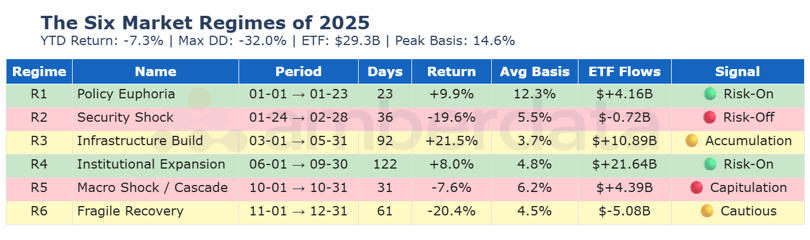 Figure 1.7: Six Regimes Summary Table - Complete regime reference with dates, triggers, returns, basis, and ETF flows. This framework applies throughout the full report.
Why Regimes Matter. The six regimes are not arbitrary divisions - each represents distinct market conditions with identifiable triggers, characteristic metrics, and different risk profiles. R1's policy euphoria created leverage. R2's security shock tested resilience. R3's infrastructure build enabled healthy accumulation. R4's institutional expansion created fragility. R5's macro shock triggered cascade. R6's fragile recovery awaits resolution.
Current Position and Transition Signals. Understanding which regime the market currently occupies (R6: Fragile Recovery) and what signals would indicate transition to a new regime enables proactive positioning rather than reactive response. The signals to watch: basis recovery above 6%, depth restoration to pre-crash levels, consistent ETF inflows above $500M weekly, and catalyst events like Fed cuts or 401(k) platform launches. When multiple signals align, regime transition becomes likely.
|
THE BOTTOM LINE |
|
The dashboard tells the meta-story: crypto in 2025 was not about retail speculation - it was about institutional infrastructure being stress-tested in real time. The market absorbed $29.3B in ETF flows, survived its largest deleveraging event ($19B all-crypto liquidations), and established regulatory frameworks (SAB 121 rescission, GENIUS Act, in-kind ETFs, 401(k) access) that position 2026 for continued institutional adoption. The year ends in fragile recovery, awaiting catalysts. The full Amberdata Crypto Market Review 2025 unpacks each dimension across 14 sections. What follows is the evidence behind every line on this dashboard. |
This executive summary establishes the regime framework that contextualizes every data point in the full report. The six-regime structure introduced here sets the analytical foundation for understanding how risk conditions evolved through 2025 and why October's cascade unfolded as it did.
From here, (S2) develops the volatility framework for stress detection, (S3) provides forensic regime-by-regime analysis, and (S5) examines the carry trade mechanics that amplified October's liquidation cascade. The 2026 outlook in (S14) models scenario probabilities using the regime signals established in this section.
This article provides the executive summary. The full Amberdata Crypto Market Review 2025 goes deeper:
- The $80,000 floor: What happens when ETF cost basis breaks?
- Which ETF issuer is already underwater? The entity-level breakdown reveals all
- October's "capitulation"? The data says arbitrage - here's the carry trade proof
- 123,173 BTC: The mega whale accumulation hiding in plain sight
- Six regimes, 14 sections: One framework that explains everything
- Early or late cycle? On-chain valuation signals decoded
- $60K or $180K? 2026 scenarios with specific price targets
- DeFi's $2B security crisis: What broke and why it matters
- SAB 121 to 401(k): The regulatory timeline reshaping crypto
- And more...
[DOWNLOAD THE FULL AMBERDATA CRYPTO MARKET REVIEW 2025]
Full-Market Research. Institutional Depth. Derivatives, ETFs, on-chain, DEXs, microstructure, risk signals - and more. Subscribe at the bottom of our page for research that covers every corner of crypto and visit the Amberdata Research Blog.
Access Amberdata Intelligence for institutional-grade digital asset intelligence, or contact our team to discuss custom solutions.

Links & Resources
Platform
Recommended next reads
ETF Cost Basis Series
- Part 1/3: The $80,000 Floor (ETF Cost Basis)
- Part 2/3: Who Breaks First (ETF Cost Basis)
- Part 3/3: The Stress Test (ETF Cost Basis)
More key reads
- The ETF Exodus Decoded: Basis Arbitrage, Not Capitulation
- Bitcoin's Great Rotation: Who Bought the Dip and Why It Matters
- October 2025 Crash (7 charts): How $3.21B Vanished in 60 Seconds
- Beyond the Spread: Market Impact and Execution
Disclaimers
The information contained in this report is provided by Amberdata solely for educational and informational purposes. The contents of this report should not be construed as financial, investment, legal, tax, or any other form of professional advice. Amberdata does not provide personalized recommendations; any opinions or suggestions expressed in this report are for general informational purposes only.
Although Amberdata has made every effort to ensure the accuracy and completeness of the information provided, it cannot be held responsible for any errors, omissions, inaccuracies, or outdated information. Market conditions, regulations, and laws are subject to change, and readers should perform their own research and consult with a qualified professional before making any financial decisions or taking any actions based on the information provided in this report.
Past performance is not indicative of future results, and any investments discussed or mentioned in this report may not be suitable for all individuals or circumstances. Investing involves risks, and the value of investments can go up or down. Amberdata disclaims any liability for any loss or damage that may arise from the use of, or reliance on, the information contained in this report.
By accessing and using the information provided in this report, you agree to indemnify and hold harmless Amberdata, its affiliates, and their respective officers, directors, employees, and agents from and against any and all claims, losses, liabilities, damages, or expenses (including reasonable attorney's fees) arising from your use of or reliance on the information contained herein.
Copyright © 2026 Amberdata. All rights reserved.