


Share this blog:
.png)
How seven reinforcing catalysts converged in 14 days to produce Bitcoin’s steepest correction since FTX - and what the data says about what comes next.
Bitcoin fell from ~$90,000 to a low of $60,033 between January 28 and February 11, 2026, marking its steepest correction since the FTX collapse. The decline - now 52% below the $126,000 all-time high set in October 2025 - was not driven by a single catalyst but by an extraordinary convergence of macro shocks, institutional de-risking, crypto-specific capitulation, and structural fragility. At least seven distinct and mutually reinforcing drivers collided within a 14-day window. BTC has since stabilized near $69,000-$70,000, but the damage to sentiment and market structure is significant: the Crypto Fear & Greed Index fell to 5 (its lowest reading ever), $6.18 billion drained from spot Bitcoin ETFs since November, open interest collapsed 58% from its $56.6 billion peak, order book depth fell 65% from September highs, and nearly half of all circulating BTC supply is now held at a loss.
What makes this correction unique is the ETF-era feedback loop - a self-reinforcing mechanism that did not exist in any prior bear market. ETF outflows reduce on-exchange liquidity, which amplifies price declines, which triggers more redemptions. Layered on top of that: the collapse of the basis trade from 15%+ annualized to below the risk-free rate, a mining sector operating 20% below production cost, and a stablecoin market in contraction for the first time in 14 months. The question facing institutional allocators is whether this is a leverage flush (like March 2020’s Covid crash, which recovered in weeks) or the beginning of a structural repricing (like 2022’s descent from $69,000 to $15,500).
For broader context on how this correction fits within the six market regimes we identified across 2025, see our Amberdata Crypto Market Review 2025 and 2026 Outlook: Six Regimes, One Story.
The Crash in Context
The 14-day sequence from January 17 to February 11 produced an unusually dense cluster of catalysts spanning macro policy, cross-asset contagion, regulatory shock, and crypto-native liquidation cascades. It began with the Greenland tariff threat on January 17, which triggered initial risk-off positioning, and escalated through the hawkish January 28 FOMC hold at 3.50-3.75%, where the committee removed language about labor market weakness and upgraded its growth assessment. Chair Powell said rate cuts before June were “unlikely.” Two days later came the Warsh nomination - a known monetary hawk who has called crypto “software pretending to be money” and a symptom of “speculative excess driven by loose monetary policy.” Within 72 hours, Bitcoin dropped from ~$88,000 to $81,000 and kept falling.
The cascade accelerated from there. Microsoft’s $357 billion single-day market cap loss on January 29 (its worst ever) sparked AI CAPEX doubts. A historic precious metals crash on January 30-31 - silver’s worst day since the Hunt Brothers in 1980 - triggered portfolio-wide margin calls that forced crypto sales. By February 1, $2.56 billion in crypto positions had been liquidated. A partial government shutdown from January 30 to February 3 delayed jobs and CPI data, reducing market visibility. Then Treasury Secretary Bessent testified on February 5 that he had “no authority to stabilize crypto markets,” Bitcoin hit $60,000, another $2.67 billion was liquidated, and China banned yuan-pegged stablecoins on February 6.
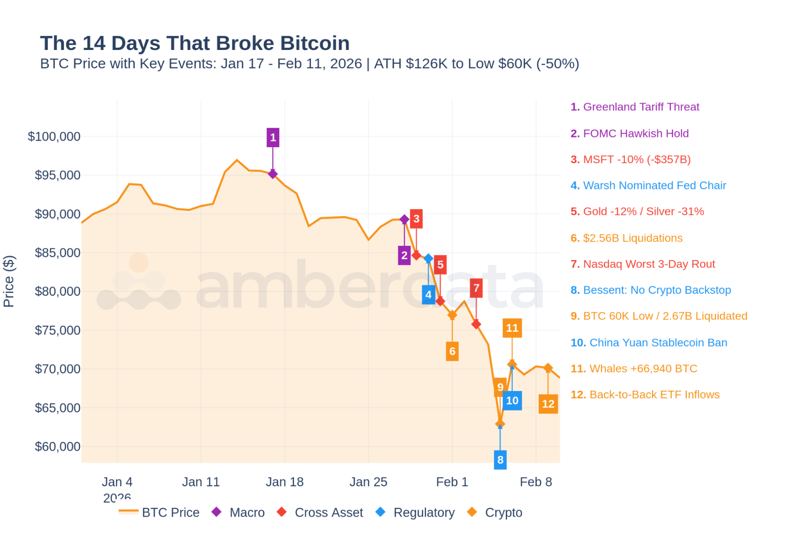
We identified and tracked twelve distinct events across four categories (macro, cross-asset, regulatory, and crypto-native) using Amberdata’s derivatives and spot data. As our FOMC impact analysis established, hawkish Fed decisions reshape crypto microstructure within hours. The January 28 FOMC meeting was no exception - but this time, the Warsh nomination compounded the damage by removing the liquidity-expansion narrative entirely. Futures markets priced in at most two rate cuts for 2026, with the earliest in June.
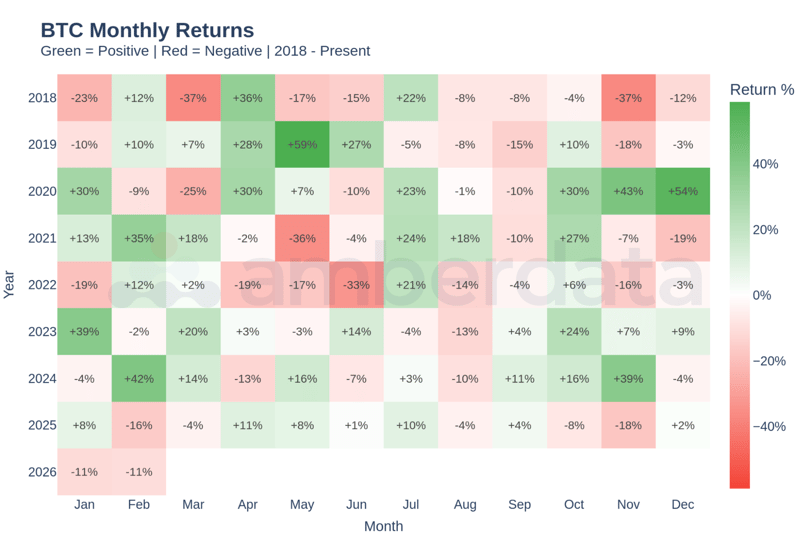
Monthly returns in context. February 2026 is on track to be one of the worst monthly performances in BTC history. Placing it alongside every month since 2018, the magnitude rivals November 2022 (FTX), June 2022 (Terra/Luna), and March 2020 (Covid). Red months tend to cluster around macro shocks; this time is no different.
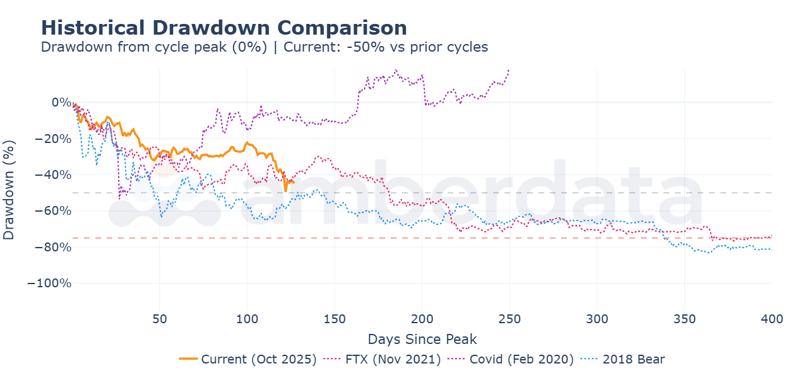
Drawdown trajectory. At -50% in roughly 120 days from the October 2025 ATH, the current drawdown sits at the midpoint between a sharp V-shaped correction (Covid’s -55% over ~30 days with a rapid recovery) and a prolonged bear market (FTX’s -77% over 380 days, or the 2018 bear’s -84% over 365 days). The path forward depends on whether this is a leverage flush or the start of a structural repricing.
It Wasn’t Just Crypto
The sell-off was turbocharged by a historic cross-asset contagion that bled directly into crypto through elevated correlation. Bitcoin’s 30-day correlation with the Nasdaq reached approximately 0.80, and its correlation with the VIX hit 0.88 - the highest ever recorded. The cascade began when Microsoft crashed 10% on January 29, followed by “CAPEX sticker shock” as four major hyperscalers announced combined 2026 capital expenditure plans of $635-$665 billion, a 67-74% jump from 2025. AMD fell 17% on February 4. A simultaneous precious metals crash - gold fell 12% from its record ~$5,600 and silver crashed 31-36% - triggered portfolio-wide margin calls that forced crypto sales, producing $1.68 billion in simultaneous liquidations.
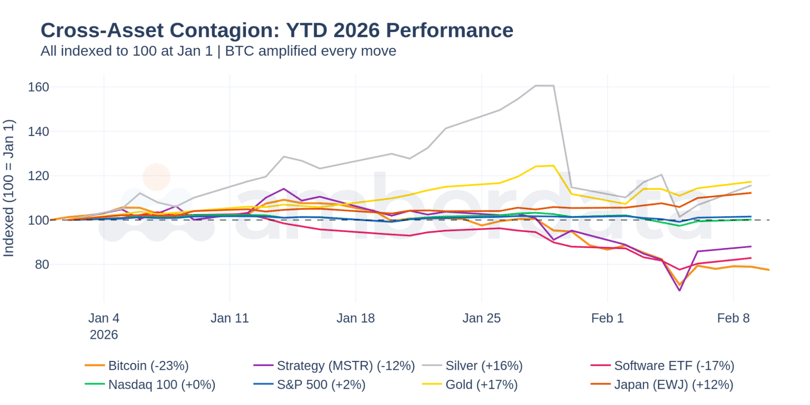
Normalizing all assets to 100 at January 1, 2026, the divergence is stark. The S&P 500 and Nasdaq dipped modestly - single-digit percentage declines. Gold held relatively firm, reinforcing its safe-haven credentials. Japan’s Nikkei (proxied by EWJ) showed moderate stress as the yen carry trade partially unwound. Silver dropped sharply. But BTC amplified every move, falling roughly 8-10x the magnitude of equity declines. Strategy (MSTR) tracked BTC closely to the downside, falling ~80% from its November 2024 post-election high. The asymmetric correlation problem remains: BTC doesn’t reliably participate in equity upside but consistently amplifies equity downside. Bitcoin failed simultaneously as digital gold, tech proxy, inflation hedge, and reserve asset - all in the same two-week window.
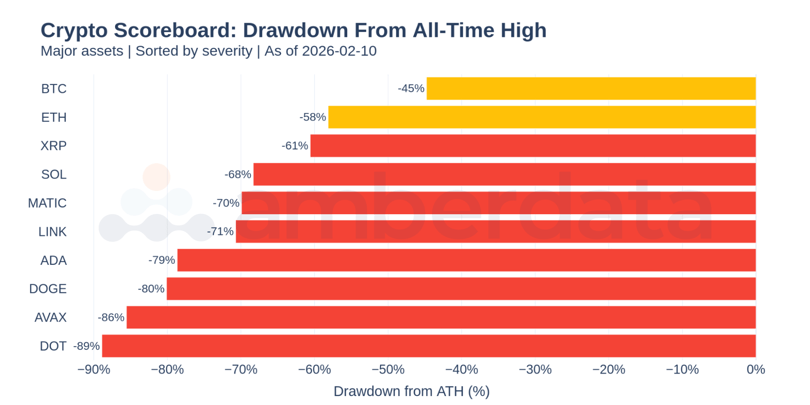
The damage extended across the entire crypto market. Of the top 10 assets by market cap, DOT fell 89% from its ATH, AVAX 86%, DOGE 80%, ADA 79%, SOL 68%, ETH 58%, and BTC 45%. Ninety of the top 100 coins were down, with 41 posting double-digit weekly losses. This was a systemic de-risking event, not an asset-specific correction.
The Leverage Machine Breaks
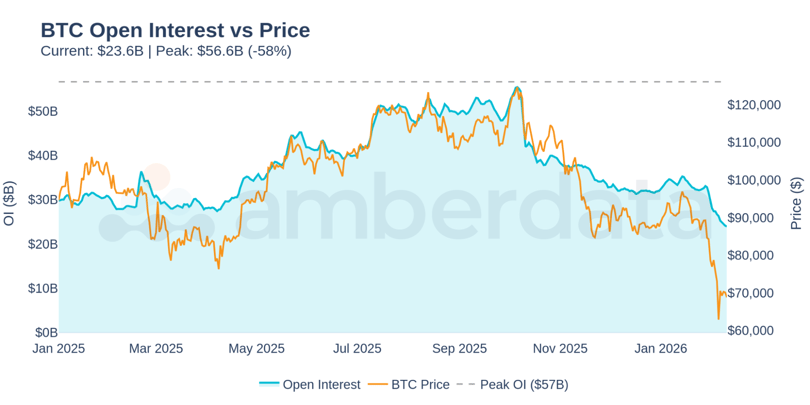
BTC open interest peaked alongside price in October 2025 at $56.6 billion and collapsed to $23.6 billion - a 58% drawdown that reflects forced position closures rather than orderly risk management. When OI drops faster than price, it signals cascading liquidations: leveraged positions being blown out trigger stop-losses and margin calls, which force further selling, which triggers more liquidations. This is precisely the mechanic we documented in our analysis of the October 2025 crash, and it repeated with even greater intensity in February.
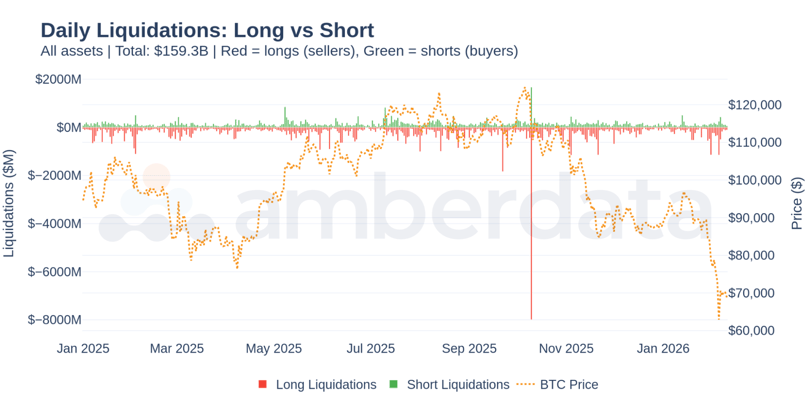
Liquidation cascades. Total liquidations across the analysis period reached $159.3 billion, with the peak single day on October 10 producing $9.67 billion. During the February crash, $2.56 billion was liquidated on February 1 (~200,000 traders blown out, the 10th-largest day in crypto history), followed by $2.67 billion on February 5 ($2.31 billion in longs alone). Bitcoin’s entity-adjusted realized loss hit a record $3.2 billion on February 5 - surpassing loss-taking during some of Bitcoin’s most severe historical shocks. The 24/7 trading environment with no circuit breakers means cascading liquidations hit overnight and on weekends when equity markets are closed, and leverage up to 100x creates forced-selling dynamics far more intense than traditional margin calls.
Funding rates tell a more nuanced story. Cumulative funding from January 1, 2026 shows funding barely went net negative across major exchanges. Current annualized funding sits at -1.5% versus a 5.9% average. The 90-day basis declined only ~100 basis points. For context, during FTX, the 90-day basis hit -9%. This lack of reaction in the fixed-rate futures market suggests we have not seen true capitulation. As our Director Of Derivatives, Greg Magadini, noted in our volatility analysis, term structure richness hit 1.30 backwardation - a level that has reliably marked major inflections at Covid, Terra/Luna, FTX, Spot ETF approval, and the US election. DVOL exploded from sub-40 to ~90. The same players own the same things - there has been no transfer of ownership from the prior cycle into fresh hands.
Where Has Demand Gone?
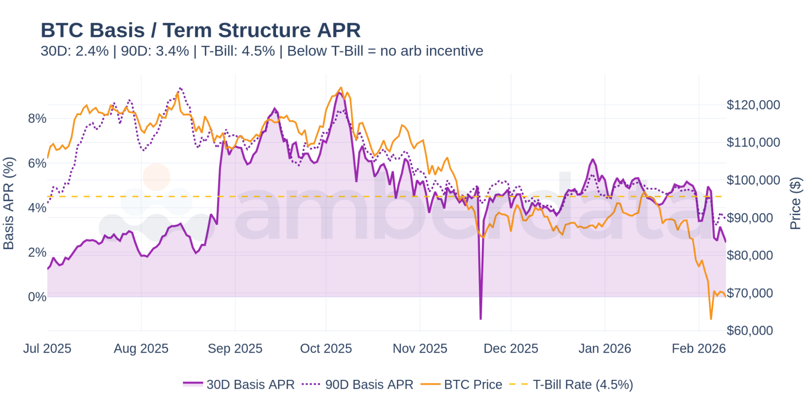
The basis trade collapsed. The 30-day annualized basis compressed from ~15%+ to 2.4%, and the 90-day basis fell to 3.4% - both well below the T-bill reference rate of 4.5%. When basis equals or falls below the risk-free rate, there is zero incentive for institutional arbitrage (buy spot ETF, short CME futures). This explains why ETF outflows were largely mechanical - hedge funds unwinding basis trades, not discretionary sellers capitulating. The carry trade that had driven billions into ETFs throughout 2025 reversed from a tailwind into a structural headwind.
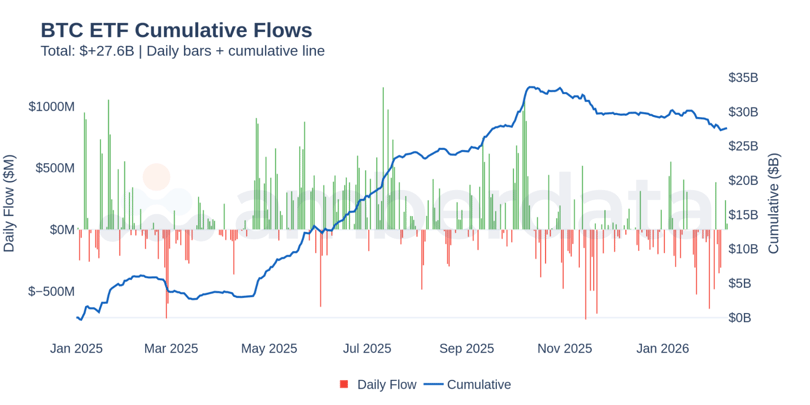
The spot Bitcoin ETF complex experienced its most severe drawdown since launching in January 2024. Cumulative net inflows stand at +$27.6 billion (+234,675 BTC), but November 2025 through January 2026 produced approximately $6.18 billion in net outflows. The worst single day was January 29 at -$817.87 million, with IBIT alone shedding $317.8 million, FBTC losing $168 million, and GBTC $119.4 million. Total ETF net assets fell below $100 billion to approximately $97 billion by February 3, down from a peak above $150 billion in October 2025. As we detailed in our ETF cost basis series, the average ETF cost basis sits at roughly $80-85k per BTC, meaning approximately 62% of all ETF inflows are now underwater. Year-to-date 2026, cumulative redemptions totaled ~$1.9 billion.
Encouragingly, flows reversed in the second week. February 9-10 delivered back-to-back inflows for the first time in a month. And despite the 50%+ price drawdown, total BTC held in ETFs only dipped ~6-7% (from 1.37 million to 1.29 million BTC) - most holders did not panic-sell. The February 5 crash produced a remarkable data point: BlackRock’s IBIT recorded 284 million shares traded with over $10 billion in notional volume, shattering its prior record.
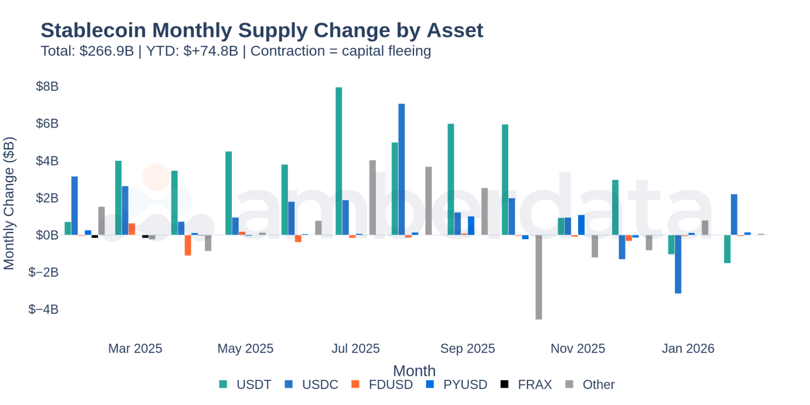
Stablecoin contraction signals capital retreat. Current total stablecoin supply stands at $266.9 billion, but the month-over-month change by asset reveals stress beneath the headline. USDT and USDC combined cap fell to ~$257.9 billion (-$7 billion from mid-December peak). USDC alone shed over $4 billion in ten days. Exchange stablecoin flows reversed dramatically: from +$9.7 billion monthly in October 2025 to -$4 billion by February, with Binance alone registering $3.1 billion in outflows. Stablecoin dominance surged to 12.5%, a three-year high, indicating capital fleeing to safety rather than deploying into risk assets. Lower stablecoin float plus lower exchange balances equals worse depth, higher slippage, and more violent cascades.
Structural Fragility
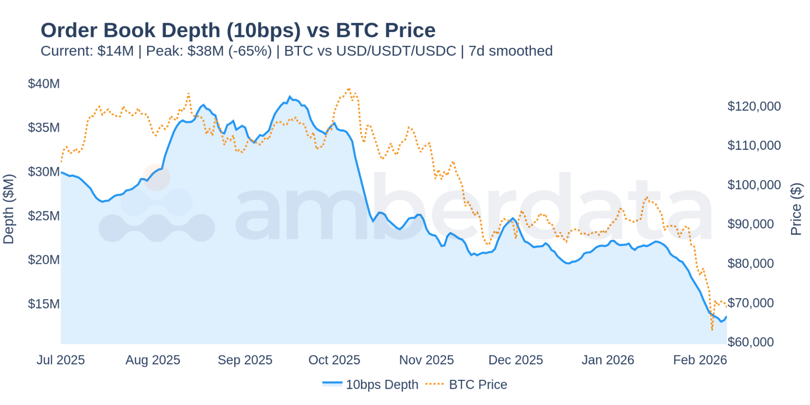
Order book depth at 10 basis points peaked at $38 million in September 2025 and has since collapsed 65% to $14 million. The market never fully recovered from the October 2025 crash ($19 billion in single-day liquidations, the largest in crypto history) - it entered this correction already structurally fragile. Wider spreads and thinner books reduce resilience to large orders, meaning any selling pressure has an outsized price impact.
Additional fragility signals reinforced the technical weakness. The death cross (50-day EMA below 200-day EMA) has been active since mid-November 2025. The Coinbase premium was negative for 21 consecutive days - the most sustained reading in a year - confirming persistent US institutional selling. BTC broke below its 365-day moving average for the first time since March 2022. Thin weekend liquidity amplified the January 31-February 2 moves, with no circuit breakers to slow the cascade. Short-term puts traded at a premium of over 10 points to calls, and $75,000 BTC put options on Deribit reached $1.159 billion in notional open interest, nearly matching the $1.168 billion in $100,000 calls. This is the ETF-era feedback loop: outflows reduce on-exchange liquidity, which amplifies price declines, which triggers more outflows - a self-reinforcing cycle that did not exist in previous bear markets.
Follow the Whales
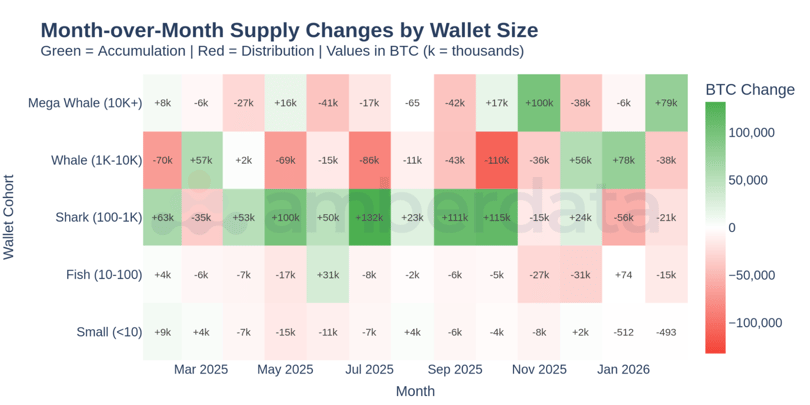
On-chain data reveals a clear divergence between large and small holders. Our BTC rotation analysis documented this pattern through the October crash - whales accumulated while retail sold - and the same dynamic intensified in February. On February 6, whale addresses accumulated 66,940 BTC in a single day, the largest accumulation event since 2022. Nearly half of all circulating BTC supply is now held at a loss, yet the month-over-month wallet heatmap shows large cohorts (Sharks, Whales, Mega Whales) consistently adding supply while smaller holders (< 10 BTC) distributed.
Mining capitulation. Hashrate dropped 12-20% since November, the largest drawdown since China’s 2021 mining ban. Mining difficulty dropped 11.16% to 125.86T, the largest single negative adjustment since 2021. Hashprice hit an all-time low of $33.31/PH/s/day on February 2. With average mining cost at approximately $87,000 versus a spot price of ~$69,000, miners are operating roughly 20% below production cost. Marathon Digital transferred 1,318 BTC ($86.9 million) in ten hours. Winter Storm Fern forced widespread Texas mining curtailment (Foundry USA lost 60% capacity), and China’s Xinjiang crackdown shut down 1.3 GW of mining capacity.
Strategy’s underwater treasury. Strategy (formerly MicroStrategy) holds 714,644 BTC at an average cost of $76,052 per coin ($54.26 billion total). Its entire treasury went underwater when BTC broke below $76,000, producing a $12.4 billion Q4 net loss (mark-to-market). The mNAV multiple collapsed to ~0.87x, effectively freezing its equity issuance mechanism. Michael Burry warned on February 9 of a potential “death spiral” - with nearly 200 public companies now holding significant BTC, further price declines could trigger risk-management-driven forced sales across the corporate sector.
Seven Drivers, One Cascade
The January 28-February 11 Bitcoin correction resulted from an unusually dense cluster of simultaneous shocks, each reinforcing the others. The Warsh nomination and hawkish FOMC removed the liquidity-expansion narrative. Tech earnings, CAPEX shock and a precious metals crash triggered cross-asset margin calls. $6.18 billion in ETF outflows drained institutional support. Mining capitulation and stablecoin contraction removed organic buy-side flow. Strategy’s underwater treasury and China’s regulatory escalation introduced contagion fears. And the new ETF-era feedback loop amplified everything.
The bull case rests on historical precedent (Fear & Greed readings this extreme have preceded local bottoms), whale accumulation behavior (66,940 BTC in a single day), the first back-to-back ETF inflows in a month, and the term structure backwardation signal at 1.30 that has reliably marked major inflections. Bernstein maintains a $150,000 year-end target, and Standard Chartered echoed similar conviction. Galaxy Digital’s Michael Novogratz said: “Often when things feel worse, it is time to be very focused and potentially accumulating.”
The bear case centers on structural damage to liquidity, mining economics operating 20% below breakeven, fading retail adoption (US consumer crypto adoption dropped from 17% to 12% per Deutsche Bank), the collapse of the basis trade that drove institutional participation, and the absence of true capitulation in funding markets. Stifel predicted Bitcoin could fall to $38,000 based on historical cycle trend lines. Our 2026 Outlook explored whether the traditional four-year halving cycle still applies. After 2025’s failure to follow the historical script, that question has become urgent.
What to watch: Basis APR recovery above 8% (currently 2.4%) would signal carry trade re-engagement. Sustained negative funding beyond 14 days has historically preceded reversals - monitor exchange-level funding dispersion for early signals. Order book depth returning toward $25M at 10bps (currently $14M) would indicate market-maker confidence returning. ETF flow momentum is critical: three consecutive positive days would confirm institutional re-engagement rather than dead-cat-bounce positioning. Mining hashrate stabilization (currently down 12-20%) would remove a key source of forced selling pressure. And the delayed January CPI report (rescheduled to February 13), alongside Warsh’s confirmation hearings, provides the next set of catalysts. Bitcoin sits at $69,000-$70,000, roughly equidistant between the bears’ $38,000 target and the bulls’ $150,000 forecast - a market deeply divided on what comes next.
Full-Market Research. Institutional Depth. Derivatives, ETFs, on-chain, DEXs, microstructure, risk signals - and more. Subscribe at the bottom of our page for research that covers every corner of crypto and visit the Amberdata Research.
Access Amberdata Intelligence for institutional-grade digital asset intelligence, or contact our team to discuss custom solutions.

Links & Resources
Platform
Recommended Next Reads
2025 Year End Review
• Amberdata Crypto Market Review 2025 and 2026 Outlook: Six Regimes, One Story
2026 Market Outlook
• 2026 Outlook: The End of the Four-Year Cycle
ETF Cost Basis Series
- Part 1/3: The $80,000 Floor (ETF Cost Basis)
- Part 2/3: Who Breaks First (ETF Cost Basis)
- Part 3/3: The Stress Test (ETF Cost Basis)
More Key Reads
• Bitcoin Volatility Surges as Macro Data and Derivatives Signals Align
• Bitcoin’s Great Rotation: Who Bought the Dip and Why It Matters
• October 2025 Crash Explained Through 7 Charts
• Five Signals of FOMC Impact on Crypto Market Microstructure
Disclaimers
The information contained in this report is provided by Amberdata solely for educational and informational purposes. The contents of this report should not be construed as financial, investment, legal, tax, or any other form of professional advice. Amberdata does not provide personalized recommendations; any opinions or suggestions expressed in this report are for general informational purposes only.
Although Amberdata has made every effort to ensure the accuracy and completeness of the information provided, it cannot be held responsible for any errors, omissions, inaccuracies, or outdated information. Market conditions, regulations, and laws are subject to change, and readers should perform their own research and consult with a qualified professional before making any financial decisions or taking any actions based on the information provided in this report.
Past performance is not indicative of future results, and any investments discussed or mentioned in this report may not be suitable for all individuals or circumstances. Investing involves risks, and the value of investments can go up or down. Amberdata disclaims any liability for any loss or damage that may arise from the use of, or reliance on, the information contained in this report.
Copyright © 2026 Amberdata. All rights reserved.