


Share this blog:

Why the 7D/30D RV Ratio Is the Single Most Useful One-Number Summary of Where You Are in the Vol Cycle
|
KEY TAKEAWAYS |
|
• Realized vol is the truth, implied vol is the forecast. RV is what already happened. IV is what the market expects to happen. The gap between them is the variance risk premium, the structural edge in vol trading. RV leads IV on regime entries; IV leads RV on regime exits. Reading the spot tape correctly is the foundation of every subsequent layer in the stack. • BTC 30D realized vol sits in the 2nd percentile of its 90-day distribution. BTC 30D RV is 28.6%. ETH 30D RV is 27.4% in the 3rd percentile. SOL 30D RV is 37.2% in the 1st percentile. The major-cap complex has not been this quiet on a rolling basis in three months, yet spot fell 5.8% to 11.7% across the three assets this week. Vol compression during a directional move is the classic setup for the next vol expansion. • The 7D/30D RV ratio is the single most useful one-number summary of vol regime. BTC's ratio is 0.98 in the 75th percentile, decompressing from an expansion. ETH's is 0.72 in the 25th percentile, deep-compression territory. SOL's is 0.93 with both legs at historic lows. The three readings describe three different points on the same vol cycle inside the same crypto complex. • ETH realized vol below BTC realized vol is a multi-year rarity. ETH 7D RV at 19.8% versus BTC 7D RV at 28.0%. ETH 30D RV at 27.4% versus BTC 30D RV at 28.6%. The structural relationship has ETH RV running 1.3 to 1.5 times BTC RV. When the relationship inverts at extremes, it has historically converged inside 4 to 8 weeks, often with ETH RV pulling above 1.4 times during the catch-up. |
This is the second piece in The Vol Stack, a 10-part series unpacking how to read crypto options markets layer by layer. Each piece anchors to live data from the Amberdata Options & Macro Weekly Report and Amberdata Intelligence.
BTC's 30-day realized volatility is 28.6%. It sits in the 2nd percentile of its 90-day distribution. ETH 30D RV is 27.4%, also in the 3rd percentile. SOL 30D RV is 37.2%, in the 1st percentile. The major-cap complex has not been this quiet on a rolling basis in three months. Over the same window, BTC spot fell 5.8% on the week, ETH fell 9.0%, SOL fell 11.7%. Vol compression during a directional decline is the structural setup for the next vol expansion. Reading why takes one ratio.
Realized vol is the truth.
Realized vol is what happened. Implied vol is what the market expects to happen. The two numbers describe different time horizons of the same process. RV is measured directly from price data over a trailing window with a known formula. Doing it correctly across multiple assets requires high-frequency data sampled at consistent intervals with rolling windows aligned timestamp by timestamp, which is harder than it looks. Daily close-to-close is too noisy on short windows; proprietary intraday computations are not comparable across venues. IV is solved-for, the volatility input that makes a Black-Scholes option price match the observed market price.
RV is the past. IV is the future. The gap between them is the variance risk premium, which is the structural edge in vol trading and the topic of Post 5. Before getting to the premium, you have to read the tape itself. The question of which leads which on a regime change is itself analytical, not mechanical. The pattern across decades of options data, including the more limited but consistent crypto sample, is that RV leads IV on regime entries: when vol expands, realized vol prints first and the surface re-prices in the following sessions. IV leads RV on regime exits: when vol compresses, the surface relaxes faster than realized vol fades. The analytical move is to read RV first and read IV against it.
The kinetic-energy reading also matters because spot direction is not the same as spot vol. A market can fall 10% on a clean trend with low intraday realized vol or trade sideways with high realized vol on choppy two-sided action. The first pattern is a directional regime. The second is a vol regime. They have different options-trading implications. The chart that conflates them, price overlaid on IV, is the most common reason traders misread the surface.
Realized vol is measured. Implied vol is solved-for. The gap between them is the whole game.
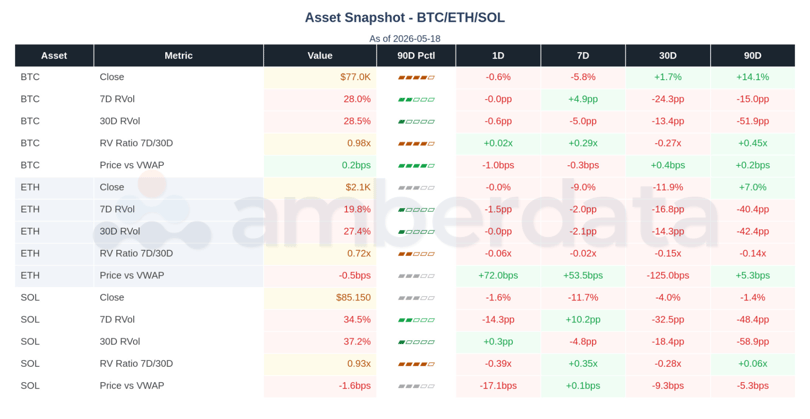
Figure 2.1: Asset Snapshot. The table joins spot, 7D and 30D returns, 7D and 30D realized vol, and the 7D/30D RV ratio in a single view. Read the 30D RV and the ratio together. Each percentile marker matters more than the level.
The 7D/30D ratio.
The single most useful one-number summary of where you are in the vol cycle is the 7-day realized vol divided by the 30-day realized vol.
Below 1.0: short-term vol is fading relative to its trailing-month baseline. The regime is compressing. Vol-selling structures are paid.
Above 1.0: short-term vol is running hot relative to baseline. The regime is expanding. Buying premium has carry.
Above 1.3: the warning zone. Short-term vol is so dislocated from trailing-month that a regime change is statistically more likely than a return to baseline. The dislocation resolves through a vol spike that confirms the inflection or a sharp compression that fades back through the baseline.
Below 0.7: the deep-compression zone. When 7D vol drops below 70% of 30D vol after a directional move, the options market's classic setup for a vol expansion is in place. This pattern resolves into a vol spike about two-thirds of the time on 30-day forward windows.
This week's reading is the second pattern, mid-transition. BTC's 7D/30D RV ratio is 0.98, which sits in the 75th percentile of its 90-day distribution. Both the numerator and denominator have compressed: BTC 7D RV at 28.0% sits in the 25th percentile, BTC 30D RV at 28.6% sits in the 2nd percentile. The ratio looks neutral, but it is neutral because both legs are extremely low. The reading 30 days ago had the ratio at 1.24, well above 1.0. The compression that has happened since means BTC is decompressing from an expansion, not entering one.
ETH tells a different story. The ETH 7D/30D ratio is 0.72, sitting in the 25th percentile of its own 90-day distribution. ETH 7D RV at 19.8% is materially below ETH 30D RV at 27.4%. The deep-compression interpretation applies more cleanly to ETH than to BTC: short-term vol has faded sharply while long-term vol still reflects the prior expansion. The forward-looking setup for ETH vol is asymmetric, with the next move much more likely to be expansion than continued compression.
SOL sits between the two. The SOL 7D/30D ratio is 0.93. Both legs are at historic lows: 7D RV at 34.5% in the 25th percentile, 30D RV at 37.2% in the 1st percentile. The 1st percentile reading on 30D is the most extreme single number in the snapshot.
The reader who only watches absolute RV would see "BTC vol is at lows" and stop. The reader who watches the ratio sees three different regimes inside the same complex: BTC in late-cycle compression, ETH in deep compression, SOL in extreme compression at the asset level. Each implies a different posture on the surface.
0.72
ETH's 7D/30D realized vol ratio sits in deep-compression territory, below the 0.75 threshold where the options market's classic setup for a vol expansion typically resolves into a spike about two-thirds of the time on 30-day forward windows.
The cross-asset picture.
Crypto is not a single market. The major-cap complex consists of three assets with structurally different volatility profiles. BTC has the lowest realized vol and the cleanest macro beta. ETH has structurally higher realized vol, more concentrated flow, and a higher retail share. SOL is the highest beta of the three, with the smallest float relative to active trading volume.
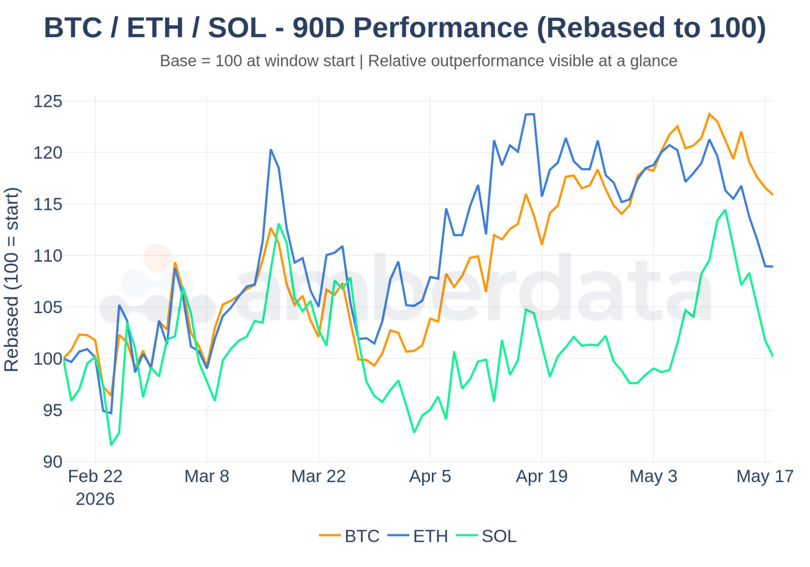
Figure 2.2: 3-Asset Price 90D, Rebased to 100. BTC, ETH, and SOL on a single chart, all rebased to 100 at window start. Watch the divergence in the back half. BTC leadership has been the dominant theme on every time window, 7D through 90D.
Over the trailing 90 days, BTC is up 14.1% and sits in the 73rd percentile of its 90-day distribution. ETH is up 7.0% in the 43rd percentile. SOL is down 1.4% in the 46th percentile. Over the trailing 30 days, the gap is starker: BTC up 1.7%, ETH down 12.0%, SOL down 4.0%. On the week, BTC fell 5.8%, ETH fell 9.0%, SOL fell 11.7%. Three observations spread across three time windows say the same thing: BTC is taking share inside the crypto complex.
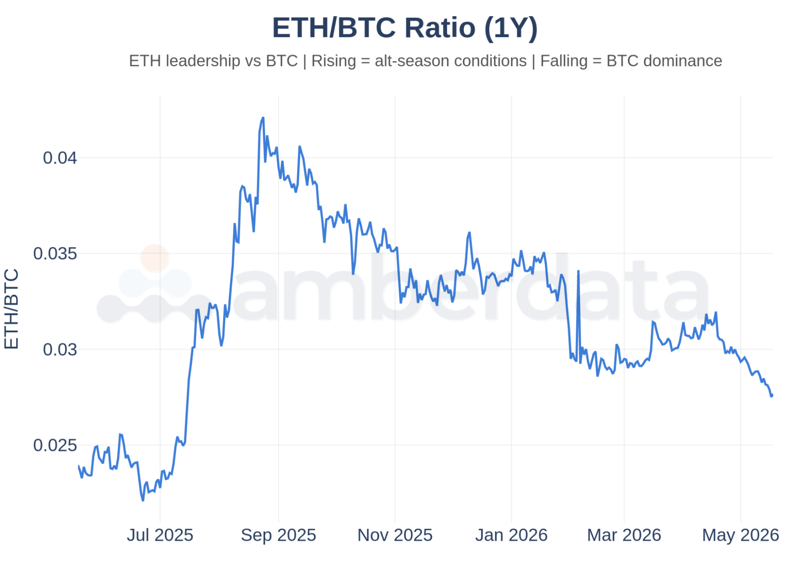
Figure 2.3: ETH/BTC Ratio 1Y. The ratio at 0.0277. Below 0.045 has historically marked BTC-dominance peaks. Above 0.085 has marked ETH cycle highs. The current reading sits well below the BTC-dominance threshold.
The ETH/BTC ratio at 0.0277 is the cleanest expression of within-crypto rotation. Below 0.045 has historically marked BTC-dominance peaks. The reading 90 days ago was higher; the ratio has compressed alongside the broader ETH underperformance. The signal is not subtle. Capital is preferring BTC inside the crypto bucket.
The follow-on observation is structural. ETH realized vol has historically run 1.3 to 1.5 times BTC realized vol. The current 30D ratio is 27.4 divided by 28.6, which gives 0.96. ETH RV is below BTC RV. On the 7D window, ETH RV at 19.8% is far below BTC RV at 28.0%, a 7D ratio of 0.71. This is rare. The setup pattern is recognizable: ETH/BTC has compressed, ETH RV has compressed faster than BTC RV, and the spot ratio has broken through structural support. When this pattern resolves, ETH RV has historically caught up to BTC RV inside 4 to 8 weeks, often pulling above 1.4 times during the catch-up. The vol convergence trade is rare but high-conviction at extremes.
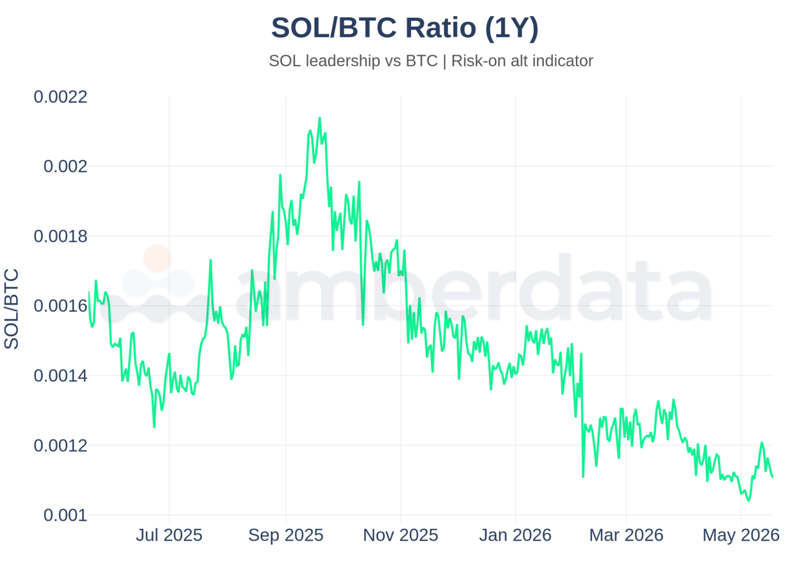
Figure 2.4: SOL/BTC Ratio 1Y. The ratio at 0.001106. SOL is the highest-beta major. Sustained SOL/BTC weakness while BTC rallies is the classic late-cycle warning that the rally is concentrating in BTC and the alt market is rolling.
SOL/BTC at 0.001106 reinforces the same read. SOL/BTC peaks tend to lead ETH/BTC peaks by 2 to 4 weeks; the lag works in both directions on a roll. The current readings, with both ratios near 90D lows and both alts underperforming BTC on the week, point to a within-crypto rotation that is broad rather than asset-specific.
VWAP spread, the flow tell.
A small observation that most readers will not have framed this way. VWAP spread, the difference between current price and volume-weighted average price expressed in basis points, is one of the cleanest flow signals available in spot data. When VWAP spread persists positive across a session or a multi-session window, late-day buying pressure is dominant. The mechanism is mechanical. Late-session buying transacts above the volume-weighted average, which is anchored by earlier session volume.
The observation that matters for an options reader is the lead time. Persistent positive VWAP spread tends to precede funding rate increases in BTC perpetuals by 1 to 2 days, when the directional flow is sustained. The signal works because VWAP spread captures the marginal buyer before that buyer's positioning shows up in derivatives data. Flow leads leverage.
The deeper mechanism is dealer inventory absorption. Passive late-session flow that the order book absorbs without aggressive lifting leaves market-makers gradually long or short on the path. That inventory has to be hedged, and the cheapest hedge is the perpetual swap. Funding rate moves come 1 to 2 sessions later when perpetuals positioning adjusts to clear the dealer book. VWAP spread is the early reading on flow that has not yet been transmitted to derivatives. The signal is most reliable when the spread persists for multiple sessions in the same direction; single-session readings are noisier and prone to false positives.
This week's reading: BTC VWAP spread at 0.22 bps, sitting in the 84th percentile of its 90-day distribution. Mildly positive on the level, but with strong percentile context. Late-session bidding has been dominant on the BTC tape despite the weekly decline. The pattern is consistent with the BTC dominance read above. Even on a down week, the marginal flow inside crypto is buying BTC late in the session.
ETH and SOL show the opposite. ETH VWAP spread at -0.45 bps. SOL VWAP spread at -1.57 bps. Both negative, both pointing to late-session selling. The flow signal aligns cleanly with the ratio signal. Capital is leaving the alts and concentrating in BTC.
|
SO WHAT? |
|
The cross-asset flow read is durable. BTC bid into late session, ETH and SOL sold into late session, ETH/BTC and SOL/BTC at or near 90D lows, BTC RV in the 2nd percentile while alt RV is even lower. The reading is not a single signal. It is four signals saying the same thing inside the same window. When four independent measurements align, the read is structural rather than noise. The asymmetry on the surface sits in alt vol, not BTC vol. |
Reading today's tape.
Synthesis. The cross-asset spot read this week is unusual.
BTC, the lower-vol asset of the three majors, is the leader on price. BTC is up 14% on 90D, up 1.7% on 30D, down 5.8% on the week. The 30-day and 90-day readings have the asset firmly above its own baseline. ETH and SOL are down meaningfully on both 30D and 90D windows. Within-crypto rotation has favored BTC for two months.
But BTC realized volatility is at extreme lows. BTC 30D RV at 28.6% is in the 2nd percentile of its 90-day distribution. The 7D RV at 28.0% is in the 25th percentile. The 7D/30D ratio at 0.98 has decompressed from a reading of roughly 1.24 thirty days ago. The decompression itself is the regime tell. BTC is exiting a vol expansion that has not yet been replaced by a fresh one.
ETH sits in deeper compression. ETH 30D RV at 27.4% in the 3rd percentile. A 7D/30D ratio at 0.72 in the 25th percentile. ETH RV has compressed faster than BTC RV. ETH spot has underperformed BTC spot. The cross-asset RV ratio has BTC RV currently above ETH RV, which is rare and structurally mean-reverting.
SOL sits in extreme compression at the asset level. SOL 30D RV at 37.2% is in the 1st percentile. The 7D/30D ratio at 0.93 is neutral but both legs are at lows. SOL is the highest-beta major and the leading edge of any alt-market vol response.
The read on the surface this implies is that the next move in crypto vol is much more likely to come from the alt complex than from BTC, and much more likely to be expansion than continued compression. The structural argument: ETH RV at 0.96 times BTC RV on 30D, and 0.71 times BTC RV on 7D, are multi-year extremes. The historical convergence period is 4 to 8 weeks. The catalyst is rarely identifiable in advance; the setup is what gives the convergence trade its asymmetry. ETH versus BTC on the implied vol surface is where Post 4 picks up the thread.
Spot tells you what already happened. Implied vol tells you what the market thinks happens next. Once the spot kinetic state is read clearly, the surface starts saying something specific.
ETH realized vol below BTC realized vol is a multi-year rarity. When the relationship inverts, it has historically converged inside 4 to 8 weeks.
What comes next in The Vol Stack.
This was the kinetic-energy layer of the stack. Spot returns are a thin slice of the spot information set. Realized vol, the 7D/30D ratio, the asset cross-ratios, and VWAP spread are the richer dataset. Post 1 established the macro vol regime that crypto vol lives inside. Post 2 has established the spot kinetic state the surface is pricing against.
Post 3 moves to implied vol level: what ATM IV mathematically is, why "the market's forecast" is the wrong framing, and how to read IV rank, term richness, and the cross-tenor surface in coordination. The three numbers together will tell you whether vol is rich, fair, or cheap on a regime basis, which is the prerequisite for every vol trade in the rest of the series.
Next in The Vol Stack: Implied Volatility: Reading the Market's Forecast.
|
THE BOTTOM LINE |
|
The cross-asset spot read this week is BTC leadership on price, BTC dominance on flow, and extreme compression on realized vol across all three majors. BTC 30D RV in the 2nd percentile, ETH 30D RV in the 3rd, SOL 30D RV in the 1st. The 7D/30D RV ratio is the single most useful one-number summary of vol regime: BTC's at 0.98 in late-cycle compression, ETH's at 0.72 in deep compression, SOL's at 0.93 with both legs at historic lows. ETH realized vol below BTC realized vol on both 7D and 30D windows is a multi-year rarity and the highest-conviction setup in the spot data. The next move in crypto vol is far more likely to come from the alt complex than from BTC, and the next implied vol reading is pricing into a spot tape with the lowest realized vol the major-cap complex has seen in 90 days. |
Full-Market Research. Institutional Depth.
Derivatives, ETFs, on-chain, DEXs, microstructure, risk signals, and more. Subscribe at the bottom of our page for research that covers every corner of crypto and visit the Amberdata Research Blog.
Access Amberdata Intelligence for institutional-grade digital asset intelligence, or contact our team to discuss custom solutions.
Links & Resources
Amberdata Research Library
https://www.amberdata.io/research-library
Amberdata Intelligence Platform
https://intelligence.amberdata.com
Amberdata Docs
Contact Us
https://www.amberdata.io/contact-us
Recent from Amberdata
• The Vol Stack #1: The Macro Vol Regime and Why Crypto Is Never an Island
• The Stress Test: ETF Cost Basis Part 3/3
• Who Breaks First: ETF Cost Basis Part 2/3
• The $80,000 Floor: ETF Cost Basis Part 1/3
• Bitcoin's Great Rotation: Who Bought the Dip and Why It Matters
• The Leverage Purge: Why the Market Is Healthier After $8.55B in Pain
• The ETF Exodus Decoded: Basis Arbitrage, Not Capitulation
• Coincidence or Signal? Did WLFI Telegraph Crypto's $6.93B Meltdown
• How $3.21B Vanished in 60 Seconds: October 2025 Crypto Crash Explained Through 7 Charts
• Five Signals of FOMC Impact: How Interest Rate Decisions Reshape Crypto Market Microstructure
Disclaimers
The information contained in this report is provided by Amberdata solely for educational and informational purposes. The contents of this report should not be construed as financial, investment, legal, tax, or any other form of professional advice. Amberdata does not provide personalized recommendations; any opinions or suggestions expressed in this report are for general informational purposes only.
Although Amberdata has made every effort to ensure the accuracy and completeness of the information provided, it cannot be held responsible for any errors, omissions, inaccuracies, or outdated information. Market conditions, regulations, and laws are subject to change, and readers should perform their own research and consult with a qualified professional before making any financial decisions or taking any actions based on the information provided in this report.
Past performance is not indicative of future results, and any investments discussed or mentioned in this report may not be suitable for all individuals or circumstances. Investing involves risks, and the value of investments can go up or down. Amberdata disclaims any liability for any loss or damage that may arise from the use of, or reliance on, the information contained in this report.
By accessing and using the information provided in this report, you agree to indemnify and hold harmless Amberdata, its affiliates, and their respective officers, directors, employees, and agents from and against any and all claims, losses, liabilities, damages, or expenses (including reasonable attorney's fees) arising from your use of or reliance on the information contained herein.
Copyright © 2026 Amberdata. All rights reserved.