


Share this blog:
.png)
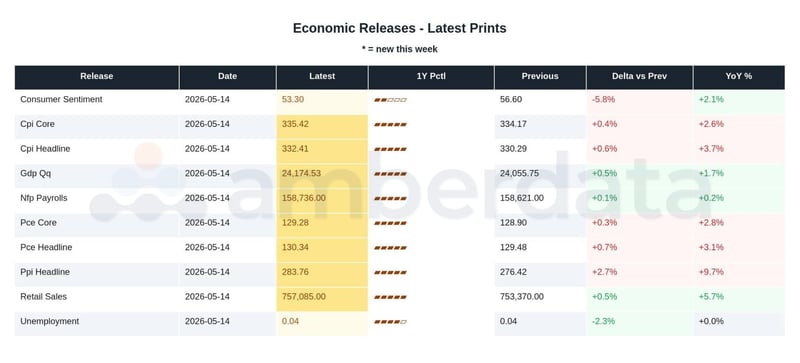
Inflation reaccelerated to 3.8% in April, the highest since May 2023, with the 10-year at 4.61% (one-year high) and the 30-year at a 90-day high as markets price a Fed hike under newly confirmed Chair Warsh. The Iranian oil shock continues to feed through energy at +17.9% annually and shelter reaccelerating; apparel, airlines, and household goods face another two quarters of tariff pass-through. Inside crypto, BTC and ETH IV sit at the 12th and 1st percentiles, while VRP runs at the 99th and 94th, deep negative skew shows persistent put demand, and ETH block flow is heavy puts and vega selling. The mix is compression, not a regime change.
Percentile rankings: 90-day rolling window. Green = health, red = stress, amber = neutral, monitor closely. Values and changes ranked over 90 days; deeper colour signals proximity to recent highs or lows. Correlations: rolling Pearson on daily log returns of close.
|
KEY TAKEAWAYS |
|
Executive Summary
1. Cover Page
|
KEY TAKEAWAYS |
|
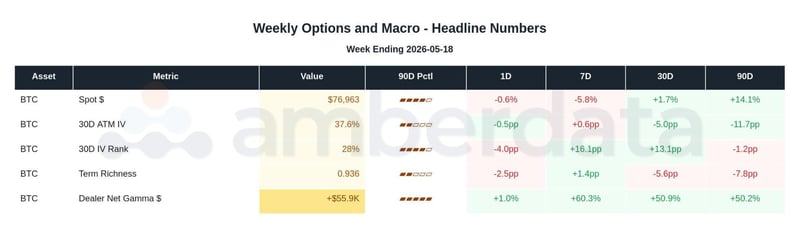
BTC at $77.0K (73rd percentile) trades against compressed vol (12th and 1st percentile IV for BTC and ETH), elevated VRP (99th and 94th), and a split dealer regime (BTC dampening, ETH amplifying). The signal mix is post-event compression, not a regime change.
2. USA Week Ahead
|
KEY TAKEAWAYS |
|
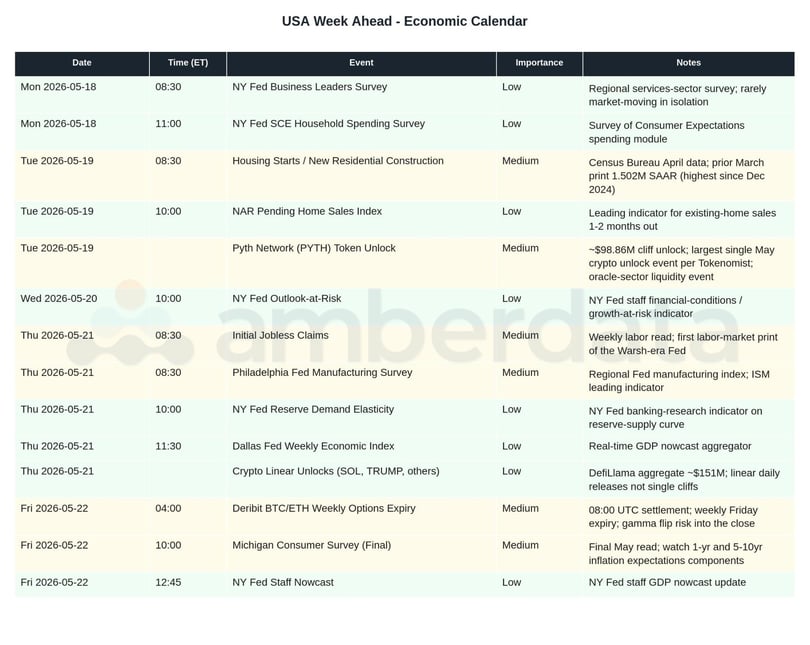
Wednesday lands the FOMC May minutes and NVDA's fiscal Q1 print after the close, the two largest event-vol catalysts on the week. Thursday adds flash PMI, Philly Fed, jobless claims, and housing starts; Friday brings final Michigan sentiment and 1-year inflation expectations. The minutes are the dominant macro tape risk under newly confirmed Chair Warsh.
3. Forward Calendar
|
KEY TAKEAWAYS |
|
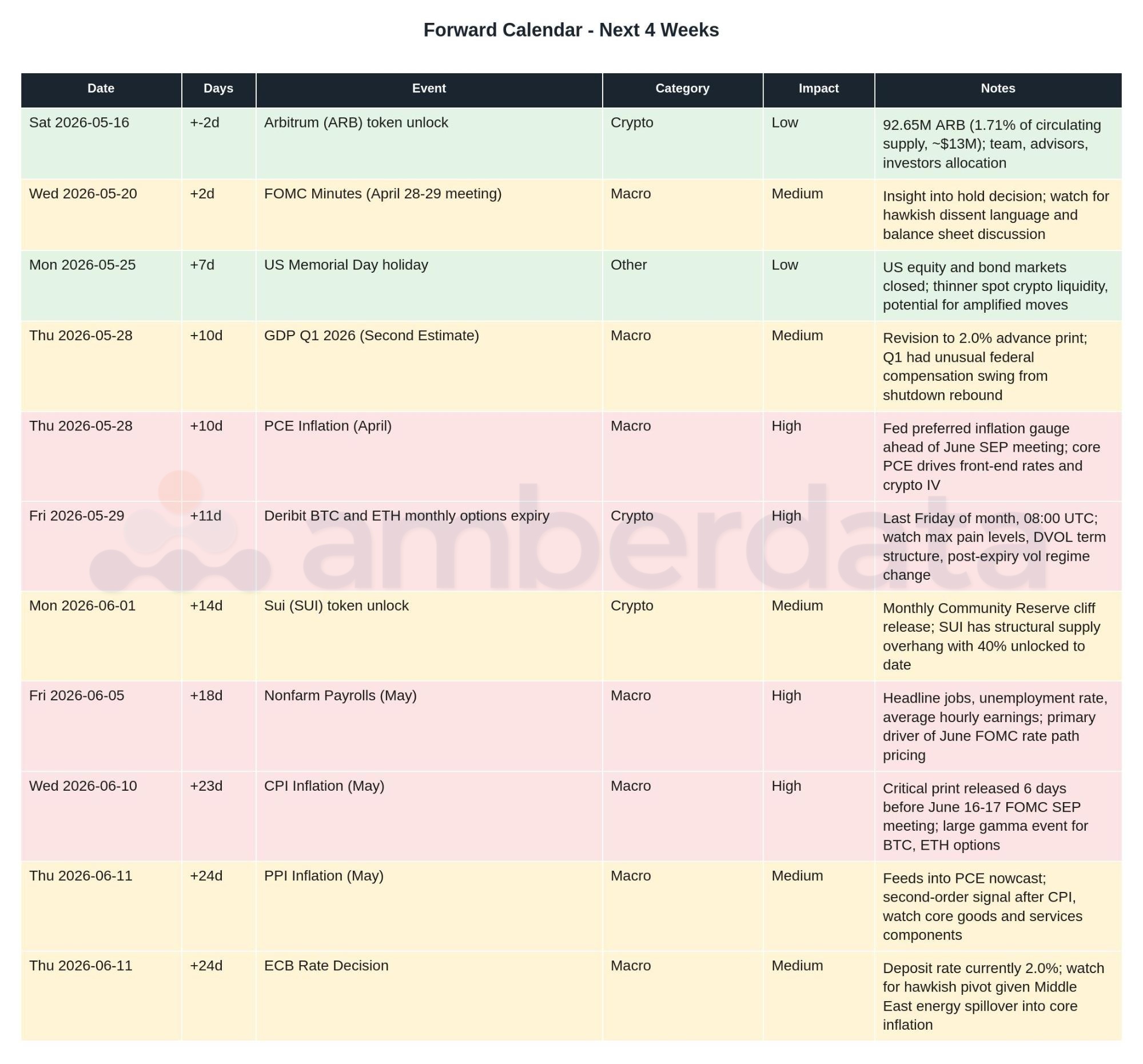
Beyond this week, the next 30 days bring monthly Deribit options expiry on May 29, May CPI on June 10, and the June FOMC meeting, where the rate-hike vs hold debate gets its first formal resolution under Warsh. CPI is the dominant event for crypto vol pricing given the inflation reacceleration; FOMC follows as the policy response.
4. Macro Recap
|
KEY TAKEAWAYS |
|
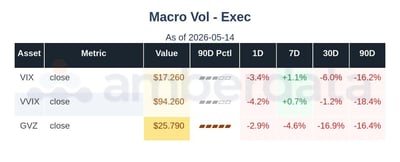
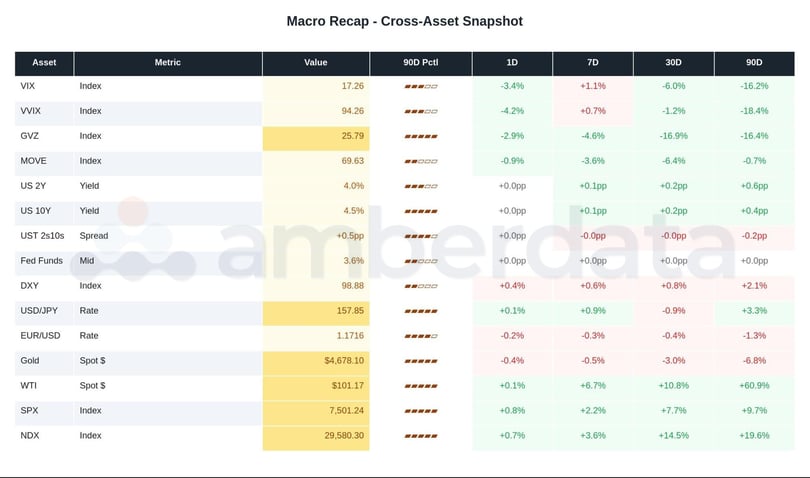
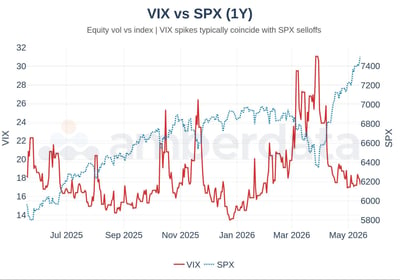
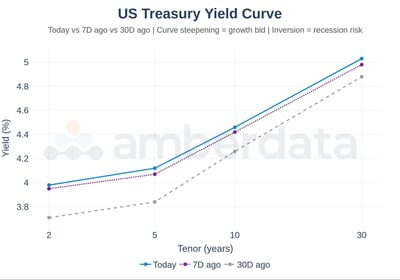
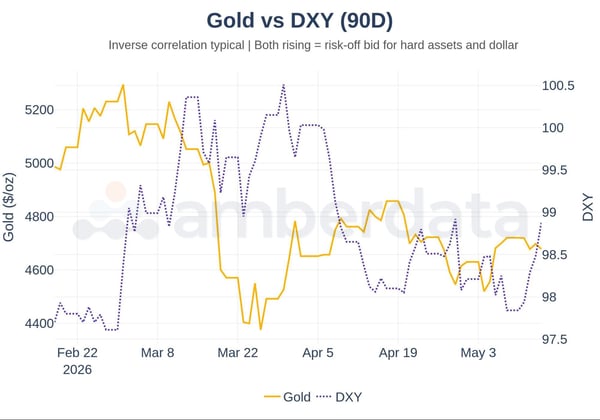
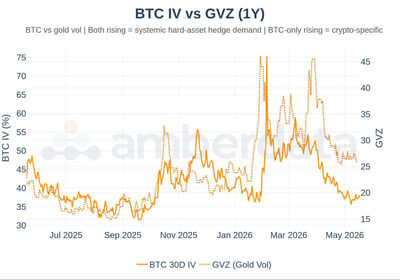
The 10-year closed at 4.61% (one-year high) and the 30-year at a 90-day high (99th percentile), with the curve bear-steepening. SPX held at 7,501 (100th percentile) while VIX at 17.26 (45th) and VVIX at 94.26 (43rd) signal well-behaved equity vol against a back-end rates push. GVZ at 25.79 (92nd) is the standout: gold vol elevated against benign equity vol.
CHARTS
DETAIL TABLES
5. Asset Snapshot
|
KEY TAKEAWAYS |
|
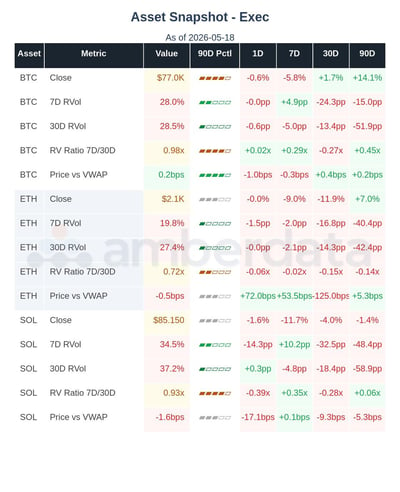
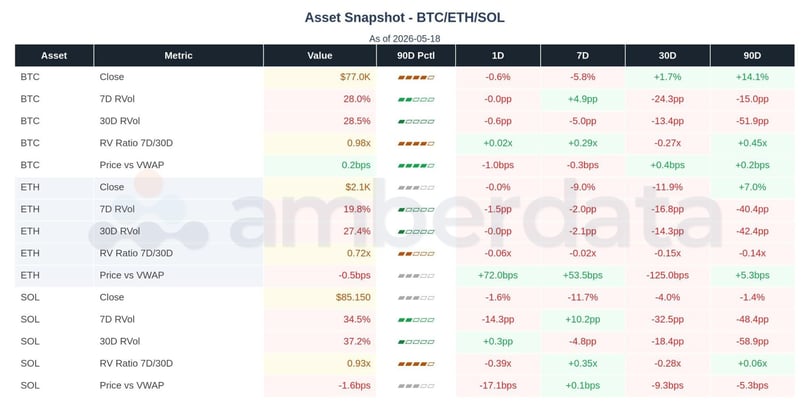
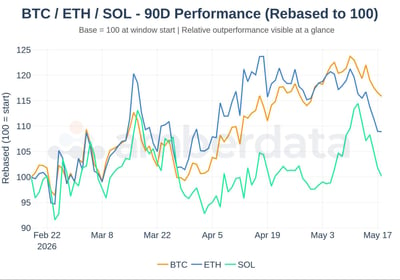
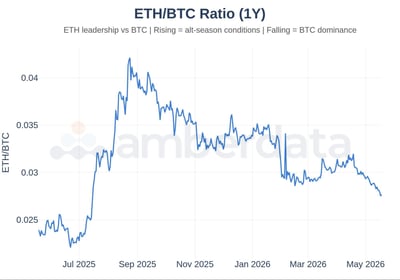
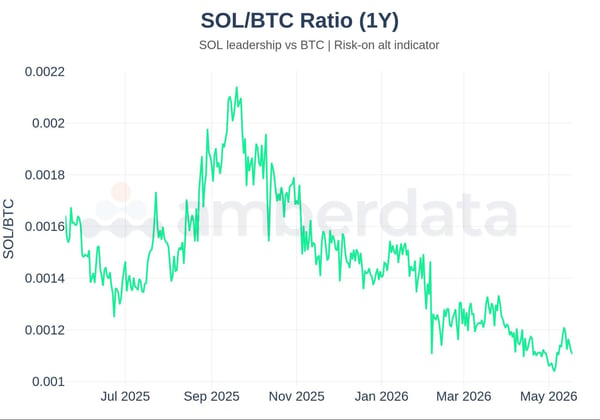
BTC at $77.0K (73rd percentile) was -5.8% with 7D RV at 28.0% and 30D RV at a 90-day low (2nd percentile). ETH closed $2,129 (-9.0%, 43rd percentile) with 30D RV at the 3rd percentile and RV ratio 0.72x. SOL was -11.7% with 30D RV at the 90-day floor (1st percentile). The RV picture is compression across the board: vol has not delivered the moves.
CHARTS
6. Volatility Regime
|
KEY TAKEAWAYS |
|
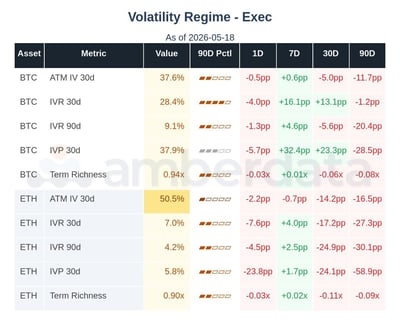
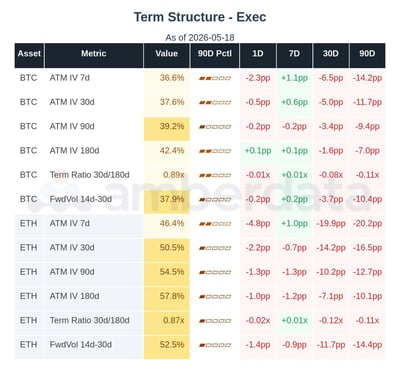
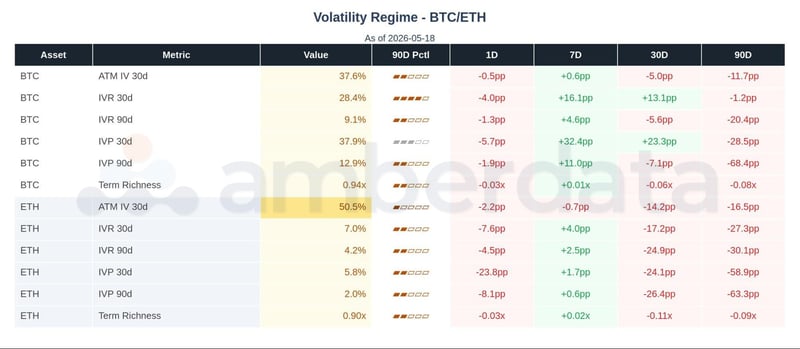
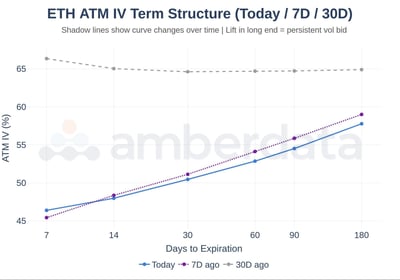
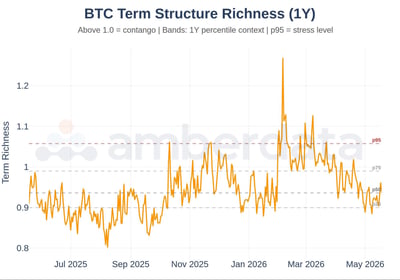
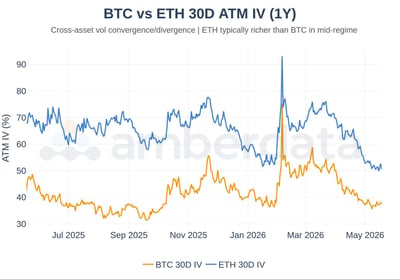
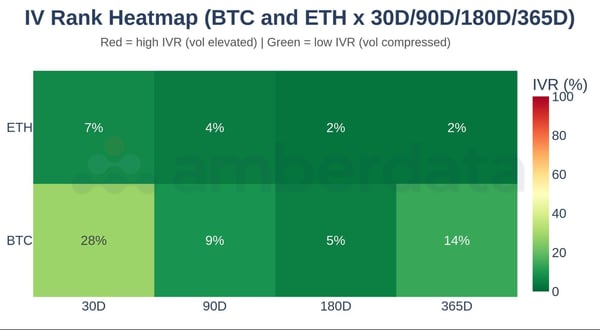
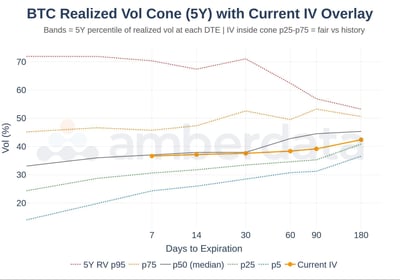
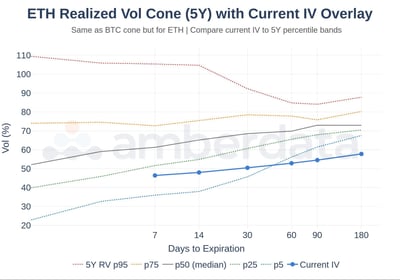
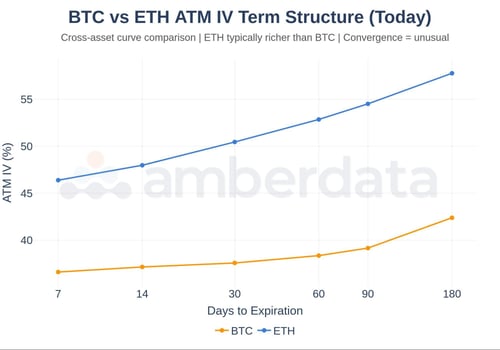
BTC 30D ATM IV at 37.6% (12th percentile) and ETH at 50.5% at a 90-day low (1st percentile). IV rank confirms it: BTC IVR 30D at 28%, ETH at the 7th. Term richness sits below 1.0 for both (BTC 0.94, ETH 0.90) and near 90-day lows: short-end cheap relative to the curve, both in absolute and relative terms.
CHARTS
7. Skew and Kurtosis
|
KEY TAKEAWAYS |
|
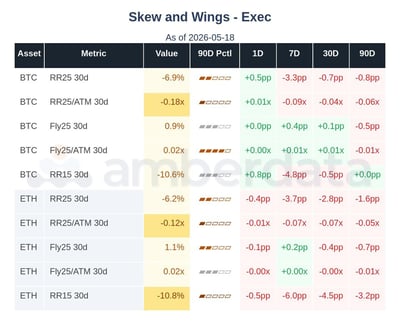
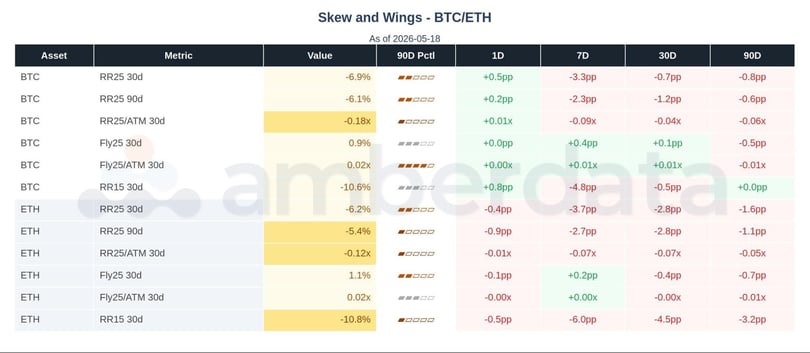
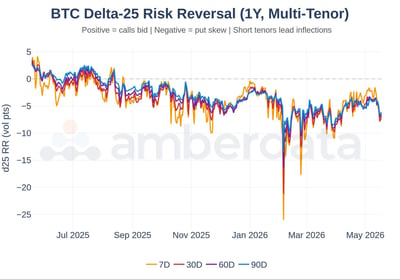
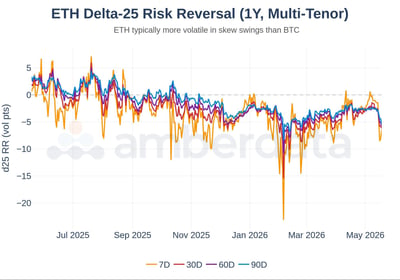
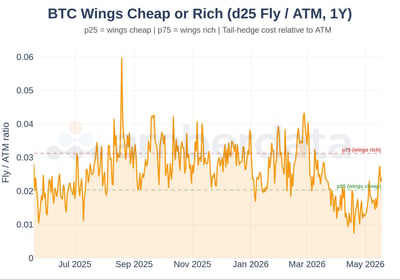
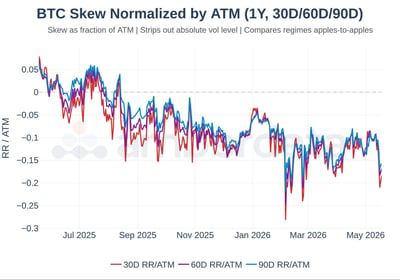
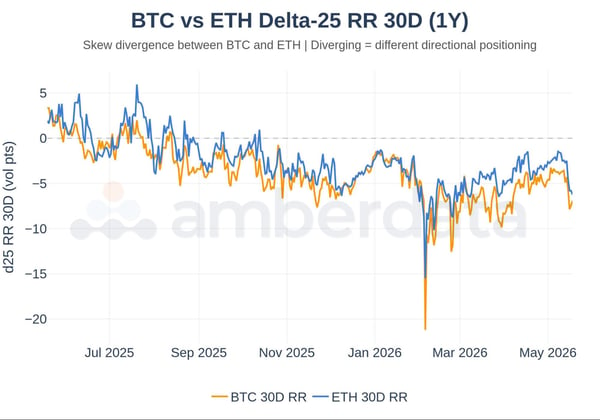
BTC 30D delta-25 RR at -6.9 vol points (34th percentile) is normal in absolute terms but RR/ATM at the 7th shows the put bid is deep relative to compressed ATM. ETH d25 RR at -6.2 vol points (11th) and RR/ATM at the 1st (90-day low) is the extreme: maximum put skew against minimum ATM. Delta-15 RR at the 9th percentile on ETH confirms the tail is bid.
CHARTS
8. Realized Vol and VRP
|
KEY TAKEAWAYS |
|
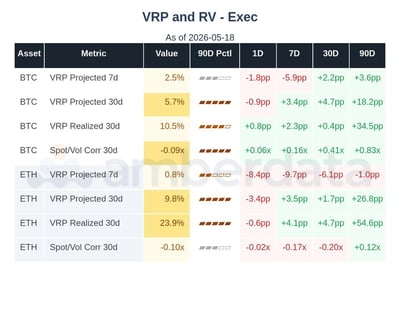
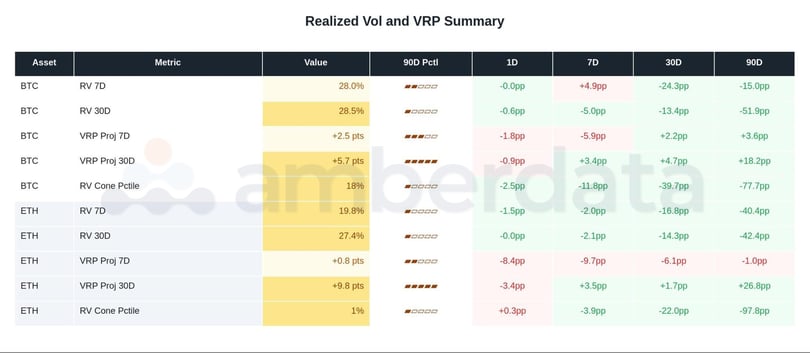
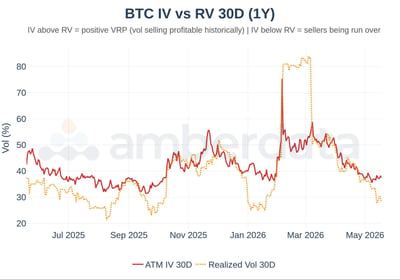
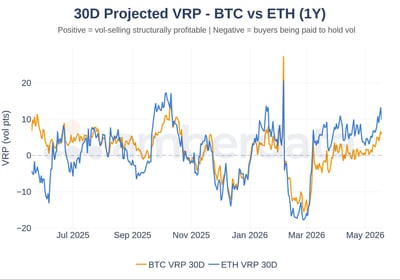
Projected 30D VRP sits near 90-day highs for both BTC (5.7 vol points, 99th percentile) and ETH (9.8, 94th). Realized 30D VRP runs at 10.5 and 23.9 (81st and 99th): IV has been rich vs delivered RV by historic margin. RV cone percentiles are at the floor (BTC 0th, ETH 1st of 5Y): not just quiet, but quiet relative to 5 years.
CHARTS
9. Term Structure and Forward Vol
|
KEY TAKEAWAYS |
|
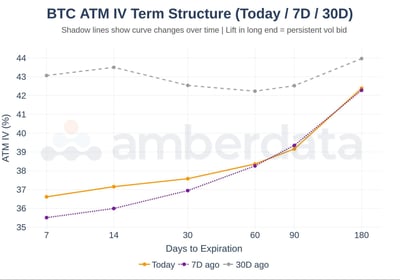
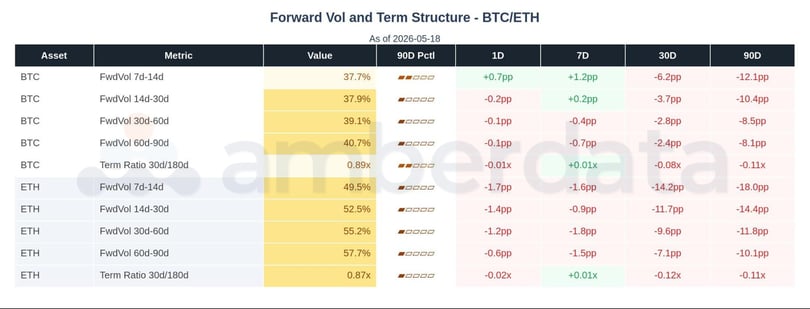
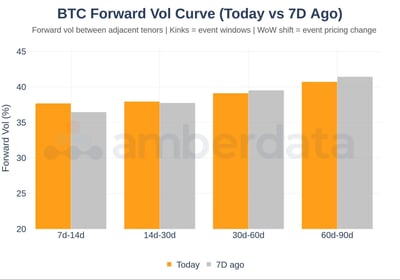
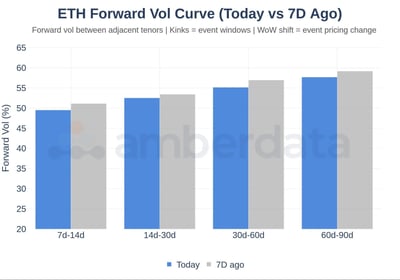
BTC and ETH term ratios at the 13th and 9th percentile (0.89 and 0.87) sit firmly in contango but flatter than typical: long-end relatively dearer than usual. Forward vol curves are flat across tenors: BTC 14d-30d at 37.9% (8th percentile) and ETH at 52.5% (90-day low). No event kink is being priced in the 14d-30d window despite FOMC minutes (May 20) and NVDA earnings landing this week.
CHARTS
10. Positioning and Basis
|
KEY TAKEAWAYS |
|
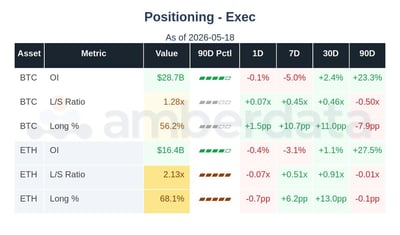
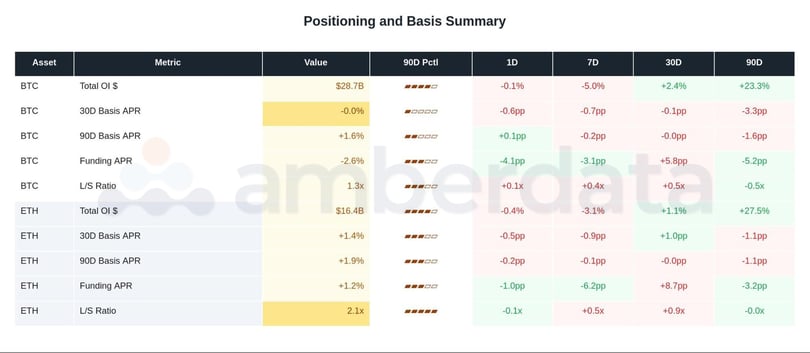
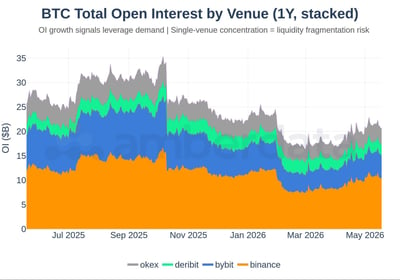
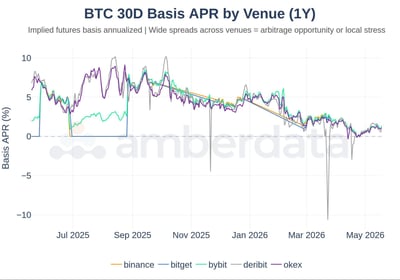
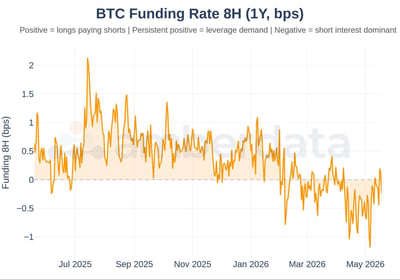
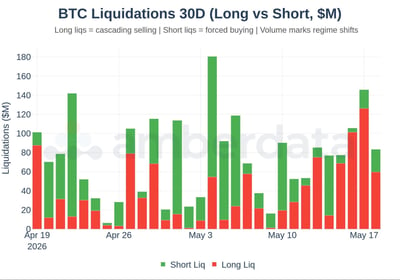
BTC OI at $28.7B (78th percentile) with L/S 1.28x (57th) and funding marginally negative: derivative positioning balanced. ETH OI at $16.4B (72nd) with L/S 2.13x (92nd, 90-day high) and longPct 68.1% (92nd): heavily crowded long. BTC 30D basis at -0.01% (3rd percentile) removes the delta-neutral carry bid. Long liquidations ran $59.7M vs $23.7M short on BTC (82nd percentile): longs taking the squeeze.
CHARTS
11. Dealer State
|
KEY TAKEAWAYS |
|
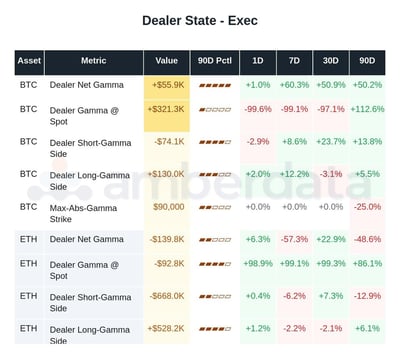
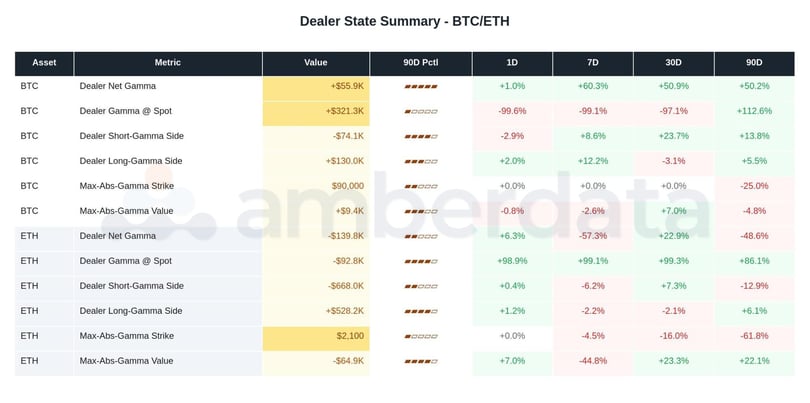
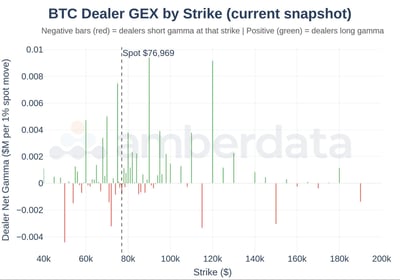
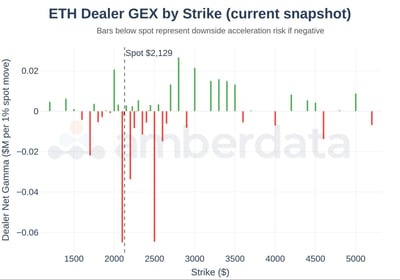
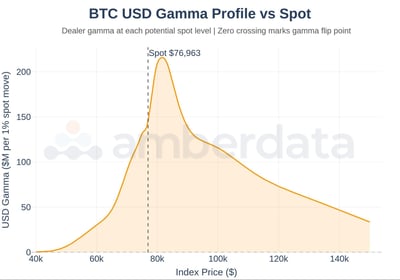
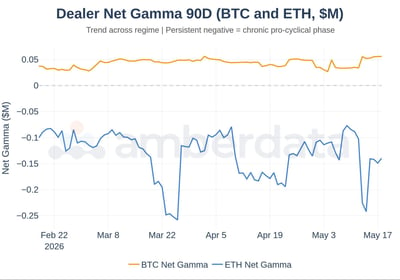
BTC dealer net gamma at +$55.9K per 1% spot move sits at the 99th percentile, placing BTC in a deep dampening regime: dealers sell rallies and buy selloffs. ETH net gamma at -$140K is the opposite: pro-cyclical. BTC gamma-at-spot at the 8th percentile means immediate hedging pressure is light; ETH at the 78th means it is heavy. ETH max abs strike at $2,100 (90-day low) marks where amplification kicks.
CHARTS
12. Flow Analysis
|
KEY TAKEAWAYS |
|
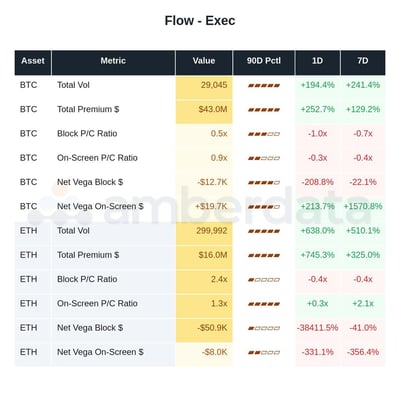
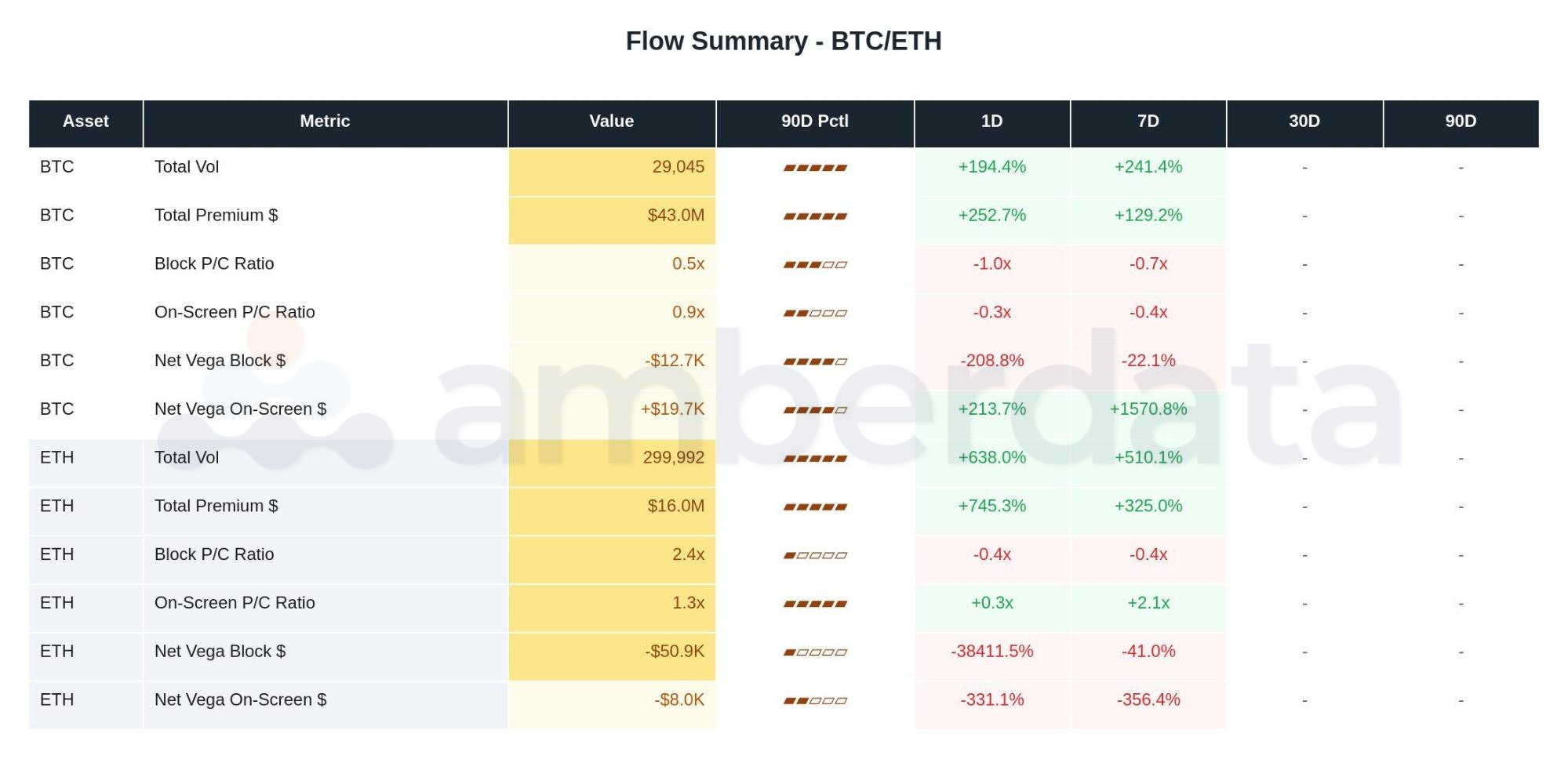
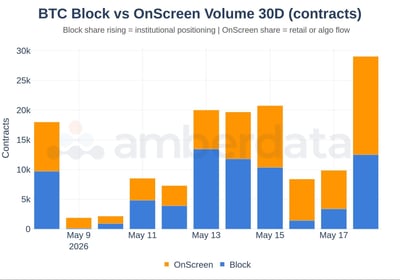
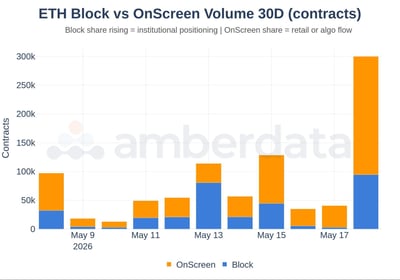
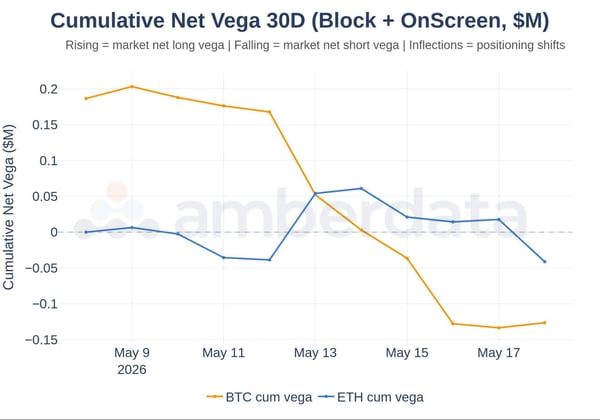
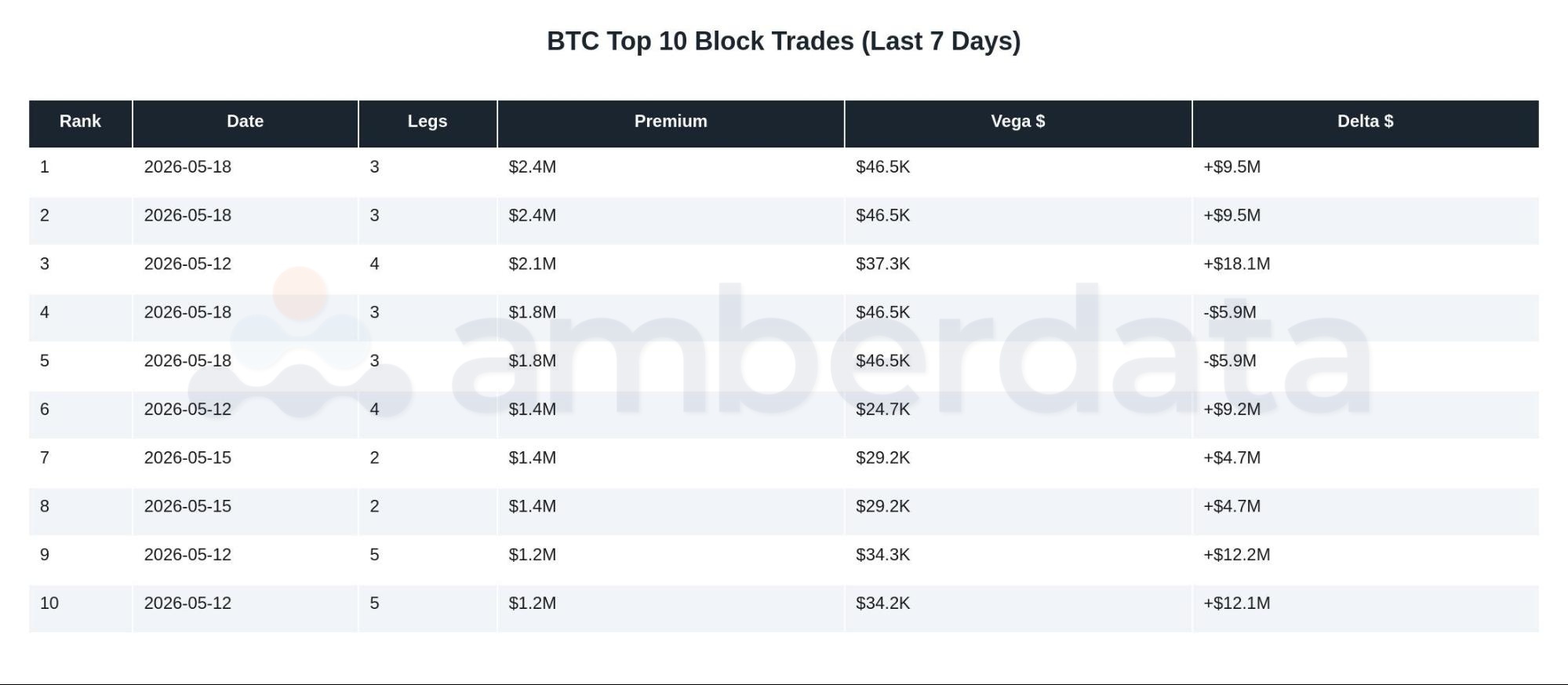
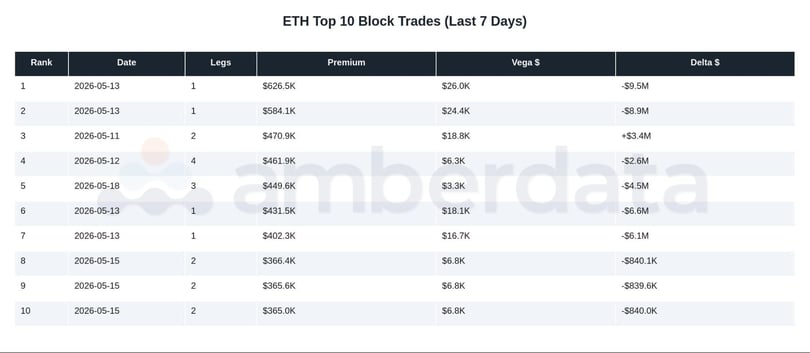
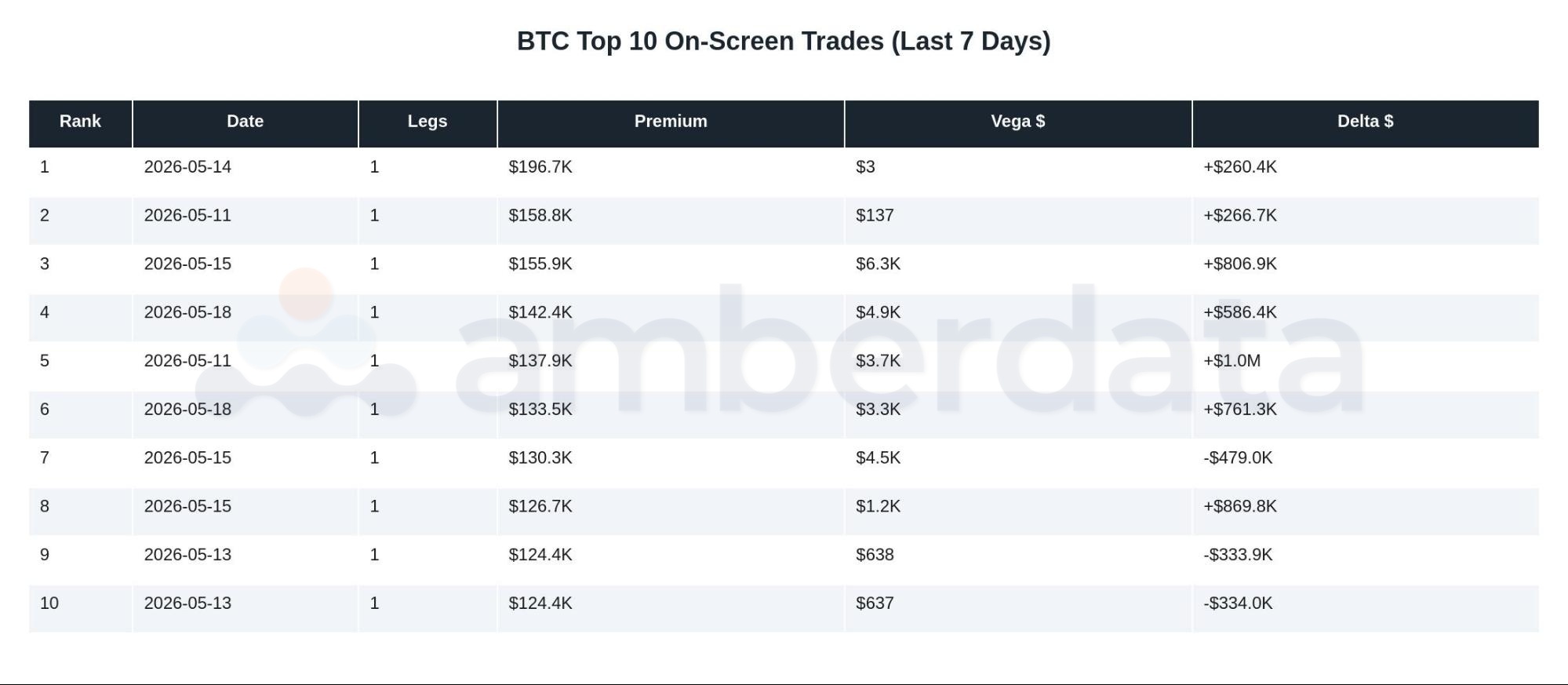
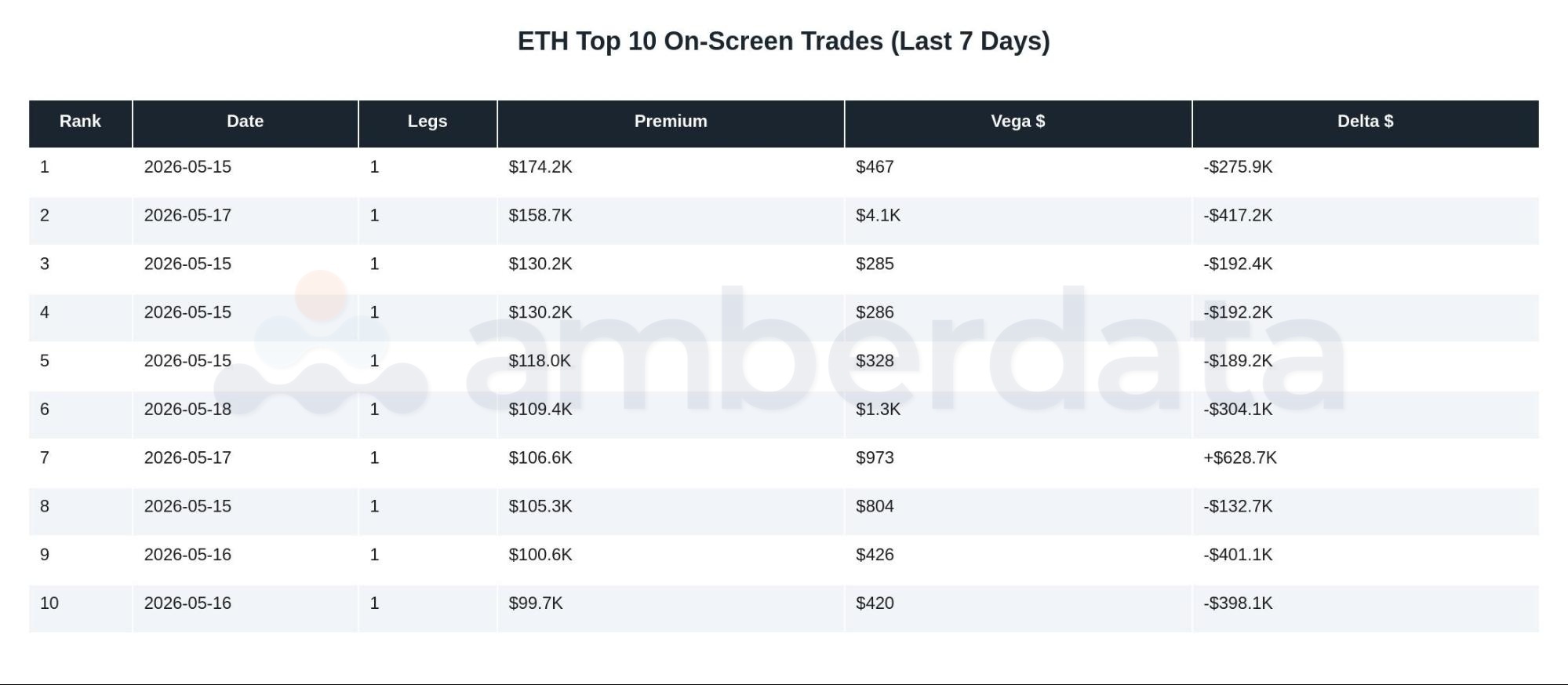
Daily option volumes spiked to the 100th percentile on both BTC (29K contracts, $43M premium) and ETH (300K, $16M premium): a coordinated positioning day. ETH block P/C at 2.45 sits at the 90-day high on put-skew; on-screen P/C at 1.28 also at the 100th. Block net vega at -$50.9K on ETH is at the 90-day low: maximum institutional vega-selling. BTC is the opposite: block P/C 0.48 (call-heavy).
CHARTS
DETAIL TABLES
13. Cross-Asset Volatility
|
KEY TAKEAWAYS |
|
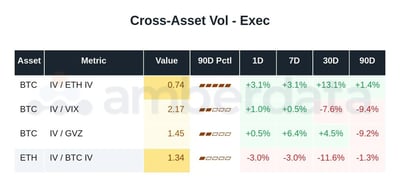
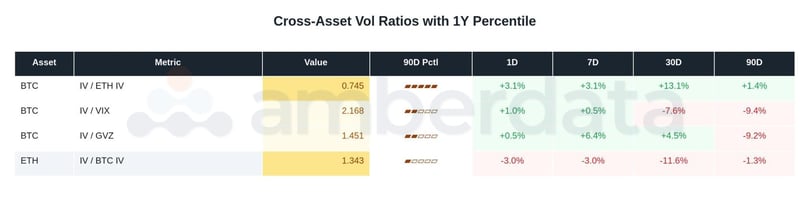
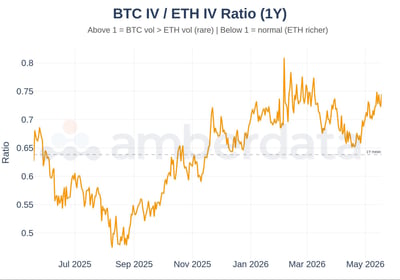
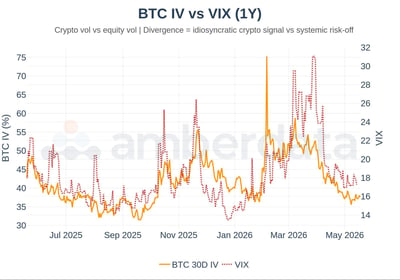
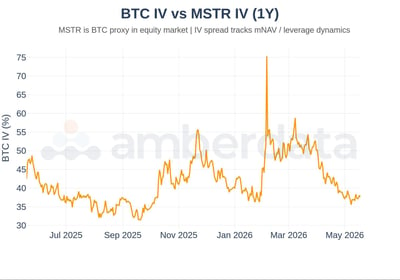
BTC IV at 37.6% against VIX at 17.26 puts the BTC/VIX ratio in typical range; ETH IV at 50.5% widens the spread but both crypto IVs are compressed in absolute terms. GVZ at 25.79 (92nd percentile) is the outlier: gold vol is bid while equity and crypto vol are not. The digital gold co-movement is absent this week; crypto compression and gold expansion run on different drivers.
CHARTS
14. Stablecoin Pulse
|
KEY TAKEAWAYS |
|
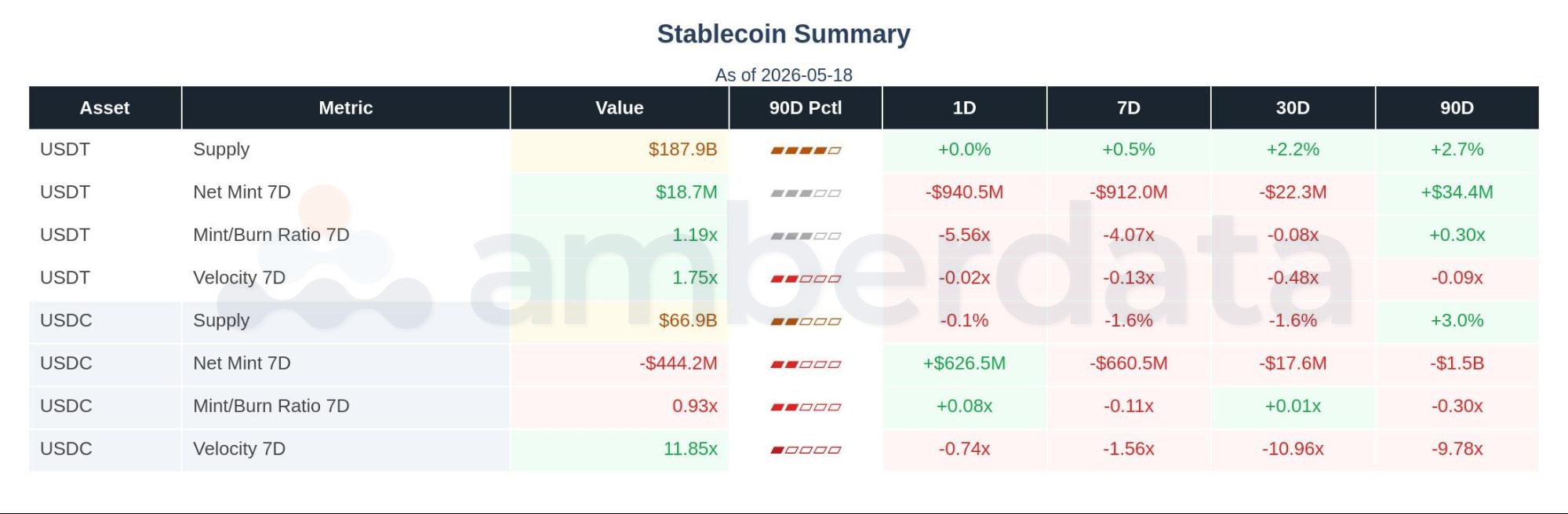
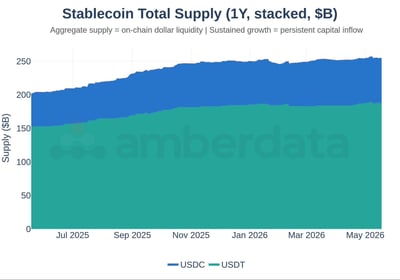
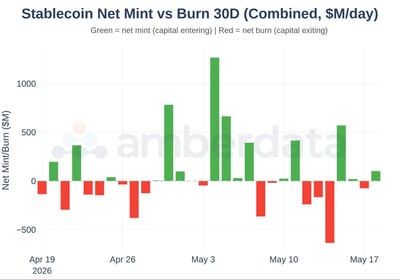
USDT supply hit a 90-day high at $187.9B (89th percentile) but velocity at 1.75x sits at the 25th: capital entering the on-ramp is sitting, not deploying. USDC contracted -$444M over 7 days (mint/burn 0.93x), with velocity at the 90-day low. The net is supply growing but transactional activity contracting: capital queued, not deployed.
CHARTS
Methodology
Universe. Options coverage focuses on BTC and ETH on Deribit, the dominant venue for institutional crypto options. Spot and derivatives reference data for the asset snapshot covers BTC, ETH, SOL, XRP, BNB, DOGE, AVAX, LINK, UNI, AAVE and WLFI across Binance, Bybit and OKX. Macro reference series include equity vol indices (VIX, VVIX, GVZ, MOVE), FX (DXY plus USD/JPY, EUR/USD, GBP/USD, USD/CNY), and US Treasury yields at the 2Y, 5Y, 10Y and 30Y tenors sourced from FRED. Stablecoin coverage focuses on USDT and USDC across Ethereum and the major chains.
Implied volatility. ATM IV pulled from Deribit's interpolated surface at 7, 14, 30, 60, 90 and 180-day tenors. IV Rank (IVR) measures the current value within the trailing 1-year [min, max] range, expressed as a percentage; an IVR of 100 means today's IV is at the 1-year high. IV Percentile (IVP) computes the rank of the current value within its trailing 365-day distribution. Both windows are 365 days unless stated otherwise.
Skew and risk reversals. 25-delta and 15-delta risk reversals (RR) are computed as call IV minus put IV at matched deltas across the relevant tenors. RR-to-ATM ratios contextualise wing premium against the at-the-money level. Butterflies (Fly) measure wing convexity as (call IV + put IV) / 2 minus ATM IV. Positive RR indicates calls are bid relative to puts (bullish skew); negative RR indicates put demand (downside hedging or bearish positioning).
Realized vol and VRP. Realized volatility is the annualised standard deviation of daily log returns scaled by sqrt(365). The 7-day and 30-day windows are reported, along with the 7D/30D ratio as a regime indicator. The variance risk premium (VRP) is computed two ways: projected (current IV minus subsequent realized, looking forward at 7-day and 30-day horizons) and realized 30D (trailing IV minus contemporaneous realized). Positive VRP indicates options are richly priced relative to realized; negative VRP indicates options are cheap. The RV cone places current realized vol in its 5-year percentile distribution at each days-to-expiration.
Term structure and forward vol. Term slope between two tenors is the percentage-point difference in their ATM IVs; positive slope indicates contango (front cheap, back rich). Forward vol between tenors T1 and T2 is derived from the variance-additivity identity: sqrt((T2 × IV_T2^2 - T1 × IV_T1^2) / (T2 - T1)). The report computes forward vol across four adjacent pairs (7d/14d, 14d/30d, 30d/60d, 60d/90d) so the expected vol path can be read across the curve. Sharp kinks often correspond to scheduled event windows (FOMC, CPI, expiries).
Positioning and basis. Open interest is sourced from each venue's derivatives feeds, aggregated across perpetuals and dated futures. Funding rate is sampled at the venue's native interval (typically 8 hours) and annualised to a funding APR; positive funding means longs are paying shorts (overlong positioning), negative funding means the reverse. Term basis (7D, 30D, 90D, 180D) is derived from the quarterly futures premium to spot, annualised. Term spread captures the slope across the front-month and back-month basis curves; flattening or inversion typically signals deleveraging or stress.
Dealer gamma. Dealer net gamma estimates the market maker's aggregate gamma exposure inferred from open interest and the assumed direction of client flow (block trades treated as primarily client-buy, on-screen flow probabilistically attributed). Positive dealer gamma implies dealers hedge counter-cyclically (selling rallies, buying dips), which dampens realized volatility. Negative gamma is pro-cyclical and amplifies moves. Gamma is reported in USD per 1% spot move. The report surfaces five metrics per asset: dealer net gamma total, gamma at spot, gamma at the max-absolute-value strike (the strike with the largest hedging requirement), and the long-side vs short-side split of dealer net gamma.
Options flow attribution. Trades are classified as block (negotiated, off-screen) or onScreen (executed on the order book). Buy/sell direction comes from the exchange's amberdataDirection field. Per-trade greeks (delta, vega, gamma) are aggregated to net positioning, with vega expressed as USD per 1% IV move and gamma as USD per 1% spot move. Put/Call ratios are computed by contract count, separately for block and on-screen, since the two channels reflect different participant types (institutional vs retail-leaning). Cumulative net vega and net gamma over 7-day and 30-day windows track the running positioning impulse.
Top trades. Top block and on-screen trades are ranked by USD premium paid per (date, asset, tradeType), showing the largest 10 of each channel over the trailing 7 days. Number of legs identifies single-leg vs structured trades; structures with 3 or more legs typically express vol or term-structure views rather than directional. Premium, Vega and Delta are shown for each trade in USD-equivalent units.
Cross-asset volatility. Crypto IVs are compared against equity vol (VIX), gold vol (GVZ), rates vol (MOVE), and vol-of-vol (VVIX). Ratios such as BTC IV / VIX or BTC IV / GVZ are tracked to identify relative pricing dislocations; when crypto vol is rich versus equity vol on a historical basis, it may indicate a regime change driven by crypto-specific factors rather than cross-asset spillover. BTC IV is scaled by 100 in these ratios so units are comparable to VIX/GVZ index levels.
Stablecoin pulse. Stablecoin supply, daily net mint/burn, and velocity are sourced from on-chain transfer data for USDT and USDC. The mint/burn ratio (7-day) measures expansion vs contraction; values above 1 indicate net minting (supply expanding), below 1 indicate net burning (supply contracting). Stablecoin supply trends serve as a leading indicator for risk-asset inflows since dollar-pegged supply must expand for new spot demand to be funded.
Macro reference and calendar. Equity volatility (VIX, VVIX), commodity vol (GVZ), rates vol (MOVE), US Treasury yields at 2Y/5Y/10Y/30Y, DXY and major FX pairs (USD/JPY, EUR/USD, GBP/USD, USD/CNY) sourced from end-of-day market-data feeds. The forward calendar (FOMC, CPI, payrolls, ECB meetings, token unlocks) is curated manually each week, with event-day windows highlighted in the report to provide context on positioning ahead of releases.
Polarity and percentile colouring. Every metric in the report carries a polarity flag describing whether higher values are positive, negative or neutral for the asset or market. Cells are coloured by combining polarity with the metric's 90-day percentile rank: bullish-polarity metrics tint green near the recent high and red near the recent low, bearish-polarity metrics invert the mapping, and neutral metrics tint amber throughout (deeper at the high and low extremes of the distribution). Shade intensity (light versus dark) scales with proximity to the distribution edge.
Refresh cadence. Reports build T+1 from end-of-day data. Options surfaces refresh daily; macro feeds refresh on their native cadence (intraday or daily). Source freshness is verified at build time and sections drawing on delayed upstream data carry an explicit "As of [date]" label in the panel title.
Full-Market Research. Institutional Depth.
Derivatives, ETFs, on-chain, DEXs, microstructure, risk signals, and more. Subscribe at the bottom of our page for research that covers every corner of crypto and visit the Amberdata Research Blog.
Access Amberdata Intelligence for institutional-grade digital asset intelligence, or contact our team to discuss custom solutions.
Links & Resources
Amberdata Research Library
https://www.amberdata.io/research-library
Amberdata Intelligence Platform
https://intelligence.amberdata.com
Amberdata Docs
Contact Us
https://www.amberdata.io/contact-us
Recent from Amberdata
• The Stress Test: ETF Cost Basis Part 3/3
• Who Breaks First: ETF Cost Basis Part 2/3
• The $80,000 Floor: ETF Cost Basis Part 1/3
• Bitcoin's Great Rotation: Who Bought the Dip and Why It Matters
• The Leverage Purge: Why the Market Is Healthier After $8.55B in Pain
• The ETF Exodus Decoded: Basis Arbitrage, Not Capitulation
• Coincidence or Signal? Did WLFI Telegraph Crypto's $6.93B Meltdown
• How $3.21B Vanished in 60 Seconds: October 2025 Crypto Crash Explained Through 7 Charts
• Five Signals of FOMC Impact: How Interest Rate Decisions Reshape Crypto Market Microstructure
• Beyond the Spread: Understanding Market Impact and Execution
Disclaimers
The information contained in this report is provided by Amberdata solely for educational and informational purposes. The contents of this report should not be construed as financial, investment, legal, tax, or any other form of professional advice. Amberdata does not provide personalized recommendations; any opinions or suggestions expressed in this report are for general informational purposes only.
Although Amberdata has made every effort to ensure the accuracy and completeness of the information provided, it cannot be held responsible for any errors, omissions, inaccuracies, or outdated information. Market conditions, regulations, and laws are subject to change, and readers should perform their own research and consult with a qualified professional before making any financial decisions or taking any actions based on the information provided in this report.
Past performance is not indicative of future results, and any investments discussed or mentioned in this report may not be suitable for all individuals or circumstances. Investing involves risks, and the value of investments can go up or down. Amberdata disclaims any liability for any loss or damage that may arise from the use of, or reliance on, the information contained in this report.
By accessing and using the information provided in this report, you agree to indemnify and hold harmless Amberdata, its affiliates, and their respective officers, directors, employees, and agents from and against any and all claims, losses, liabilities, damages, or expenses (including reasonable attorney's fees) arising from your use of or reliance on the information contained herein.
Copyright © 2026 Amberdata. All rights reserved.