


Share this blog:
.png)
How to Read Risk Reversal, Butterfly, and the Structural Sign of the Vol Surface
|
KEY TAKEAWAYS |
|
Equity skew is structurally negative; crypto skew is structurally positive. Equity index options have priced negative risk reversal (puts richer than calls) for 35 years, driven by pension funds, insurance companies, and structured products that buy downside protection. Crypto has flipped that sign for most of the past two years, driven by retail call buying, miner-side covered call selling, and yield-chasing structured products. Two participant mixes. Two structural signs. The same surface mechanic in mirror image. BTC 25-delta RR sits at -3.46 vol points, but at the 98th percentile of its 90-day distribution. The current reading is negative (puts bid), which reads as equity-like skew. The percentile context is the more important fact. Skew has been more negative for nearly every session in the trailing 90 days. Risk reversal is normalizing toward the structural positive baseline that has defined the regime for two years. The post-correction put bid is fading. Risk reversal is the truth serum of options markets. Headline narratives can deceive. Skew direction cannot. When OTM calls are bid above OTM puts at the same delta, the market is paying for upside. When OTM puts are bid, the market is paying for downside. RR strips out the narrative and shows you the actual flow that paid for protection. The level is regime. The trend is the trade. Wings are rich, body is compressed. BTC delta-25 fly normalised by ATM IV sits in the 90th percentile of its 90-day distribution. Tail-hedge demand has persisted even as ATM IV has compressed to the 12th percentile. The market is not paying up for body vol but is paying up for tail protection. That divergence is the signature of complacency on the median outcome combined with respect for the tail. |
This is the fourth piece in The Vol Stack, a 10-part series unpacking how to read crypto options markets layer by layer. Each piece anchors to live data from the Amberdata Options & Macro Weekly Report and Amberdata Intelligence.
Equity index options have priced negative risk reversal, stable, for 35 years. Crypto flipped that sign roughly two years ago and has run with positive skew most of the time since. This week BTC 25-delta RR sits at -3.46 vol points: negative, equity-like. The level reads like a regime change. The percentile reads like a regime that is recovering. The current value sits in the 98th percentile of its 90-day distribution. Skew has been more negative on almost every session over the trailing three months. Reading what that means requires understanding what the smile is for, what risk reversal measures, and why crypto's structural skew has the sign it does.
Two charts, two markets, opposite signs.
The single most striking visual in derivatives research is the side-by-side comparison of equity skew and crypto skew. Pull up a 1-year chart of SPX 25-delta risk reversal and a 1-year chart of BTC 25-delta risk reversal, place them next to each other, and the structural fact jumps off the page. SPX skew oscillates in negative territory, sometimes deeper, sometimes shallower, never crossing into positive for any sustained period. BTC skew has spent meaningful stretches of the past two years in positive territory, with sharp dips negative during corrections but a recurring tendency to return toward and above zero.
The structural sign is the marker. Equity skew has been structurally negative for 35 years. Crypto skew has been structurally positive for most of the past two. The two markets price the same mathematical object (an implied vol surface across strikes) with the same instruments (listed European options) and arrive at opposite structural conclusions. That outcome is not random and is not narrative-driven. It is mechanical, and the mechanism is participant mix.
This week's reading complicates the simple framing. BTC RR at -3.46 vol points is negative across all four tenors (7D, 30D, 60D, 90D). That looks like equity-style skew. But the 98th percentile placement of the 30D reading inside its own 90-day distribution tells the more important story. The structural positive bias has been temporarily inverted by the spot correction that ran through the recent window. The market paid up for downside during that move. The put bid is now fading. RR is recovering toward its structural zero, and beyond it is the historical positive regime that defines crypto's skew identity.
Why the smile exists.
Black-Scholes makes one assumption that the market has never agreed with. Volatility is treated as a single number applied uniformly across every strike. In the model, an OTM call 30% above spot and an OTM put 30% below spot trade at implied vols that are roughly equal. In the actual market, they almost never do.
The reason is structural. Real return distributions have fatter tails than the lognormal distribution that Black-Scholes assumes. Markets crash harder and rally faster than a normal distribution would predict. Option traders have known this for decades and have priced wing options accordingly. The vol smile is the market's correction to Black-Scholes. The smile says: vol at OTM strikes is higher than vol at ATM strikes because the tail risk is real.
The shape the smile takes is the second structural fact. In some markets the smile is symmetric: both wings bid roughly equally. In others, one wing is structurally bid more than the other. That asymmetry is the skew. A smile that leans toward the put wing is a market where downside is more bid than upside. A smile that leans toward the call wing is the reverse.
The instruments to measure this are simple. The 25-delta risk reversal is the call IV at the 25-delta strike minus the put IV at the same delta. Positive RR means calls are bid above puts. Negative RR means puts are bid above calls. The 25-delta butterfly is the average of the wings (call25 IV plus put25 IV) minus ATM IV, which measures how much vol is bid in the wings relative to the body. These two numbers describe most of what the smile is doing, and reading them together is the analytical move.
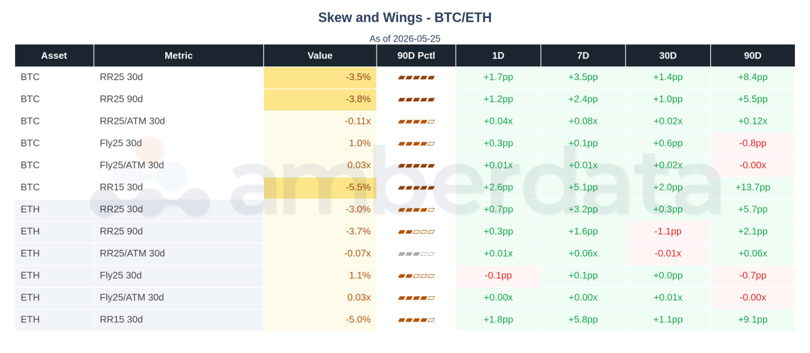
Figure 4.1: Skew and Wings. BTC and ETH delta-25 RR and Fly at 30D, with raw and ATM-normalised variants, plus delta-15 RR for the tail read. All in vol points. The percentile markers on each value matter more than the level.
Reading the risk reversal.
Risk reversal carries information at three resolutions: the level, the term structure, and the rate of change.
The level tells you the current state. Positive RR means OTM calls are bid above OTM puts. The market is paying more for upside protection than downside protection. Negative RR means the reverse. Zero means the wings are priced symmetrically, which is unusual in any market because participant mix is rarely balanced.
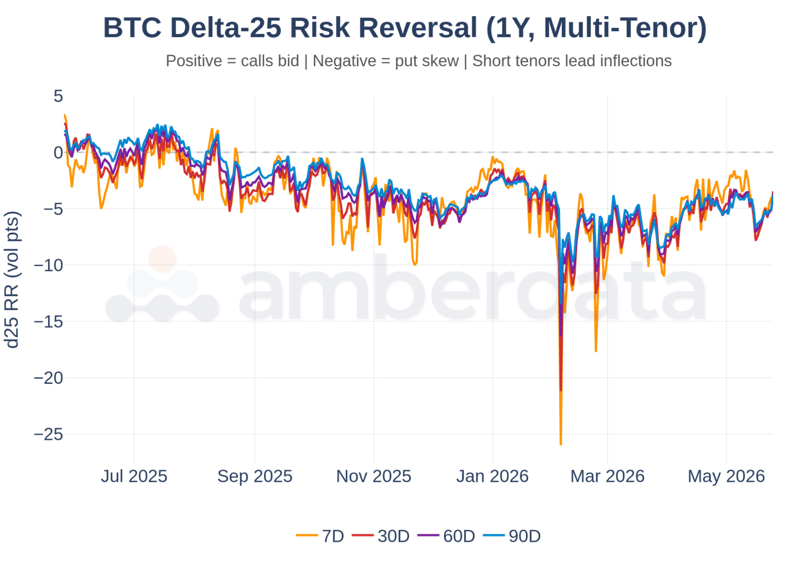
Figure 4.2: BTC delta-25 risk reversal at 7D, 30D, 60D, 90D tenors over 1 year. Each line is call25 IV minus put25 IV at that tenor, in vol points. Persistent positive readings across all four tenors mark the structural crypto regime. Persistent negative readings across all four mark the rare crash regimes.
This week's BTC RR is negative across the entire term structure: -4.15 at 7D, -3.46 at 30D, -3.71 at 60D, -3.79 at 90D. The negative readings across all four tenors mean the put bid is uniform, not isolated to the front end. That is the signature of a structural shift, not a tactical hedge.
But the percentile context flips the read. The 30D RR at the 98th percentile of its 90-day distribution means the put bid is weaker than nearly every session in the trailing window. The 60D at the 94th percentile and 90D at the 97th percentile say the same thing. Skew is uniformly less negative than its recent history. The structural positive bias is reasserting itself.
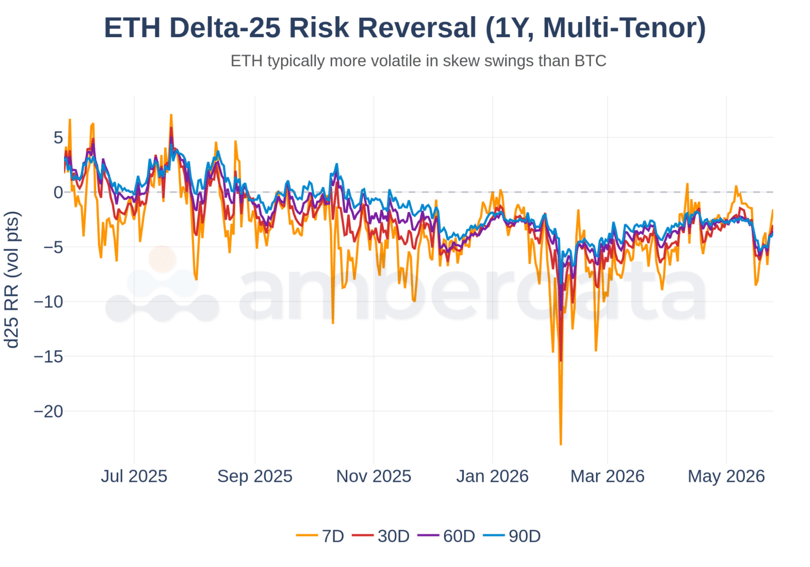
Figure 4.3: ETH delta-25 risk reversal at 7D, 30D, 60D, 90D tenors over 1 year. ETH skew is structurally more volatile than BTC skew (thinner option book, broader catalyst set). ETH 7D RR often leads BTC RR by 1 to 2 days on regime inflections.
ETH skew tells a parallel but slightly different story. ETH 25-delta RR is -3.01 at 30D and -1.57 at 7D. The 7D reading is materially less negative than the longer tenors and sits in the 82nd percentile of its own 90-day distribution. ETH's front-end skew is leading the normalization. That lead-lag relationship has been a reliable feature of the crypto skew complex: ETH RR turns first on directional regime changes, and BTC RR follows inside a few sessions.
Equity skew vs crypto skew.
The structural sign of skew is set by participant mix, not by market direction. This is the post's central observation, and it is the answer to why equity and crypto trade with opposite signs on the same instrument.
Equity index options live inside an institutional ecosystem that is structurally short downside. Pension funds run liability-driven strategies that require equity exposure but need to cap drawdown. Insurance companies write variable annuity products that promise principal protection and have to hedge that promise. Structured product issuers create autocallable notes that embed put-selling and need to lay off the tail risk. Together, these three buyer classes generate persistent demand for OTM puts. The put bid is structural and price-insensitive. The result is the 35-year track record of negative SPX risk reversal.
Equity index options have had structural negative skew for 35 years. Crypto flipped that sign. The skew tells you the participant mix.
Crypto options live inside a different ecosystem. Retail call buying is a recurring source of demand: when spot rallies, OTM calls get bid because retail wants leveraged upside. Miner-side covered call selling generates persistent OTM call supply at one set of strikes but the residual demand keeps the call wing bid at others. Yield-enhancement structured products built on selling puts and buying calls reinforce the asymmetry. Together, these three flows generate persistent OTM call demand and put supply, which is the opposite of the equity participant mix.
The mathematical instrument is identical. The 25-delta risk reversal in SPX and the 25-delta risk reversal in BTC compute the same way. The opposite signs come from opposite participant mixes flowing through the same calculation. Reading skew correctly means reading the participant mix that the level implies. The headline narrative about why a market is up or down does not change skew. The flow that pays for protection changes skew. That is the analytical separation that makes RR informative.
Wings and the tails.
Risk reversal measures the directional asymmetry of the smile. The butterfly measures the kurtosis. Together they describe most of the shape.
The 25-delta butterfly is the average of the wings (25-delta call IV plus 25-delta put IV) minus ATM IV. When fly is high, the wings are bid relative to the body. When fly is low, the wings are cheap relative to the body. Cross-regime comparison requires normalising fly by ATM IV, since a 1 vol point fly in a 50% ATM regime is half as significant as the same 1 vol point fly in a 25% ATM regime. The ratio puts both on the same scale.
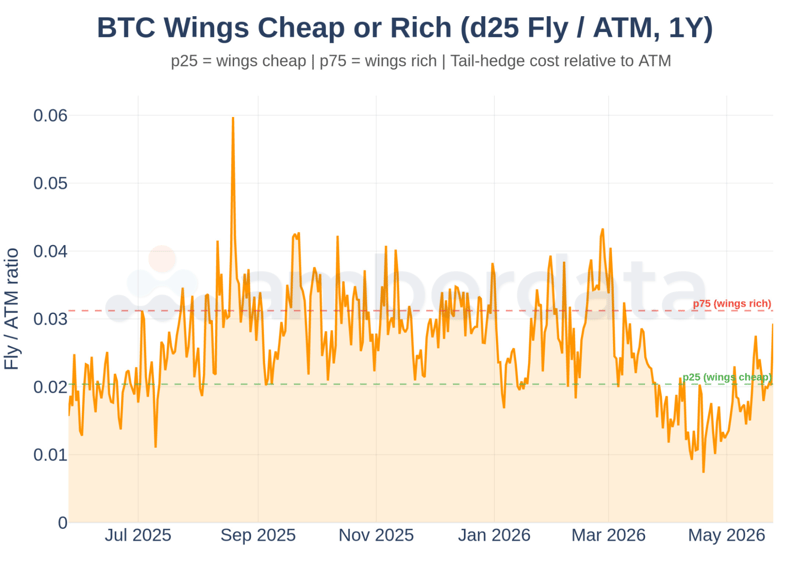
Figure 4.4: BTC delta-25 fly normalised by ATM IV at 30D over 1 year, with p25 and p75 reference bands. Below p25 indicates wings are cheap relative to 1Y range (entry for long tails). Above p75 indicates wings are rich (exit for long tails or harvest premium).
This week's BTC reading is 0.029, which places fly/ATM in the 90th percentile of its 90-day distribution. The wings are bid relative to the body. The detail that makes this informative is the cross-reference. ATM IV is at the 12th percentile (Post 3 anchor). Body vol is compressed. Wing vol is not.
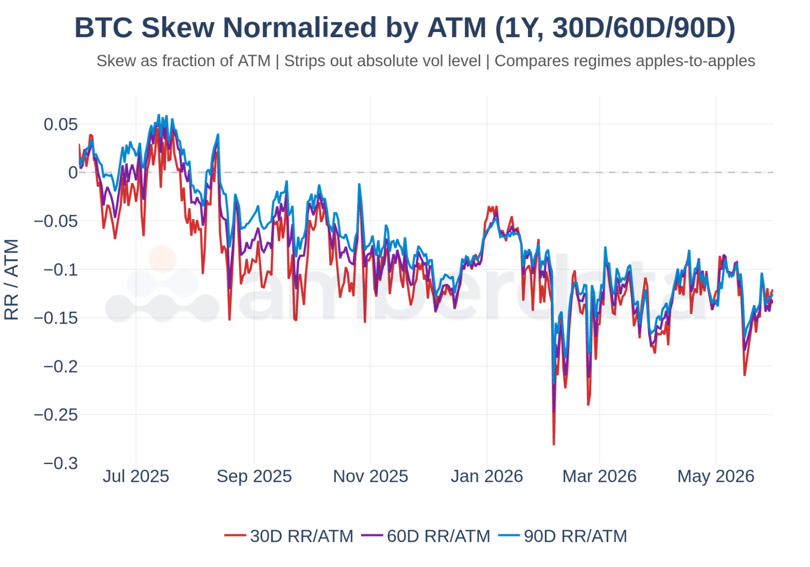
Figure 4.5: BTC delta-25 RR divided by ATM IV at 30D, 60D, 90D tenors over 1 year. Normalised skew strips out the absolute vol regime so the structural sign is visible across high-vol and low-vol periods.
The combination is informative. Compressed body vol with elevated wing vol is the signature of a market that thinks the modal outcome is calm but respects the tail. The participants have stopped paying up for vol on the median path but are still paying up for vol on the extremes. That is not complacency, and it is not panic. It is a market that has differentiated between the expected and the possible.
BTC vs ETH.
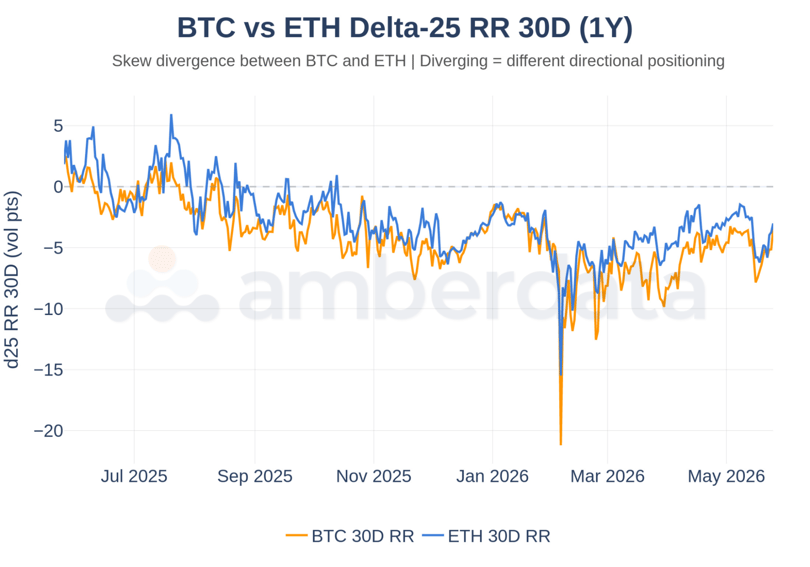
Figure 4.6: BTC and ETH 30D delta-25 RR overlaid over 1 year, both in vol points. The spread between them is itself a tradeable cross-asset skew position. ETH leads on regime exits, BTC leads on regime entries.
The BTC versus ETH risk reversal comparison is the cross-asset skew read. Both 30D readings sit in negative territory this week (BTC at -3.46, ETH at -3.01), with ETH about 45 basis points less negative than BTC. The structural pattern has ETH RR more sensitive than BTC RR on inflections because ETH has the thinner option book and the broader catalyst set. When the crypto-wide skew normalizes from a correction, ETH typically turns first, then BTC follows inside a few sessions.
This week the leadership shows in the 7D readings. ETH 7D RR at -1.57 is materially less negative than BTC 7D RR at -4.15. The ETH front-end is already close to neutral. If the historical pattern holds, BTC front-end RR follows ETH front-end RR by 1 to 3 sessions, and the skew normalization completes inside the next week or two. The spread between BTC and ETH RR at the 7D tenor is the cleanest single number for tracking whether the regime normalization is broad-based or asset-specific.
98
BTC 25-delta risk reversal sits in the 98th percentile of its 90-day distribution. The level is still negative at -3.46 vol points, but the put bid is weaker than nearly every session in the trailing window. The structural positive-skew regime is reasserting itself after the recent correction.
Reading today.
Synthesis. The skew read this week is structurally informative.
The level says equity-like skew. BTC 25-delta RR is -3.46 vol points and uniformly negative across the 7D to 90D term structure. The reading 30 days ago was less negative; the put bid has built modestly over the trailing month and is now in the process of fading.
The percentile says structural normalization. BTC 30D RR at the 98th percentile of its 90-day distribution means the current level is the least negative the skew has been in three months. The 60D and 90D tenors print at the 94th and 97th percentiles. The crypto skew complex is rebuilding toward zero, and the structural positive-skew regime that has defined the last two years is reasserting itself.
The skew is the truth serum. Headline narratives can deceive. Skew direction cannot.
The wings tell a complementary story. Fly/ATM at the 90th percentile with ATM at the 12th percentile means the body is compressed while the wings are bid. That is a market expecting calm on the median outcome but respecting the tail. The combination is consistent with the spot read from Post 2: the recent correction is behind us, vol has compressed, but the market is not paying up only for body-pinned outcomes.
What comes next in The Vol Stack.
This was the skew layer of the stack. Risk reversal across tenors, butterfly across regimes, the structural participant-mix argument, and the cross-asset BTC versus ETH read. Post 1 established the macro regime. Post 2 established the spot kinetic state. Post 3 established the IV level, rank, and shape. Post 4 has established the smile.
Post 5 moves to the variance risk premium: the gap between implied vol and subsequent realized vol, the structural edge of vol selling, and the conditions under which that edge inverts. Skew tells you what the market expects. The variance risk premium tells you whether the market is right. The framework starts paying for itself in Post 5.
Next in The Vol Stack: The Vol Premium: Where the Edge Lives.
|
THE BOTTOM LINE |
|
The skew read this week is BTC 25-delta RR at -3.46 vol points, negative on the level but at the 98th percentile of its 90-day distribution. The put bid that built during the recent correction is fading, and the structural positive-skew regime that has defined crypto for the past two years is reasserting itself. ETH skew is leading the normalization, with the 7D ETH RR already close to neutral at -1.57 vol points. The wings tell a complementary story: fly/ATM at the 90th percentile with ATM IV at the 12th percentile means the body is compressed while the wings are bid. The market expects calm on the median outcome while respecting the tail. The structural fact remains: equity index skew has been negative for 35 years, crypto skew has flipped that sign for most of the past two, and the difference is participant mix, not narrative. |
Full-Market Research. Institutional Depth.
Derivatives, ETFs, on-chain, DEXs, microstructure, risk signals, and more. Subscribe at the bottom of our page for research that covers every corner of crypto and visit the Amberdata Research Blog.
Access Amberdata Intelligence for institutional-grade digital asset intelligence, or contact our team to discuss custom solutions.
Links & Resources
Amberdata Research Library
https://www.amberdata.io/research-library
Amberdata Intelligence Platform
https://intelligence.amberdata.com
Amberdata Docs
Contact Us
https://www.amberdata.io/contact-us
Recent from Amberdata
• The Vol Stack #3: Implied Volatility: Reading the Market's Forecast
• The Vol Stack #2: Spot, Leadership, and How Realized Vol Tells the Story First
• The Vol Stack #1: The Macro Vol Regime and Why Crypto Is Never an Island
• The Stress Test: ETF Cost Basis Part 3/3
• Who Breaks First: ETF Cost Basis Part 2/3
• The $80,000 Floor: ETF Cost Basis Part 1/3
• Bitcoin's Great Rotation: Who Bought the Dip and Why It Matters
• The Leverage Purge: Why the Market Is Healthier After $8.55B in Pain
• The ETF Exodus Decoded: Basis Arbitrage, Not Capitulation
• Coincidence or Signal? Did WLFI Telegraph Crypto's $6.93B Meltdown
Disclaimers
The information contained in this report is provided by Amberdata solely for educational and informational purposes. The contents of this report should not be construed as financial, investment, legal, tax, or any other form of professional advice. Amberdata does not provide personalized recommendations; any opinions or suggestions expressed in this report are for general informational purposes only.
Although Amberdata has made every effort to ensure the accuracy and completeness of the information provided, it cannot be held responsible for any errors, omissions, inaccuracies, or outdated information. Market conditions, regulations, and laws are subject to change, and readers should perform their own research and consult with a qualified professional before making any financial decisions or taking any actions based on the information provided in this report.
Past performance is not indicative of future results, and any investments discussed or mentioned in this report may not be suitable for all individuals or circumstances. Investing involves risks, and the value of investments can go up or down. Amberdata disclaims any liability for any loss or damage that may arise from the use of, or reliance on, the information contained in this report.
By accessing and using the information provided in this report, you agree to indemnify and hold harmless Amberdata, its affiliates, and their respective officers, directors, employees, and agents from and against any and all claims, losses, liabilities, damages, or expenses (including reasonable attorney's fees) arising from your use of or reliance on the information contained herein.
Copyright © 2026 Amberdata. All rights reserved.