


Share this blog:
$8.55 billion liquidated in 57 days. Over two-thirds - $6.08 billion - came from longs. The market was crowded on one side, and when the price turned, the unwind was violent.
October 10 was the breaking point. $2.28 billion was wiped out in a single day as cascading liquidations triggered more liquidations. Overleveraged bulls who had chased the rally to $125,000 got margin called on the way /down. Price fell from $117,125 to $88,575 - a 24.4% drawdown that erased months of gains in weeks.
The prevailing interpretation: the bull market is over.
The derivatives data tells a different story. This was a leverage flush, not a sentiment shift. And the market that emerges is structurally healthier than the one that entered October.
The Positioning Problem
The long/short liquidation ratio reveals what happened. At 71% long versus 29% short, the market was decisively offside heading into the correction. Traders had levered up, expecting continuation. They got a flush instead.
The cascade mechanism is self-reinforcing. When the price drops, leveraged longs breach the maintenance margin. Exchange liquidation engines execute market sell orders. Those sells push prices lower, triggering more margin breaches, creating more forced selling. The loop feeds itself until leverage is exhausted or price finds buyers.
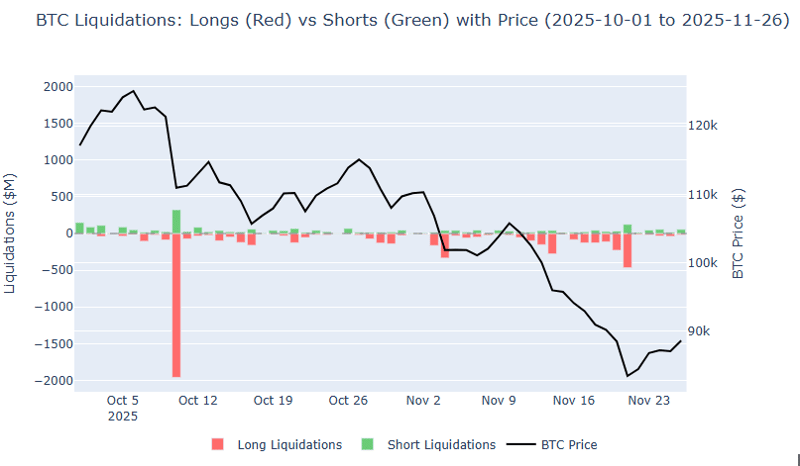
The October 10 spike wasn't organic distribution - it was mechanical. Margin calls are hitting stop losses, hitting margin calls. Price overshoots fundamentals during these events, creating dislocation between where the market trades and where it should trade.
The Liquidation Timeline
The cascade unfolded in waves rather than a single event. Three distinct phases emerge from the data.
Phase 1: The Initial Break (October 6-12). Price cracked from its $125,000 peak, and liquidations spiked immediately. Long liquidations dominated at 85%+ on peak days as traders who had levered up near the top got stopped out in rapid succession. Damage: ~$3.8B.
Phase 2: The Grind (October 13 - November 10). Liquidations moderated but remained elevated at $100-300M daily. More balanced long/short liquidations as initial positioning cleared. Damage: ~$2.9B.
Phase 3: The Aftershock (November 11-26). Secondary spike as price broke below $90,000. By late November, daily liquidations normalized below $50M. Damage: ~$1.9B. The flush was complete.
At peak, daily liquidations reached 2.1% of total open interest - 1 in 50 dollars of positioning liquidated in a single day. When intensity normalized below 0.3%, the cascade was effectively over.
The Derivatives Reset
With the cascade finished, three metrics confirm normalization.
Open interest dropped from $10.05B to $6.99B - a 30.5% reduction. The deleveraging was broad-based across Binance (-$1.25B), Bybit (-$1.24B), and OKX (-$0.61B).
Funding rates collapsed from elevated levels to near zero. Before the correction, funding ran persistently positive - longs paying shorts, signaling crowded positioning. After the flush, neutral funding indicates balanced markets.
The 30-day annualized basis fell from 6.63% to 4.47% - below the 5% breakeven threshold for carry trades. When the basis drops below the cost of capital, arbitrageurs unwind. Current basis sits at the 21st percentile of the past 91 days.
The structure is less fragile. Lower OI means smaller cascade risk. Neutral funding means no crowded trade to unwind. Compressed basis means arbitrage flows have cleared.
The Stablecoin Counter-Signal
While $8.55B in leveraged positions got wiped, stablecoin supply grew from $264.2B to $269.5B - a $5.3B addition. Capital didn't flee the ecosystem. It rotated to safety.
Stablecoins function as crypto's waiting room. The last four weeks showed +$1.32B in net inflows - accelerating after the initial shock. Dry powder sits at a record $269.5B. When confidence returns, this capital has to go somewhere.
The Complete Analysis
The full report includes:
- Liquidation Timeline: Phase-by-phase breakdown with daily granularity and intensity metrics
- Cascade Mechanics: How the feedback loop creates non-linear acceleration
- Derivatives Reset: OI by exchange, funding normalization, and basis term structure
- Basis Trade Explained: Why the 5% threshold matters and the connection to ETF flows
- Stablecoin Flows: Mint/burn dynamics, chain distribution, and the dry powder thesis
- Forward Signals: Bullish and bearish triggers with specific levels to monitor
Three Signals to Watch
<$50M Daily Liquidations - Normalized volume indicating cascade completion. Spikes above $200M signal renewed stress.
~0% Funding Rate - Neutral positioning with no crowded trade. Persistently positive rates signal fragility rebuilding; deeply negative rates indicate squeeze risk.
$269.5B Stablecoin Supply - Record dry powder. Watch for supply declining while price rises - capital rotating back into risk.
Full-Market Research. Institutional Depth. Derivatives, ETFs, on-chain, DEXs, microstructure, risk signals - and more. Subscribe below for weekly research that covers every corner of crypto.

Links & Resources
For more crypto market microstructure analysis, visit the Amberdata Research Blog. Access Amberdata Intelligence for institutional-grade digital asset intelligence powering actionable insights across blockchain and market data, or contact our team to discuss custom solutions for your risk management strategy.
Amberdata Research Library
https://www.amberdata.io/research-library
Amberdata Intelligence Platform
Amberdata Docs
Contact Us
https://www.amberdata.io/contact-us
Recent from Amberdata
- The ETF Exodus Decoded: Basis Arbitrage, Not Capitulation
- Coincidence or Signal? Did WLFI Telegraph Crypto's $6.93B Meltdown
- How $3.21B Vanished in 60 Seconds: October 2025 Crypto Crash Explained Through 7 Charts
- Five Signals of FOMC Impact: How Interest Rate Decisions Reshape Crypto Market Microstructure
- Beyond the Spread - Understanding Market Impact and Execution
- The Rhythm of Liquidity - Temporal Patterns in Market Depth
- DeFi Activity, Stablecoins, and the Impact on Price Volatility: Part 1
- DeFi Activity, Stablecoins, and the Impact on Price Volatility: Part 2
- DeFi Activity, Stablecoins, and the Impact on Price Volatility: Part 3
- How Do On-Chain Metrics Explain Bitcoin Volatility? Part 1
- How Do On-Chain Metrics Explain Bitcoin Volatility? Part 2
- Amberdata 2024 Digital Asset Market Intelligence Report: Exchanges & Derivatives
- Crypto Pairs Trading: Part 1 — Foundations of Moving Beyond Correlation
- Crypto Pairs Trading: Part 2 — Verifying Mean Reversion with ADF and Hurst Tests
- Crypto Pairs Trading: Part 3 — Constructing Your Strategy with Logs, Hedge Ratios, and Z-Scores
- Crypto Pairs Trading: Part 4 — Empirical Results & Performance Analysis
Disclaimers
The information contained in this report is provided by Amberdata solely for educational and informational purposes. The contents of this report should not be construed as financial, investment, legal, tax, or any other form of professional advice. Amberdata does not provide personalized recommendations; any opinions or suggestions expressed in this report are for general informational purposes only.
Although Amberdata has made every effort to ensure the accuracy and completeness of the information provided, it cannot be held responsible for any errors, omissions, inaccuracies, or outdated information. Market conditions, regulations, and laws are subject to change, and readers should perform their own research and consult with a qualified professional before making any financial decisions or taking any actions based on the information provided in this report.
Past performance is not indicative of future results, and any investments discussed or mentioned in this report may not be suitable for all individuals or circumstances. Investing involves risks, and the value of investments can go up or down. Amberdata disclaims any liability for any loss or damage that may arise from the use of, or reliance on, the information contained in this report.
By accessing and using the information provided in this report, you agree to indemnify and hold harmless Amberdata, its affiliates, and their respective officers, directors, employees, and agents from and against any and all claims, losses, liabilities, damages, or expenses (including reasonable attorney’s fees) arising from your use of or reliance on the information contained herein.
Copyright © 2025 Amberdata. All rights reserved.