


Share this blog:

BTC Institutional flows have replaced halving as the dominant price driver - here's what that means.
|
BTC KEY TAKEAWAYS |
|---|
|
For a decade, Bitcoin's price followed a four-year halving cycle with religious predictability. The supply shock of each halving - block rewards cut in half - created bull markets that peaked roughly 12-18 months later. The 2012 halving preceded the run to $1,000. The 2016 halving preceded the run to $20,000. The 2020 halving preceded the run to $69,000. Traders built entire strategies around this cycle. Institutions timed entries to post-halving windows. The halving was the fundamental driver of Bitcoin's long-term price appreciation, and anyone who understood this simple fact outperformed those who didn't.
In 2025, that paradigm broke. The mathematics changed fundamentally, and the old models stopped working.
12x
ETF daily flows vs daily mining supply. The halving reduced new supply by $40M/day. ETFs routinely move $500M+ daily.
ETF flows now move more capital in a month than miners produce in a year. The April 2024 halving reduced new supply by approximately 450 BTC per day - roughly $40 million at current prices. This sounds significant until you compare it to ETF flows. In 2025, ETFs routinely saw daily flows of $500 million or more. On peak days, ETF inflows topped $1 billion, equivalent to 25 days of mining supply absorbed in 24 hours.
The mathematics are unambiguous: institutional flows have superseded mining supply as the marginal price driver. When ETFs are buying, prices rise regardless of mining output. When ETFs are selling, prices fall regardless of the halving's supply constraint. The halving cycle is over. The institutional flow cycle has begun.
This article synthesizes the full Amberdata Crypto Market Review 2025 analysis into a 2026 outlook: the current market setup, scenario analysis with probability-weighted outcomes, the watchlist indicators that will signal regime changes, and the catalysts that could accelerate or derail each scenario.
As context for this outlook, the full Amberdata Crypto Market Review 2025 and 2026 Outlook identifies six distinct market regimes:
- Regime 1: Policy Euphoria (Jan-Feb) - Post-election rally, regulatory optimism
- Regime 2: Security Shock (Feb-Mar) - Bybit hack, confidence crisis
- Regime 3: Infrastructure Build (Mar-Jul) - Quiet accumulation, regulatory progress
- Regime 4: Institutional Expansion (Jul-Oct) - ETF inflows surge, rally to highs
- Regime 5: Macro Shock (Oct) - Tariff headlines, liquidation cascade
- Regime 6: Fragile Recovery (Nov-Dec) - De-risked but impaired liquidity
The year's arc, from euphoria through crisis to fragile equilibrium, sets the stage for 2026.
Current Setup: De-Risked but Fragile
Bitcoin enters 2026 in a peculiar state: de-risked by October's leverage purge but still showing signs of structural fragility. The market has corrected from Regime 4's euphoric highs, leverage has been flushed from the system, and valuations have reset to more sustainable levels. But the recovery remains tentative, with liquidity impaired and the carry trade unattractive. Understanding this setup is essential for positioning in the year ahead.
The October correction wasn't a random event - it was a necessary reset. Open interest had reached unsustainable levels. The basis trade was overcrowded. Funding rates signaled excessive leverage. When the tariff headlines hit, the overleveraged market couldn't absorb the selling pressure. The cascade that followed, detailed in Section 7, purged weak hands and reset positioning. What emerged is a market that's healthier structurally but waiting for direction.
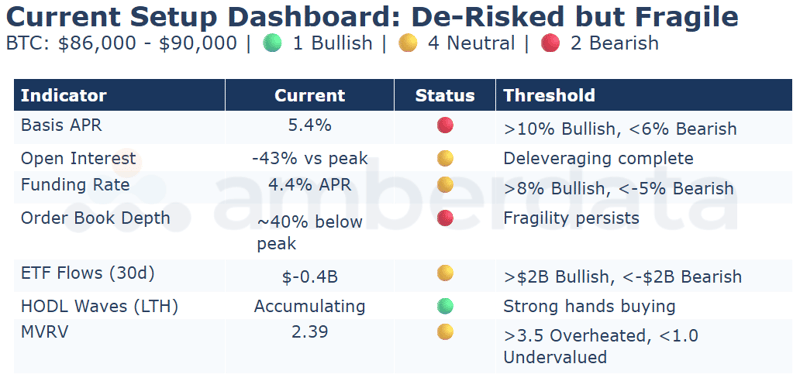
Figure 14.1: Current Setup Dashboard - Note the basis APR compression below 6% (carry trade dead) while HODL waves show accumulation (strong hands buying). This divergence is the setup.
Key Indicator Status:
Basis APR: Compressed below 6% - carry trade unattractive, leverage demand subdued
Open Interest: Down significantly from September peaks - deleveraging complete
Funding Rates: Oscillating around neutral - no directional conviction
Order Book Depth: Impaired, ~40% below pre-crash levels - fragility persists
ETF Flows: Volatile, neither consistently positive nor negative - institutional uncertainty
HODL Waves: Long-term holders accumulating - strong hands buying weakness
MVRV: Below 3.0, not euphoric - room to run before overvaluation
|
SO WHAT? The market is coiled but not ready to spring. Strong hands are accumulating while speculative capital waits on the sidelines. The carry trade that powered 2025's rally (basis APR >15%) is absent. Until it returns, expect range-bound price action. The catalyst will likely be external: Fed cuts, 401(k) launches, or a macro risk-on shift. |
The Flow Cycle: Why the Halving No Longer Matters
The April 2024 halving reduced Bitcoin's daily new supply from approximately 900 BTC to 450 BTC - roughly $40 million per day at $90,000 prices. This was historically significant: previous halvings created supply shocks that took months to absorb, driving prices higher as demand exceeded new supply.
But ETFs changed the calculus entirely. In 2025, ETF daily flows regularly exceeded $500 million - more than 12x the daily mining supply. On peak days, ETF inflows topped $1 billion. The marginal price driver is no longer the trickle of new mining supply but the tsunami of institutional flows. When ETFs are buying, prices rise regardless of mining output. When ETFs are selling, prices fall regardless of the halving's supply constraint.
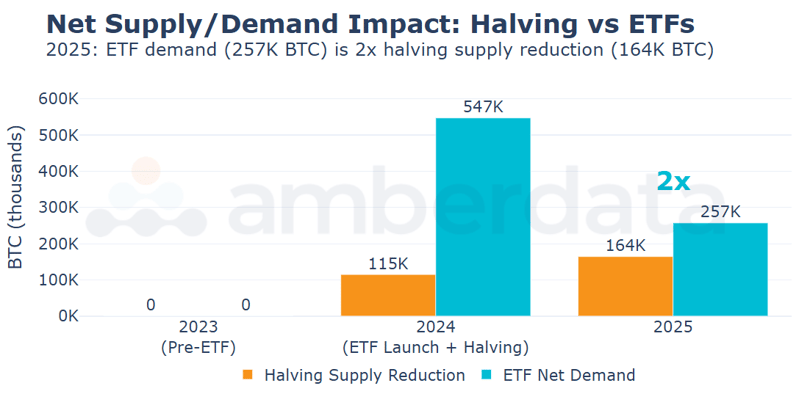 Figure 14.2: Net Supply/Demand Impact. ETF demand is 2x the halving's supply reduction. The flow cycle has replaced the halving cycle.
On peak days, ETF inflows topped $1 billion - equivalent to 25 days of mining supply absorbed in 24 hours.
New Cycle Drivers: The new cycle drivers operate on different timescales than the four-year halving rhythm:
Fed Policy: Rate cuts support risk assets; rate hikes pressure them. Fed cycles don't align with halvings
ETF Flow Momentum: Flows self-reinforce - inflows beget more inflows. Momentum cycles last months, not years
Regulatory Catalysts: Policy decisions unlock or restrict capital pools. 401(k) access could dwarf historical ETF volumes
Macro Conditions: Risk-on vs risk-off positioning affects institutional allocation independent of Bitcoin-specific factors
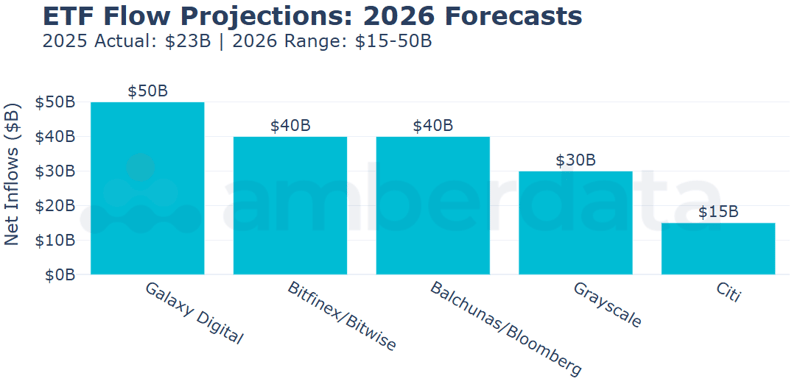
Figure 14.3: ETF Flow Projections. 2026 forecasts range $15-50B vs $23B actual in 2025. Galaxy most bullish; Citi conservative.
The Cost Basis Floor. The ETF cost basis around $80,000 creates a psychological and practical floor. Institutional investors who allocated via ETFs in 2024-2025 have an average cost basis in this range. These investors are unlikely to panic sell at losses - institutional mandates typically don't permit realizing losses without a fundamental thesis change, and the regulatory clarity thesis has only strengthened. The floor isn't absolute - severe macro stress like a 2008-style crisis could breach it - but it represents a new structural feature of Bitcoin's market dynamics.
2026 Scenario Analysis: Probability-Weighted Outcomes
The scenario framework assigns probabilities to distinct market outcomes, each with specific assumptions and early warning signals. Use these scenarios not as predictions but as a framework for thinking about potential paths and positioning appropriately for multiple outcomes.
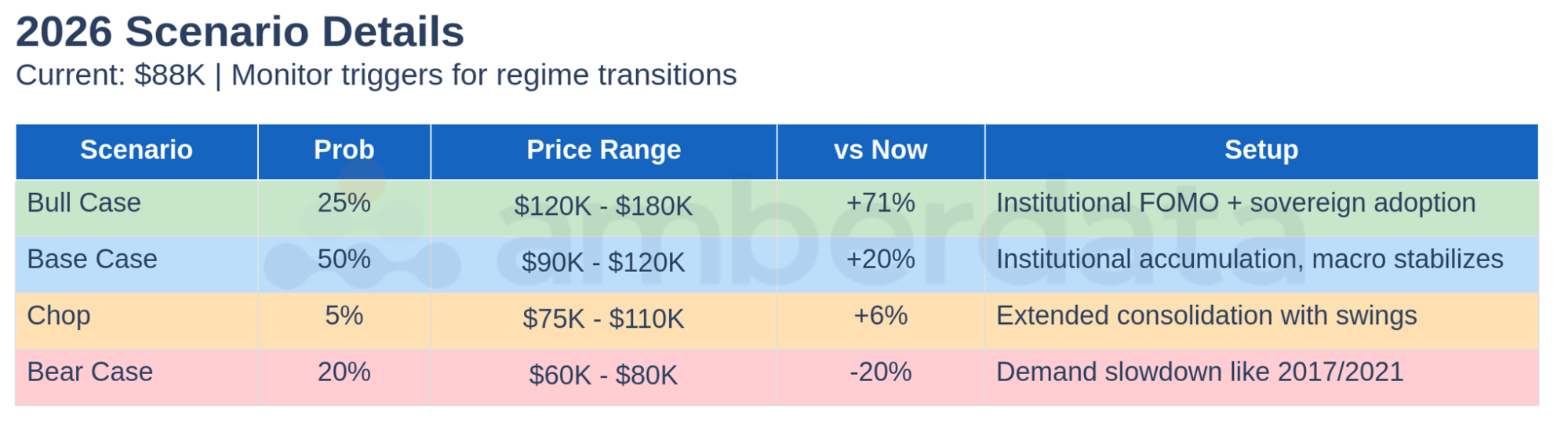
Figure 14.4: 2026 Scenario Analysis - Scenario Probability Distribution - Base case dominates at 50%, but note the asymmetric upside: bull case ($120-180K) has higher expected return than bear case downside ($60-80K).
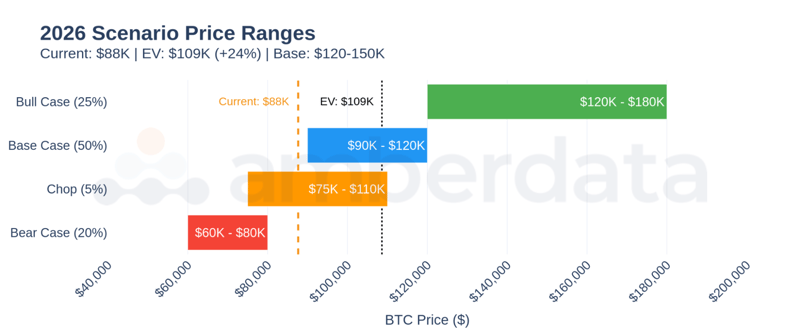
Figure 14.5: 2026 Price Scenario Ranges - Current price shown as a horizontal line. Note the $80K ETF cost basis floor providing structural support in all scenarios except severe macro stress.
BTC Base Case (50% Probability): $90,000 - $120,000
Setup: Range-bound consolidation until macro catalyst arrives. This is the 'muddle through' scenario where conditions don't deteriorate significantly but don't improve dramatically either. The market trades in a wide range, frustrating both bulls waiting for breakouts and bears expecting collapse. Volatility compresses. Interest fades. Then something changes.
Key Assumptions: Federal Reserve eventually cuts rates in H1 2026, providing risk-asset support but not unleashing euphoria. ETF flows stabilize around neutral, neither persistently positive nor negative. Liquidity gradually recovers as market makers rebuild positions over months. No major security incidents or regulatory reversals disrupt the fragile equilibrium.
Early Signals: Basis APR recovering to 8-10% would indicate carry trade revival. ETF flows turning consistently positive would show institutional re-engagement. Order book depth improving toward pre-crash levels would reduce fragility. Funding stabilizing in positive territory would confirm directional conviction returning.
$109K
Probability-weighted expected value: (50% x $105K) + (25% x $150K) + (20% x $70K) + (5% x $92.5K) = ~$109K
BTC Bull Case (25% Probability): $120,000 - $180,000
Setup: Institutional re-engagement accelerates alongside sovereign adoption. Multiple bullish catalysts align, creating momentum that feeds on itself. The flow cycle enters its expansion phase.
Key Assumptions: Fed cuts aggressively as inflation concerns fade, unleashing risk appetite across all markets. 401(k) products launch at scale, opening the $40 trillion retirement capital pool. Additional sovereign nations announce Bitcoin reserve allocations following the precedent set in 2024-2025. Ethereum ETF staking approved, validating the broader crypto institutional framework and attracting yield-seeking capital.
Early Signals: ETF inflows accelerating above $1B weekly would confirm institutional FOMO returning. Basis APR expanding to 15%+ would indicate aggressive leverage demand. New accumulation cohorts appearing in HODL wave data would show fresh capital entering at scale.
$40 trillion in U.S. retirement accounts. Even 1% allocation = $400 billion in potential demand.
BTC Bear Case (20% Probability): $60,000 - $80,000
Setup: Macro conditions deteriorate beyond current expectations, and risk-off sentiment dominates global markets. Crypto correlation to traditional risk assets increases during the selloff.
Key Assumptions: Trade war escalates beyond current tariff levels, impacting global growth and corporate earnings. Recession fears materialize with employment weakness and consumer pullback becoming evident in the data. A major exchange failure or security incident destroys confidence in the space. Regulatory reversal (unlikely given 2025's transformation but remains a tail risk) undermines the institutional framework.
Early Signals: Persistent ETF outflows exceeding $1B weekly would confirm institutional capitulation. Basis collapsing below 3% would indicate carry trade is fully unwound. Stablecoin redemptions would show capital fleeing the ecosystem entirely. The $80K ETF cost basis could be tested, though institutional holders are unlikely to panic sell at losses without a fundamental thesis change.
BTC Volatility/Chop Case (5% Probability): $75,000 - $110,000
Setup: Extended range with violent swings in both directions, no clear trend emerges. This scenario is frustrating for directional traders but potentially profitable for volatility and range-bound strategies. Market participants lose conviction in either direction.
Early Signals: High funding rate volatility swinging between positive and negative extremes. Open interest spikes followed by rapid collapses as positions get liquidated in both directions. ETF flows showing no consistent pattern - inflows one week, outflows the next.
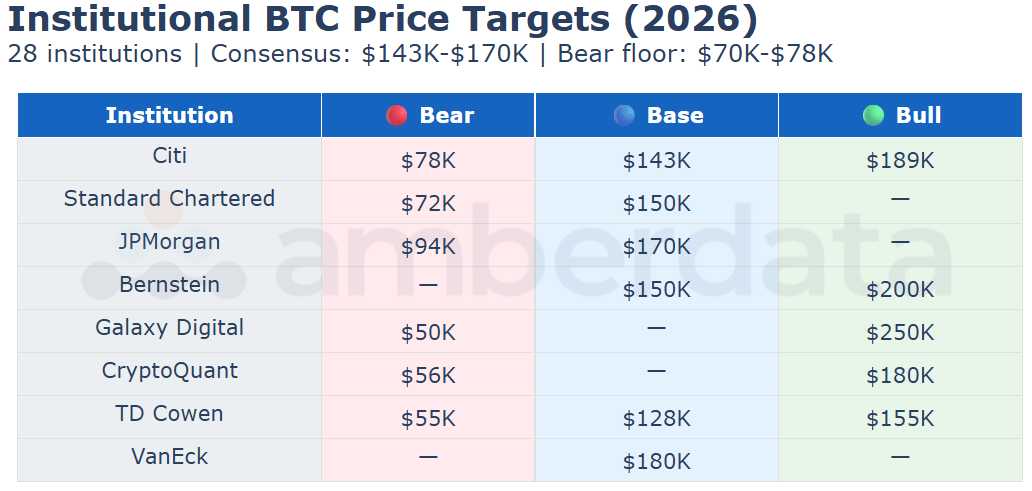
Figure 14.6: Institutional BTC Price Targets. Base cases cluster $150-170K, skewing bullish. Forecasts vary widely; caution is warranted.
2026 Catalysts: What Could Move the Market
$15T
Assets managed by major wirehouses. If they enable 1-3% crypto allocation, that's $150-450B in potential demand.
Q1-Q2: DOL 401(k) Guidance. Final Department of Labor guidance enabling 401(k) crypto allocation could arrive in the first half. This guidance is the critical implementation step following the August 2025 Executive Order. Once the DOL finalizes rules, plan sponsors gain the legal clarity needed to offer Bitcoin options without fear of fiduciary liability. Early adopter plans - likely from crypto-forward companies - could launch by mid-year. This is the single most important regulatory catalyst for 2026 given the scale of potential flows.
Q1-Q3: Bank Custody Launches. Major banks, including BNY Mellon, State Street, and potentially JPMorgan, are expected to launch crypto custody services following SAB 121's rescission. Bank custody provides the institutional-grade infrastructure that pension funds, endowments, and sovereign wealth funds require. These institutions have fiduciary obligations that demand regulated, insured custody with established counterparties. Each major bank custody launch represents a catalyst as their client base gains access to crypto allocation for the first time.
Ongoing: Market Structure Legislation. Comprehensive legislation defining token classification (security vs commodity) and establishing jurisdictional boundaries between the SEC and CFTC remains pending in Congress. Progress would complete the regulatory framework that 2025 started. This isn't essential for the bull case - the foundation already exists - but passage would remove remaining uncertainty.
Potential: ETH Staking ETF. SEC approval of staking within ETF wrappers would make Ethereum ETFs significantly more attractive with ~3-4% yield. More importantly, it would validate Ethereum's commodity status definitively. This is a wildcard catalyst that could arrive anytime or not at all in 2026.
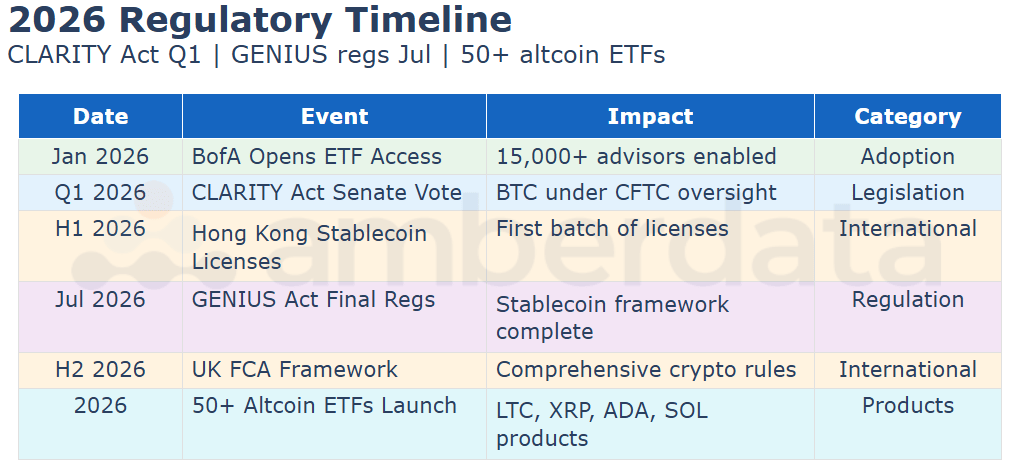
Figure 14.7: 2026 Regulatory Timeline - Key dates and expected announcements. Each represents a potential catalyst; clustering of positive announcements could trigger bull scenario.
Wealth Platform Adoption: The Structural Driver. Morgan Stanley, Merrill Lynch, UBS, Wells Fargo Advisors, and other major wealth platforms collectively manage approximately $15 trillion in client assets. Their adoption of crypto products - allowing financial advisors to recommend Bitcoin allocations to clients - would represent a structural demand transformation unlike anything the market has seen. Currently, most platforms restrict or prohibit advisor crypto recommendations. That's changing as regulatory clarity improves and custody solutions mature.
The math is compelling. If platforms enable 1-3% crypto allocation recommendations - a conservative range for alternative assets in diversified portfolios - that represents $150-450 billion in potential demand. Even if only 10% of eligible clients adopt the allocation recommendation in the first year, that's $15-45 billion in new flows. For context, Bitcoin ETFs accumulated approximately $35 billion in their first year. Wirehouse adoption could match or exceed ETF flows.
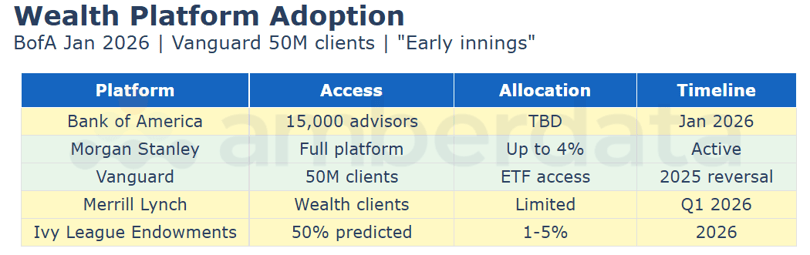 Figure 14.8: Major wirehouses collectively manage ~$15T in client assets. Green = active, Yellow = pending 2026.
Stablecoin Dry Powder. Stablecoin market capitalization exceeded $200 billion in 2025, representing capital already on-chain but not yet deployed into volatile assets. This dry powder provides potential fuel for rallies if sentiment shifts. Conservative estimates suggest 30-50% of the stablecoin supply could deploy into crypto assets if conditions warranted - $60-100 billion in potential flows. The GENIUS Act's regulatory clarity could accelerate stablecoin growth beyond current trajectories as institutional treasurers gain confidence in the framework.
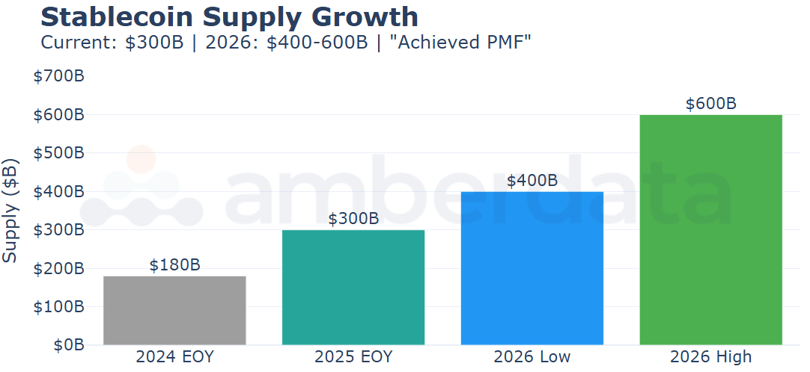 Figure 14.9: Stablecoin Supply Growth. Stablecoins doubled in 2025 to $300B. 2026 forecasts range $400-600B as the GENIUS Act provides regulatory clarity.
The 2026 Watchlist: Early Warning Indicators
Use this watchlist to detect regime changes early. When three or more bullish triggers fire simultaneously, bull scenario probability increases. When three or more bearish triggers fire, bear scenario probability increases.
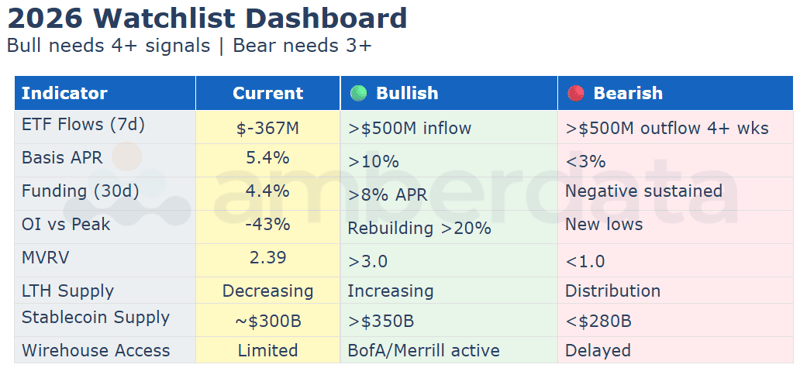
Figure 14.10: 2026 Watchlist Dashboard - Color-coded current status. Green = bullish signal firing. Red = bearish. Yellow = neutral. Currently, mostly yellow - base case in effect.
Bullish Triggers (look for 3+ firing):
ETF Inflows: Exceeding $1B per week consistently
Basis APR: Recovering above 10% (carry trade revival)
Funding Rates: Consistently positive above 8% APR
Open Interest: Rebuilding toward pre-crash levels
Order Book Depth: Recovering toward September 2025 levels
Bearish Triggers (look for 3+ firing):
ETF Outflows: Exceeding $1B per week consistently
Basis APR: Collapsing below 3%
Funding Rates: Persistently negative
Open Interest: Collapsing further
LTH Distribution: Long-term holder distribution accelerating
The question isn't whether institutions can participate - that's been answered. The question is how quickly they will.
Key Takeaways: Positioning for 2026
- The Paradigm Has Shifted. The four-year halving cycle has been superseded by institutional flow dynamics. ETFs move more capital than miners produce. The halving still matters for long-term supply dynamics, but it's no longer the marginal price driver. Watch flows, not halvings. The institutional flow cycle operates on different timescales driven by Fed policy, risk appetite, and regulatory catalysts.
- The Infrastructure Is Built. Bank custody enabled. Stablecoins regulated. ETFs optimized with in-kind redemptions. Retirement access pathway opened. The regulatory transformation of 2025 was comprehensive. The question isn't whether institutions can participate - that's been definitively answered. The question is how quickly they will move through the newly-opened doors. The adoption phase begins in 2026.
- The Market Is De-Risked but Fragile. October's leverage purge created healthier positioning. Open interest flushed. Weak hands liquidated. Funding rates normalized. But liquidity remains impaired - order book depth hasn't recovered to pre-crash levels. Violent moves remain possible in either direction on thin order books. This fragility cuts both ways.
- Strong Hands Are Accumulating. HODL waves show long-term holders buying weakness throughout Q4 2025. This accumulation pattern - where patient capital buys what weak hands sell - historically precedes major rallies. But the timing can vary from months to years. The signal is bullish for direction, not necessarily for immediate timing.
- Valuation Metrics Say 'Room to Run'. MVRV below 3.0 - not in euphoria territory. NUPL not in the distribution zone. Realized price at $62,000 providing a structural floor. The market isn't overvalued by historical standards. If anything, it's reset to levels that preceded appreciation in previous cycles, not major corrections.
- The Watchlist Is Clear. Basis APR above 8% signals carry trade revival. Depth recovery to pre-crash levels resolves fragility concerns. Consistent ETF inflows above $1B weekly confirm institutional conviction. 401(k) allocation announcements activate a new capital pool. Until these conditions align, the Fragile Recovery regime continues. When they align, bull case probability increases significantly.
|
THE BOTTOM LINE |
|---|
|
2025 proved that crypto's market structure has fundamentally changed. The halving cycle is over. The institutional flow cycle has begun. The regulatory infrastructure is built. The adoption phase starts now. The timing is uncertain, but the direction of the structural trend is not. Institutional adoption is expanding, not contracting. 2026 will reveal how quickly the market moves through the doors that 2025 opened. |
This analysis synthesizes findings from (S3)'s regime framework, (S5)'s carry trade mechanics, (S7)'s leverage analysis, and (S8)'s ETF flow dynamics into forward-looking scenarios.
The valuation thresholds draw from (S10)'s on-chain metrics. The regulatory catalyst timeline builds on (S13)'s transformation analysis. The security risk assessments incorporate (S12)'s crisis findings.
This article provides the executive summary. The full Amberdata Crypto Market Review 2025 goes deeper:
- The $80,000 ETF cost basis floor and what happens if it breaks
- Entity-level breakdown showing which ETF issuer is already underwater
- Carry trade mechanics explaining why October outflows were arbitrage, not capitulation
- HODL wave analysis revealing 123,173 BTC accumulated by mega whales during the crash
- The six regime framework applied to every metric across 14 sections
- On-chain valuation signals and where we sit in the cycle
- 2026 scenario analysis with specific price targets and catalysts
- DeFi TVL, DEX volumes, and the $2B security problem
- Regulatory timeline from SAB 121 to 401(k) access
- And more...
[DOWNLOAD THE FULL AMBERDATA CRYPTO MARKET REVIEW 2025]
Full-Market Research. Institutional Depth. Derivatives, ETFs, on-chain, DEXs, microstructure, risk signals - and more. Subscribe at the bottom of our page for research that covers every corner of crypto and visit the Amberdata Research Blog.
Access Amberdata Intelligence for institutional-grade digital asset intelligence, or contact our team to discuss custom solutions.

Links & Resources
Platform
Recommended next reads
ETF Cost Basis Series
- Part 1/3: The $80,000 Floor (ETF Cost Basis)
- Part 2/3: Who Breaks First (ETF Cost Basis)
- Part 3/3: The Stress Test (ETF Cost Basis)
More key reads
- The ETF Exodus Decoded: Basis Arbitrage, Not Capitulation
- Bitcoin's Great Rotation: Who Bought the Dip and Why It Matters
- October 2025 Crash (7 charts): How $3.21B Vanished in 60 Seconds
- Beyond the Spread: Market Impact and Execution
Disclaimers
The information contained in this report is provided by Amberdata solely for educational and informational purposes. The contents of this report should not be construed as financial, investment, legal, tax, or any other form of professional advice. Amberdata does not provide personalized recommendations; any opinions or suggestions expressed in this report are for general informational purposes only.
Although Amberdata has made every effort to ensure the accuracy and completeness of the information provided, it cannot be held responsible for any errors, omissions, inaccuracies, or outdated information. Market conditions, regulations, and laws are subject to change, and readers should perform their own research and consult with a qualified professional before making any financial decisions or taking any actions based on the information provided in this report.
Past performance is not indicative of future results, and any investments discussed or mentioned in this report may not be suitable for all individuals or circumstances. Investing involves risks, and the value of investments can go up or down. Amberdata disclaims any liability for any loss or damage that may arise from the use of, or reliance on, the information contained in this report.
By accessing and using the information provided in this report, you agree to indemnify and hold harmless Amberdata, its affiliates, and their respective officers, directors, employees, and agents from and against any and all claims, losses, liabilities, damages, or expenses (including reasonable attorney's fees) arising from your use of or reliance on the information contained herein.
Copyright © 2026 Amberdata. All rights reserved.