


Share this blog:
.png)
This is Section 6, excerpted from our Amberdata Crypto Market Review 2025 and 2026 Outlook: Six Regimes, One Story. Our full report spans 14 sections - ETF flows, derivatives, on-chain, liquidity, and our complete 2026 outlook.
When October's liquidation cascade hit, market makers disappeared - and haven't fully returned
|
KEY TAKEAWAYS |
|---|
|
Order book depth at 10 basis points collapsed 46% in 48 hours - from $48 million to $26 million. Market makers pulled liquidity as the cascade accelerated, widening spreads and amplifying every forced liquidation. Three months later, depth remains 40% below pre-crash levels.
Liquidity is the market's immune system. When stressed, it determines whether a correction stays contained or cascades into crisis. October tested that immune system - and found it wanting. Understanding what happened to liquidity, and why it hasn't fully recovered, is essential context for assessing 2026 risk.
The Full Year Liquidity Story: Building and Breaking
Measuring Depth. Order book depth measures resting liquidity - how much capital sits in limit orders waiting to be filled. Depth at 10 basis points (0.1% from mid-price) captures institutional execution quality. Higher depth means larger orders execute with less slippage.
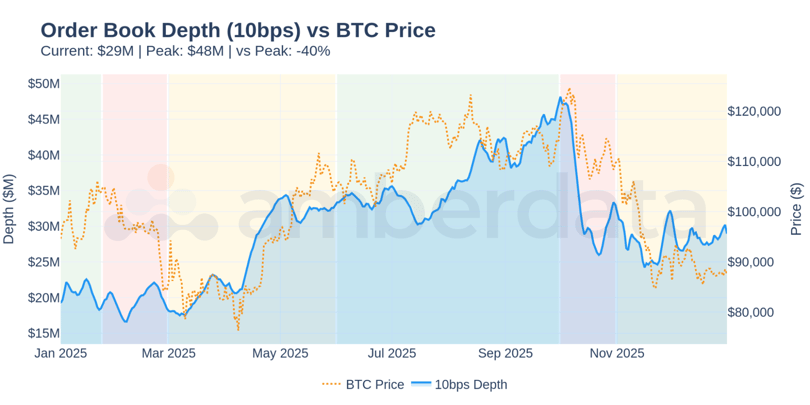
Figure 6.1: Order Book Depth vs Price - Note the divergence between depth and price during R4. Depth peaked in early October, then collapsed while price was still elevated - a leading indicator of fragility.
R1-R3: The Building Phase. Depth grew steadily from $21M (R1) to $26M (R3) as market makers expanded capacity. ETF launches brought new institutional flow, and market makers responded by posting more liquidity to capture the spread.
R4: Peak Liquidity. Average depth reached $37M during Institutional Expansion (R4), with the absolute peak of $48M on October 1st. This represented the healthiest liquidity conditions of the year - deep books, tight spreads, and robust market maker participation.
R5-R6: Collapse and Incomplete Recovery. October's cascade destroyed the liquidity infrastructure. Average depth fell to $34M during R5, then to $28M in R6 as market makers maintained conservative positioning. Current depth at $29M remains 40% below peak.
-40%
Current order book depth versus the October 1st peak. Three months after the crash, market maker liquidity has not recovered to pre-crisis levels.
|
SO WHAT? Depth levels provide early warning of market fragility. When depth peaked October 1st then began declining before price, it signaled market makers were already reducing exposure. Monitoring depth relative to recent peaks helps identify when the market's capacity to absorb shocks is deteriorating. |
Regime Analysis: How Liquidity Responded to Each Phase
Mapping Liquidity to Regimes. Mapping liquidity to the year's six regimes reveals distinct patterns in market maker behavior during different market conditions.

Figure 6.2: Average Depth by Regime - R4 peak at $37M versus R6 at $28M shows 24% permanent reduction. Market makers have not restored full liquidity despite price stabilization.
Depth by Regime. Average order book depth (10bps) across 2025:
R1 Policy Euphoria: $21M average - moderate depth given uncertainty about new ETF flow patterns
R2 Security Shock: $20M average - brief 5% withdrawal during Bybit hack uncertainty
R3 Infrastructure Build: $26M average - gradual expansion as market makers grew comfortable
R4 Institutional Expansion: $37M average - peak liquidity conditions, deepest books of year
R5 Macro Shock: $34M average - 7% decline, understates 46% intraday collapse
R6 Fragile Recovery: $28M average - 24% below R4 peak, market makers remain cautious
Market makers remember. October's cascade taught them that crypto liquidity can evaporate faster than they can adjust quotes. The 24% permanent reduction reflects that lesson.
October Case Study: Anatomy of a Liquidity Crisis
Textbook Example. October 10-11 provides a textbook example of how liquidity crises unfold in crypto markets. The sequence reveals how market maker behavior amplifies - rather than dampens - volatility during stress.

Figure 6.3: October Liquidity Collapse - Dual-panel view showing depth collapse (top) coinciding with liquidation surge (bottom). Note depth hit minimum during peak liquidation intensity.
Phase 1: The Trigger. Tariff headlines triggered initial selling. Depth remained stable as market makers absorbed the initial flow. Price declined but within normal ranges.
Phase 2: Liquidation Cascade Begins. As price dropped through key levels, leveraged long liquidations accelerated. Market makers began widening quotes to protect against inventory risk.
Phase 3: Liquidity Withdrawal. With liquidations cascading, market makers faced adverse selection - every fill was likely followed by further forced selling. Rational response: pull quotes. Depth collapsed from $48M to $26M in hours.
Phase 4: Maximum Stress. At crisis peak, thin order books meant each liquidation moved price further, triggering more liquidations. The feedback loop continued until leverage was exhausted.
Phase 5: Stabilization. As liquidations slowed, market makers cautiously returned. Depth recovered to $30M+ but well below pre-crisis levels.
46%
Peak-to-trough depth collapse during October 10-11. From $48M to $26M in hours as market makers withdrew during the cascade.
Key Insight. Market makers are momentum amplifiers during stress, not stabilizers. Their rational response to adverse selection - pulling quotes - is exactly what transforms corrections into cascades. This is not a flaw in the market; it is the market's fundamental nature.
|
SO WHAT? During liquidation cascades, do not expect order book depth to provide support. Market makers will withdraw, spreads will widen, and slippage will spike. Position sizing must account for the possibility of execution quality deteriorating precisely when you need to exit. Pre-set stops may execute far worse than expected. |
Depth Profile: Near vs Far Liquidity
Depth at Different Levels. Order book depth at different distance levels reveals distinct liquidity characteristics. Near-market depth (10bps) serves institutional execution; far-market depth (100bps) represents stress capacity.
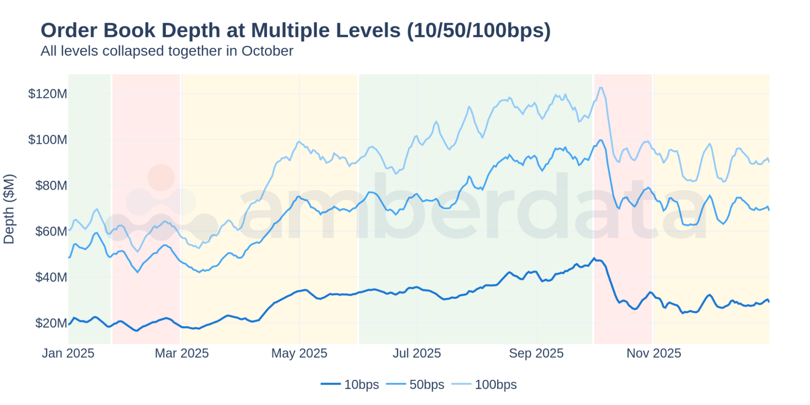
Figure 6.4: Depth at Multiple Levels - All three levels (10/50/100bps) collapsed together in October, indicating market-wide liquidity withdrawal rather than just near-market thinning.
Current Depth Profile. Depth at different distances from mid-price:
10bps: $29M (institutional execution)
50bps: $69M (large retail)
100bps: $90M (stress capacity)
The ratio of 100bps to 10bps depth (3.1x) indicates a reasonable depth profile shape - liquidity increases with distance from mid-price. A healthy market shows this graduated structure; crisis conditions flatten the profile as all levels thin simultaneously.
October Pattern. During October's collapse, all depth levels fell proportionally - this is significant. If only near-market depth had thinned, it would suggest market makers were simply widening quotes. The parallel collapse across all levels indicates wholesale liquidity withdrawal - market makers pulling entire quote ladders rather than just adjusting spreads.
Execution Implications. For execution purposes, the 10bps depth determines institutional fill quality. At $29M, a $5M market order would consume roughly 17% of near-market depth, resulting in meaningful slippage. For comparison, at October 1st peak ($48M), that same order would have consumed only 10% of available depth.
Venue Dynamics: Where Liquidity Lives
Volume Concentration. Trading volume concentration reveals where market participants execute and where liquidity risk concentrates during stress.
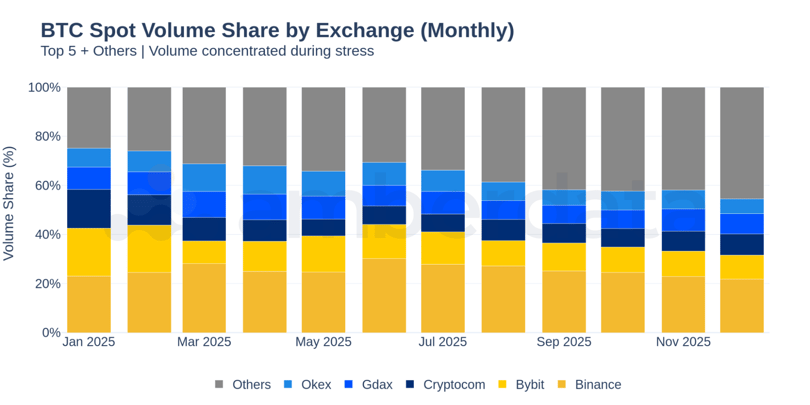
Figure 6.5: Volume Share by Exchange - Top 5 exchanges capture 67% of BTC spot volume. During October stress, concentration increased further as traders sought deepest liquidity.
Volume Distribution. BTC spot volume by exchange:
Coinw: 24.1%
Binance: 19.1%
Bybit: 10.0%
Crypto.com: 7.2%
Coinbase/GDAX: 6.7%
Others: 33%
This concentration means systemic risk is heavily weighted toward a few venues.
Stress Behavior. During October, volume concentrated further on Binance and Coinbase as traders sought the deepest liquidity. Smaller venues saw relative volume decline as participants consolidated execution on venues most likely to absorb large orders. This flight to liquidity is rational but creates concentration risk - if the dominant venues experience issues, alternatives are limited.
Risk and Opportunity. The venue concentration creates both risk and opportunity. Risk: if a major venue experiences technical issues during stress, execution alternatives are limited. Opportunity: monitoring depth and spread on top venues provides a strong signal about market-wide liquidity conditions. Binance's order book serves as a reasonable proxy for aggregate market health.
Liquidity Resilience Score: A Composite Signal
Composite Metric. The Liquidity Resilience Score combines depth and volume into a single metric that captures how well the market can absorb trading activity. Formula: (Depth at 100bps / Daily Volume) x 100.

Figure 6.6: Liquidity Resilience Score - Score collapsed from R4's 8.0 average to October trough of 1.3 - a 6x deterioration. Current 12.6 reflects recovery but masks underlying structural changes.
Interpreting the Score. How to read the Liquidity Resilience Score:
Above 7.4: Strong liquidity (75th percentile)
3.9-7.4: Normal conditions
Below 3.9: Weak conditions (25th percentile)
October's trough at 1.3 represented extreme stress - depth evaporated while volume spiked during panic selling.
Current Reading: 12.6. This elevated score reflects two factors: moderate depth recovery ($29M at 10bps) and reduced trading volume as the market consolidates. The ratio benefits from low volume as much as strong depth. Elevated scores during low-activity periods can mask underlying fragility.
Regime Patterns. Liquidity Score by regime:
R1: 3.6
R2: 3.3
R3: 4.5
R4: 8.0 (healthy)
R5: 5.2 (stress recovery)
R6: 6.4 (consolidation)
The R4 peak coincided with both strong depth and active trading - genuine healthy conditions rather than low-activity artifact.
|
SO WHAT? The Liquidity Score below 4.0 should trigger heightened awareness of execution risk. Current 12.6 is reassuring but partially reflects subdued activity. If volume surges without corresponding depth increase, the score will collapse rapidly. Monitor both components, not just the ratio. |
2026 Implications: Trading in a Fragile Structure
Persistent Characteristics. October's liquidity crisis revealed structural characteristics that persist into 2026. Trading strategy must account for these realities.
Depth Recovery Thresholds. Current $29M (10bps) represents the new baseline. Recovery above $35M would signal market maker confidence returning. Sustained readings above $40M would indicate pre-crisis conditions restored. Current trajectory suggests gradual improvement but full recovery is unlikely in near term.
Stress Indicators. Watch for depth declining while price remains stable - this divergence preceded October's collapse. Depth below $25M (10bps) combined with rising volume would signal elevated cascade risk.
Execution Implications. In current conditions, expect 10-20% more slippage on large orders than pre-October norms. Scale position sizes accordingly. During any stress episode, assume slippage will multiply 3-5x from normal levels as market makers withdraw. Pre-positioned limit orders may not fill as market makers skip price levels entirely during fast moves.
The market structure has fundamentally changed. Market makers learned that crypto liquidity can evaporate faster than traditional risk models predict. Their permanent reduction in liquidity provision is not a temporary caution - it is a rational response to demonstrated risk. Trading in 2026 means trading in a structurally thinner market.
|
THE BOTTOM LINE |
|---|
|
Liquidity is the market's immune system, and in 2025 that immune system was tested severely. October's 46% depth collapse demonstrated how quickly market maker liquidity can evaporate during stress. Three months later, depth remains 40% below peak - market makers remember, and they've permanently reduced their risk appetite. The Liquidity Score's collapse from 8.0 to 1.3 quantified the stress intensity. Current elevated readings (12.6) partly reflect subdued activity rather than restored health. For 2026, assume thinner markets, worse execution during stress, and the possibility that any correction can cascade if leverage has rebuilt. The market's immune system is weaker than it was. |
This analysis connects to (S2)'s October crash anatomy (the event that broke liquidity) and (S5)'s basis compression analysis (which triggered the ETF outflows that added to selling pressure during the crisis).
From here, (S7) examines the leverage that fueled October's cascade - the $56.6B in open interest that provided the fuel. (S14) incorporates the fragile liquidity structure into 2026 scenario analysis and risk assessment.
This article provides the liquidity analysis. The full Amberdata Crypto Market Review 2025 goes deeper:
- The $80,000 floor: What happens when ETF cost basis breaks?
- Which ETF issuer is already underwater? The entity-level breakdown reveals all
- October's "capitulation"? The data says arbitrage - here's the carry trade proof
- 123,173 BTC: The mega whale accumulation hiding in plain sight
- Six regimes, 14 sections: One framework that explains everything
- Early or late cycle? On-chain valuation signals decoded
- $60K or $180K? 2026 scenarios with specific price targets
- DeFi's $2B security crisis: What broke and why it matters
- SAB 121 to 401(k): The regulatory timeline reshaping crypto
- And more...

Full-Market Research. Institutional Depth. Derivatives, ETFs, on-chain, DEXs, microstructure, risk signals - and more. Subscribe at the bottom of our page for research that covers every corner of crypto and visit the Amberdata Research Blog.
Access Amberdata Intelligence for institutional-grade digital asset intelligence, or contact our team to discuss custom solutions.
Links & Resources
Platform
Recommended next reads
ETF Cost Basis Series
- Part 1/3: The $80,000 Floor (ETF Cost Basis)
- Part 2/3: Who Breaks First (ETF Cost Basis)
- Part 3/3: The Stress Test (ETF Cost Basis)
More key reads
- The ETF Exodus Decoded: Basis Arbitrage, Not Capitulation
- Bitcoin's Great Rotation: Who Bought the Dip and Why It Matters
- October 2025 Crash (7 charts): How $3.21B Vanished in 60 Seconds
- Beyond the Spread: Market Impact and Execution
Disclaimers
The information contained in this report is provided by Amberdata solely for educational and informational purposes. The contents of this report should not be construed as financial, investment, legal, tax, or any other form of professional advice. Amberdata does not provide personalized recommendations; any opinions or suggestions expressed in this report are for general informational purposes only.
Although Amberdata has made every effort to ensure the accuracy and completeness of the information provided, it cannot be held responsible for any errors, omissions, inaccuracies, or outdated information. Market conditions, regulations, and laws are subject to change, and readers should perform their own research and consult with a qualified professional before making any financial decisions or taking any actions based on the information provided in this report.
Past performance is not indicative of future results, and any investments discussed or mentioned in this report may not be suitable for all individuals or circumstances. Investing involves risks, and the value of investments can go up or down. Amberdata disclaims any liability for any loss or damage that may arise from the use of, or reliance on, the information contained in this report.
By accessing and using the information provided in this report, you agree to indemnify and hold harmless Amberdata, its affiliates, and their respective officers, directors, employees, and agents from and against any and all claims, losses, liabilities, damages, or expenses (including reasonable attorney's fees) arising from your use of or reliance on the information contained herein.
Copyright © 2026 Amberdata. All rights reserved.