


Share this blog:
This is Section 8, excerpted from our Amberdata Crypto Market Review 2025 and 2026 Outlook: Six Regimes, One Story. Our full report spans 14 sections - ETF flows, derivatives, on-chain, liquidity, and our complete 2026 outlook.
$29.3B in ETF inflows, $77B in stablecoin growth, and the October outflow that wasn't what it seemed.
|
KEY TAKEAWAYS |
|---|
|
In October, ETF headlines screamed "institutional exodus." The numbers looked damning - billions flowing out of spot Bitcoin ETFs during one of the year's sharpest corrections. Financial media framed it as smart money abandoning ship.
They got the story wrong.
The outflows were mechanical-based arbitrage positions unwinding as the carry trade collapsed from 15%+ APR to under 5%. This was not fundamental selling. Understanding the difference was the edge that separated reactive trading from informed positioning. This section follows the money: where it came from, where it went, and what the flow patterns reveal about 2026.
The ETF Story: What $29.3 Billion Tells Us
Structural Transformation. The headline number - $29.3 billion in cumulative net inflows - understates the structural transformation that occurred in 2025. For perspective, this represents 257,285 BTC absorbed by institutional vehicles, approximately 7% of Bitcoin's circulating supply now sitting in regulated ETF custody.
257,285 BTC
Total BTC accumulated by spot ETFs in 2025 - approximately 7% of circulating supply now held in institutional custody.
Consistent Demand. The flow pattern revealed consistent institutional demand. Of 305 trading days, 195 (64%) saw net inflows while only 110 (36%) saw outflows. This asymmetry matters: institutional buyers maintained accumulation pressure through multiple volatility regimes, corrections, and macro shocks.
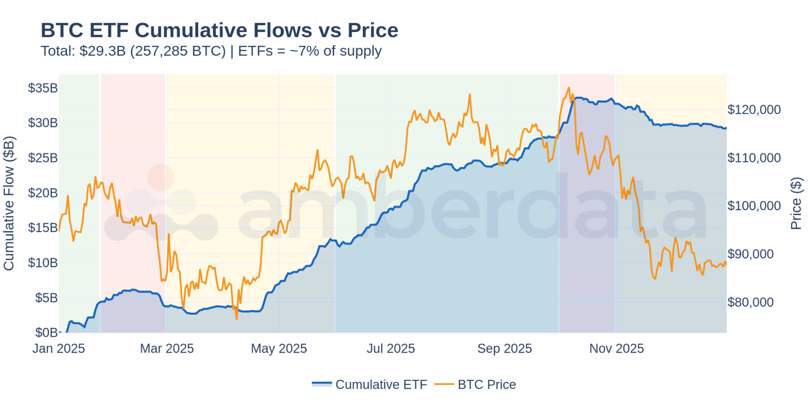
Figure 8.1: BTC ETF Cumulative Flows vs Price - Note the steady accumulation trend despite price volatility. The gap between price peaks and flow peaks reveals systematic buying behavior rather than performance chasing.
The January Surge. ETF approval euphoria drove record volumes exceeding $4.6 billion daily in January's opening weeks. This initial burst captured pent-up institutional demand that had accumulated during years of regulatory uncertainty.
The Infrastructure Build. July brought in-kind redemptions approval, a seemingly technical change with profound implications. Market makers could now arbitrage ETF premiums more efficiently, tightening spreads and improving execution for all participants.
The August Milestone. By August, aggregate AUM across 76 Bitcoin ETPs globally reached $156 billion. The spot Bitcoin ETF complex had become the most successful ETF launch in history by capital raised in the first year.
|
SO WHAT? ETF flows represent a fundamental shift in Bitcoin's market structure. With 7% of supply now in institutional custody, the marginal price setter has changed. Tracking ETF flows provides insight into how the largest market participants are positioned - information that was previously invisible to retail traders. |
October's Misunderstood Outflows: Arbitrage vs Capitulation
Misleading Headlines. October's outflows triggered alarming headlines. Multiple days saw hundreds of millions flowing out of spot ETFs. The surface narrative was compelling: institutions were fleeing Bitcoin during a market correction. This interpretation missed the mechanism entirely.
The October ETF outflows were not institutional capitulation - they were mechanical arbitrage unwinds forced by basis compression. The distinction was worth billions in alpha for those who understood it.
The Basis Arbitrage Mechanism. Throughout 2025's first three quarters, basis traders captured 15%+ annualized yields by holding spot Bitcoin in ETFs while shorting futures. This "cash and carry" trade was one of the most reliable institutional strategies in crypto. When October's volatility compressed basis to under 5%, the trade's economics inverted.
Basis arbitrage unwinds require selling the spot position (ETF redemptions) while covering the short futures position. From outside, this looks identical to fundamental selling. The distinction: arbitrage unwinds are mechanical responses to changed economics, not judgments about Bitcoin's value.
15% → 5%
Basis APR compression that triggered mechanical arbitrage unwinds. The carry trade economics, not fundamental views, drove October's ETF outflows.
What the Flows Actually Showed. Regime-level analysis reveals the pattern. R4 (Institutional Expansion, through September) saw $15.16 billion in inflows - the peak of institutional accumulation. R5 and R6 combined saw mixed flows as arbitrage positions unwound and then partially rebuilt.
The Key Evidence. GBTC, which has minimal basis arbitrage activity due to its structure, saw proportionally smaller outflows than lower-fee ETFs favored by arbitrageurs. If the outflows represented fundamental selling, GBTC would have led given that its higher fee structure creates stronger exit incentives for long-term holders. The opposite pattern confirms the arbitrage interpretation.
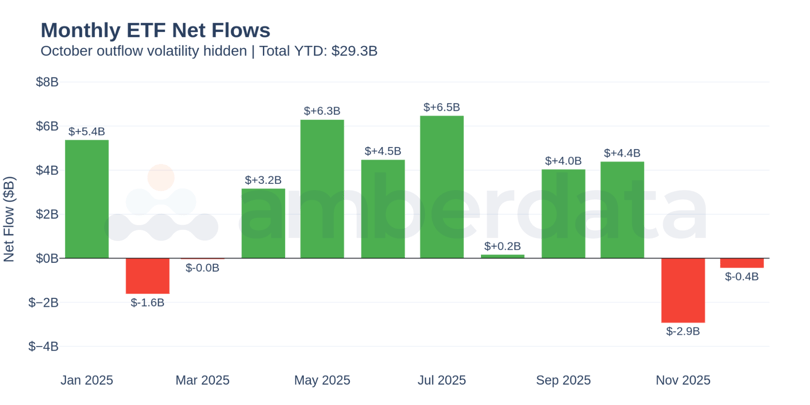
Figure 8.2: Monthly ETF Net Flows - October's outflows visible in context of full year. Note the magnitude relative to cumulative inflows - the "exodus" represented a fraction of YTD accumulation.
Issuer Dynamics: The Winner-Take-Most Competition
Market Consolidation. The ETF issuer landscape consolidated rapidly. Two names captured the vast majority of net new capital, while the rest fought for scraps or experienced outflows.
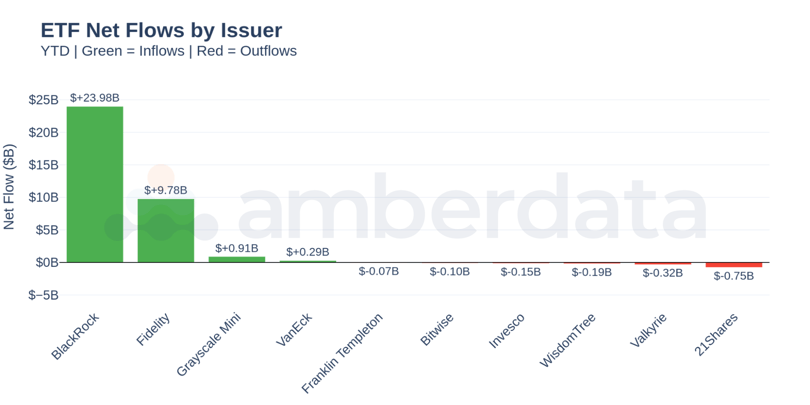
Figure 8.3: ETF Net Flows by Issuer - BlackRock and Fidelity dominate genuine net new flows.
BlackRock's IBIT: $23.98 billion. The world's largest asset manager captured 82% of net new ETF flows. IBIT's advantages compound: brand recognition, liquidity depth, and distribution access through BlackRock's institutional relationships. The Aladdin platform integration gave advisors seamless portfolio allocation tools.
Fidelity's FBTC: $9.78 billion. Fidelity secured the second position with strong retail distribution. Their self-custody model - holding BTC on Fidelity infrastructure rather than using Coinbase - appealed to investors with custody preferences.
The Long Tail. Everyone else combined for minimal to negative net flows. Grayscale Mini captured $0.91B, but this largely represented internal transfers from GBTC. VanEck, Franklin Templeton, Bitwise, WisdomTree, Invesco, Valkyrie, and 21Shares all saw net outflows or minimal positive flows.
82%
Share of net new ETF capital captured by BlackRock's IBIT. The ETF competition quickly became a duopoly.
|
SO WHAT? The ETF market has consolidated into a duopoly with BlackRock and Fidelity commanding 80%+ market share of flows. For traders monitoring institutional positioning, this simplifies analysis - tracking IBIT and FBTC flows provides most of the signal. The distribution advantages of these two firms suggest further consolidation is likely. |
Stablecoin Supply: The $269 Billion Dry Powder Indicator
Broader Capital View. While ETF flows capture institutional positioning in Bitcoin specifically, stablecoin supply provides a broader view of crypto-ready capital. At $269.4 billion, stablecoin supply reached all-time highs in 2025, up $77.3 billion year-to-date.
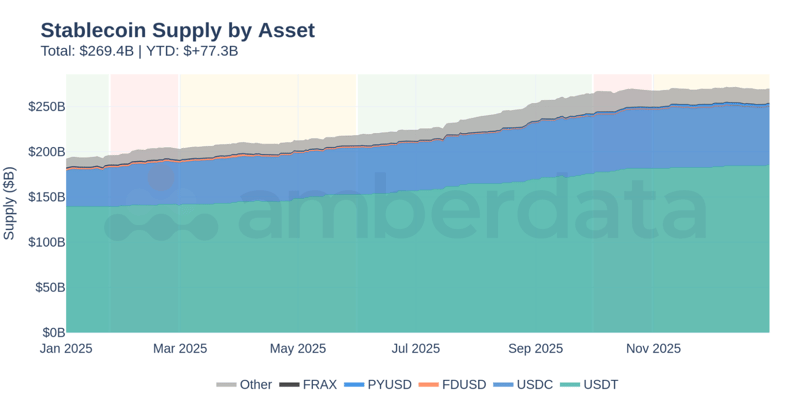
Figure 8.4: Stablecoin Supply by Asset - USDT dominates at $185.6B (69%), followed by USDC at $64.6B (24%). The expansion pattern shows capital staged and ready for deployment.
Stablecoin Distribution. Market share across stablecoin issuers:
USDT: $185.6B (69% share) - primary trading pair across offshore exchanges
USDC: $64.6B (24% share) - regulated alternative for institutional demand
PYUSD: $2.7B - PayPal's fintech entry
Others: $15.9B - FDUSD, FRAX, and specialized use cases
Stablecoin supply at $269 billion represents the largest-ever pool of crypto-ready capital. When conviction returns, this dry powder deploys rapidly.
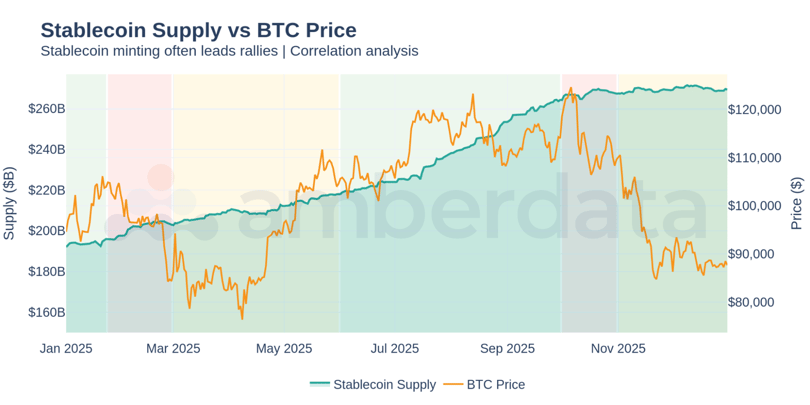
Figure 8.5: Stablecoin Supply vs BTC Price - Note the leading indicator relationship - stablecoin expansion often precedes BTC rallies as capital stages before deployment.
The Leading Indicator Pattern. Historically, stablecoin minting precedes Bitcoin rallies. The mechanism is straightforward: investors convert fiat to stablecoins before deploying into risk assets. Rising stablecoin supply without corresponding price appreciation suggests capital accumulating on the sidelines.
The current $77.3B YTD expansion - a 40% increase - represents one of the largest-ever stablecoin growth periods. Much of this capital remains undeployed, parked in yield strategies or waiting for entry points. When macro conditions or crypto catalysts align, this dry powder can deploy rapidly, amplifying price moves.
Flow Patterns by Regime: When Capital Moved
Institutional Response. Mapping ETF flows to the year's six market regimes reveals how institutional capital responded to different market conditions.
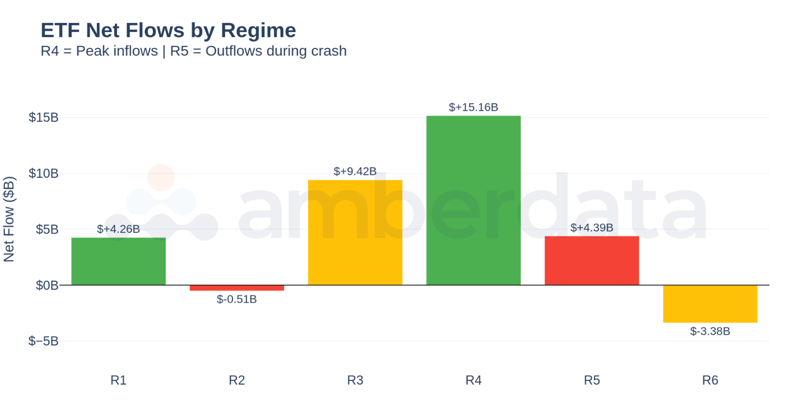
Figure 8.6: ETF Net Flows by Regime - R4 (Institutional Expansion) dominates with $15.16B - peak institutional accumulation. R5/R6 shows mixed flows during and after the October correction.
ETF Flows by Regime. How capital moved across 2025's six phases:
R1 Policy Euphoria: +$4.26B - ETF launch momentum drove initial accumulation
R2 Security Shock: -$0.51B - Bybit incident triggered brief, contained outflows
R3 Infrastructure Build: +$9.42B - steady accumulation, in-kind redemptions improved structure
R4 Institutional Expansion: +$15.16B - peak inflows, positive feedback loop with price
R5 Macro Shock: +$4.39B - net positive despite headlines about outflows
R6 Fragile Recovery: -$3.38B - arbitrage unwinds and year-end rebalancing
|
SO WHAT? Institutional flows respond to regime changes with a lag. The R4 peak came during price strength, not before it. This confirms that large allocators are generally price takers rather than price setters - they respond to established trends rather than anticipating reversals. Understanding this timing pattern helps calibrate expectations for flow-driven moves. |
2026 Implications: What Flow Patterns Signal
Baseline Metrics. The 2025 flow data provides baseline metrics for monitoring 2026 positioning. Several key thresholds emerge from this year's patterns.
ETF Flow Thresholds. Sustained inflows exceeding $1B/week characterized strong accumulation phases. Below $500M/week suggested institutional pause. Outflow weeks exceeding $2B signaled either arbitrage unwinds or genuine de-risking.
Stablecoin Supply Levels. The $269B base represents unprecedented dry powder. Weekly minting exceeding $5B suggests accelerating institutional preparation. Supply contraction would signal capital rotation out of crypto entirely.
Issuer Concentration. BlackRock and Fidelity will likely maintain flow dominance. Watching their flows provides the clearest read on institutional positioning. Secondary issuers may see further outflows as the duopoly consolidates.
The structural shift of 2025 - 7% of supply is now in ETF custody - creates new market dynamics. Institutional flows are now large enough to move prices directly, not just reflect sentiment. This amplifies both rallies and corrections, creating faster, more volatile price discovery than the pre-ETF era.
|
THE BOTTOM LINE |
|---|
|
The 2025 ETF flow narrative was misread in real-time. What headlines called institutional exodus was mechanical arbitrage unwinding. The actual story: $29.3B in net accumulation, 257,285 BTC absorbed, 7% of supply now in institutional custody. Stablecoin supply at $269B represents record dry powder staged for deployment. BlackRock and Fidelity dominate the institutional access points. The infrastructure for the next institutional wave is built and tested. The flow data says one thing clearly: institutional infrastructure is expanding, not contracting. |
This analysis builds on (S5)'s examination of the ETF-basis connection (how basis arbitrage mechanics created the October "outflows") and (S7)'s derivatives positioning data (which provided the leverage context for understanding forced unwinds).
From here, (S9) examines the on-chain perspective: where did the Bitcoin go? HODL wave analysis and balance bucket rotation reveal whether ETF accumulation represented new market participants or existing holder rotation. (S14) projects these flow patterns forward to construct 2026 scenarios.
This article provides the flow analysis. The full Amberdata Crypto Market Review 2025 goes deeper:
- The $80,000 floor: What happens when ETF cost basis breaks?
- Which ETF issuer is already underwater? The entity-level breakdown reveals all
- October's "capitulation"? The data says arbitrage - here's the carry trade proof
- 123,173 BTC: The mega whale accumulation hiding in plain sight
- Six regimes, 14 sections: One framework that explains everything
- Early or late cycle? On-chain valuation signals decoded
- $60K or $180K? 2026 scenarios with specific price targets
- DeFi's $2B security crisis: What broke and why it matters
- SAB 121 to 401(k): The regulatory timeline reshaping crypto
- And more...

Full-Market Research. Institutional Depth. Derivatives, ETFs, on-chain, DEXs, microstructure, risk signals - and more. Subscribe at the bottom of our page for research that covers every corner of crypto and visit the Amberdata Research Blog.
Access Amberdata Intelligence for institutional-grade digital asset intelligence, or contact our team to discuss custom solutions.
Links & Resources
Platform
Recommended next reads
ETF Cost Basis Series
- Part 1/3: The $80,000 Floor (ETF Cost Basis)
- Part 2/3: Who Breaks First (ETF Cost Basis)
- Part 3/3: The Stress Test (ETF Cost Basis)
More key reads
- The ETF Exodus Decoded: Basis Arbitrage, Not Capitulation
- Bitcoin's Great Rotation: Who Bought the Dip and Why It Matters
- October 2025 Crash (7 charts): How $3.21B Vanished in 60 Seconds
- Beyond the Spread: Market Impact and Execution
Disclaimers
The information contained in this report is provided by Amberdata solely for educational and informational purposes. The contents of this report should not be construed as financial, investment, legal, tax, or any other form of professional advice. Amberdata does not provide personalized recommendations; any opinions or suggestions expressed in this report are for general informational purposes only.
Although Amberdata has made every effort to ensure the accuracy and completeness of the information provided, it cannot be held responsible for any errors, omissions, inaccuracies, or outdated information. Market conditions, regulations, and laws are subject to change, and readers should perform their own research and consult with a qualified professional before making any financial decisions or taking any actions based on the information provided in this report.
Past performance is not indicative of future results, and any investments discussed or mentioned in this report may not be suitable for all individuals or circumstances. Investing involves risks, and the value of investments can go up or down. Amberdata disclaims any liability for any loss or damage that may arise from the use of, or reliance on, the information contained in this report.
By accessing and using the information provided in this report, you agree to indemnify and hold harmless Amberdata, its affiliates, and their respective officers, directors, employees, and agents from and against any and all claims, losses, liabilities, damages, or expenses (including reasonable attorney's fees) arising from your use of or reliance on the information contained herein.
Copyright © 2026 Amberdata. All rights reserved.